

Mixed electric circuits (series – parallel)
The online mixed circuit simulations on this page allow you to explore how the series and parallel parts are combined and behave within the same circuit. Through virtual setups with a power source, switch, bulbs, resistors, ammeters, and voltmeters, you can analyze how current and voltage are distributed in each section and how to calculate the equivalent resistance by simplifying the circuit step by step.
This Thematic Unit is part of our Circuits collection

STEM OnLine mini dictionary
Circuit Simplification
Analytical process consisting of reducing a complex circuit to a simpler one by successively solving series and parallel groups.
Electrical Node
Point in a circuit where three or more conductors connect, essential for identifying parallel branches.
Equivalent Resistance
A single resistance that could replace all those in the circuit producing the same effect; in series, it is the sum of all of them.
Mixed Circuit
Configuration that combines series and parallel connections within the same electrical network.
Step-by-step Analysis
Resolution strategy that divides the mixed circuit into identifiable sections as purely series or purely parallel.
Voltage Drop
Decrease in electric potential when passing through a resistive component due to the energy consumption of the charges.
What are mixed electric circuits
Mixed circuits combine series and parallel sections within one setup. This structure allows some parts of the circuit to share the same current, as in the series sections, while other branches have independent paths for current flow, as in the parallel sections. To analyze these circuits, you first identify the series and parallel sections, calculate the equivalent resistance for each part, and then simplify the circuit step by step. This type of configuration is very common in real-world setups and serves as a bridge between simple circuits and the analysis of more complex electrical systems.
How to identify series and parallel sections
In a mixed circuit, the first step is to visually distinguish which components are in series and which form parallel branches. Two elements are in series when the current can only advance by passing through them one after the other, with no split between them. On the other hand, components are in parallel when the conductor divides into two or more independent paths that later rejoin. Recognizing these structures allows you to break down the circuit into simpler blocks and apply the rules you already know for series and parallel circuits to each section. This initial identification is essential for correctly analyzing the behavior of the complete circuit.
How to calculate equivalent resistance in a mixed circuit
The calculation of equivalent resistance in a mixed circuit is done by simplifying the setup in parts. First, you identify the sections that are clearly in parallel and replace them with their equivalent resistance. Then you add the resistances that remain in series. This process is repeated successively until the entire circuit is reduced to a single total resistance. This step-by-step method allows you to analyze setups that may seem complex at first glance and understand how each section affects the overall behavior of the circuit.
To carry out these simplifications, it is necessary to remember the basic formulas for each type of connection:
Resistances in series
Req = R1 + R2 + R3 + … + Rn
Resistances in parallel
1/Req = 1/R1 + 1/R2 + 1/R3 +…+ 1/Rn
These two rules let you break down any mixed circuit in stages and obtain its equivalent resistance in an organized way.
How current and voltage are distributed in a mixed circuit
In a mixed circuit, the rules for series and parallel circuits are combined. In the series sections, the current is the same in all components and the voltage is divided according to the value of each resistance. In the parallel sections, the opposite occurs: the voltage is the same across all branches and the current is split among them. Analyzing a mixed circuit involves applying these two rules in an orderly fashion, section by section, to determine how the current flows and how the voltage is distributed in each part of the circuit. This analysis allows you to understand the functioning of real electrical setups, where both configurations are often combined.

STEM OnLine mini dictionary
Circuit Simplification
Analytical process consisting of reducing a complex circuit to a simpler one by successively solving series and parallel groups.
Electrical Node
Point in a circuit where three or more conductors connect, essential for identifying parallel branches.
Equivalent Resistance
A single resistance that could replace all those in the circuit producing the same effect; in series, it is the sum of all of them.
Mixed Circuit
Configuration that combines series and parallel connections within the same electrical network.
Step-by-step Analysis
Resolution strategy that divides the mixed circuit into identifiable sections as purely series or purely parallel.
Voltage Drop
Decrease in electric potential when passing through a resistive component due to the energy consumption of the charges.
Explore the exciting STEM world with our free, online, simulations and accompanying companion courses! With them you’ll be able to experience and learn hands-on. Take this opportunity to immerse yourself in virtual experiences while advancing your education – awaken your scientific curiosity and discover all that the STEM world has to offer!
Simulations of mixed electrical circuits
Basic mixed electric circuit
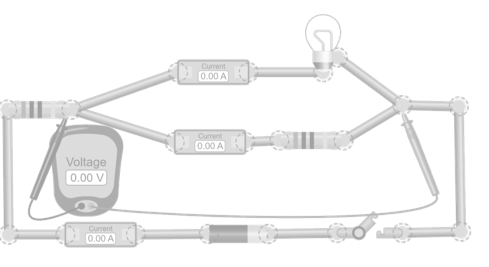
This simulation shows a circuit with one series resistance and two parallel branches: one with a resistor and the other with a bulb. Ammeters let you see how the current is the same in the series section and divides when it reaches the parallel branches. The voltmeter lets you check that the voltage is the same in both branches and measure the drop across the series resistance. This is a brief and clear activity to introduce how series and parallel combine in a mixed circuit.
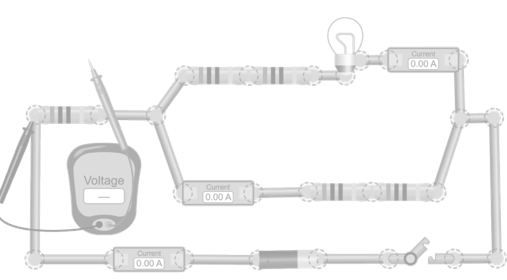
Circuit with two parallel branches with internal series sections
This simulation presents a mixed circuit consisting of an external series resistance and two parallel branches with different internal configurations. One branch contains a bulb and two resistors in series, creating a path with a high total resistance. The other branch has two resistors in series, forming a simpler path but with its own resistance to current flow. This difference between branches allows you to see how the current divides unevenly in the parallel section, since each path offers a different total resistance. Ammeters let you compare the current in each section, while the voltmeter lets you measure the voltage between different points in the circuit. This setup is designed to help you understand how several levels of series and parallel can be combined within a single mixed circuit and how each section affects the overall behavior.
CCircuit with two parallel branches with internal series sections
This simulation presents a mixed circuit consisting of an external series resistance and two parallel branches with different internal configurations. One branch contains a bulb and two resistors in series, creating a path with a high total resistance. The other branch has two resistors in series, forming a simpler path but with its own resistance to current flow. This difference between branches allows you to see how the current divides unevenly in the parallel section, since each path offers a different total resistance. Ammeters let you compare the current in each section, while the voltmeter lets you measure the voltage between different points in the circuit. This setup is designed to help you understand how several levels of series and parallel can be combined within a single mixed circuit and how each section affects the overall behavior.
Comparison between a mixed circuit and its equivalent resistance
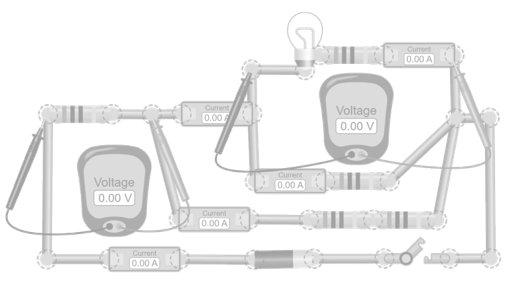
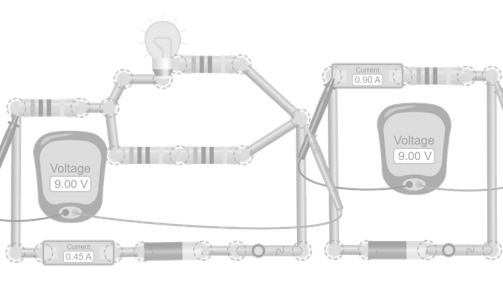
This simulation presents two circuits placed side by side to directly observe how the equivalent resistance formulas work in mixed circuits. The first circuit includes an external resistance and two parallel branches, each with its own total resistance. The second circuit is much simpler: it contains only a single resistor, whose value can be adjusted to match the equivalent resistance calculated from the mixed circuit. This setup allows you to see that, when the resistance of the simple circuit matches the equivalent resistance of the complex circuit, both show the same total current for the same applied voltage. This activity is designed to experimentally verify that different internal configurations can behave electrically equivalent when their total resistance is the same, reinforcing the concept of equivalence between circuits.
Giants of science
“If I have seen further, it is by standing on the shoulders of giants”
Isaac Newton
Michael Faraday
–
James Clerk Maxwell
–
Become a giant
Principles of Modeling, Simulations, and Control for Electric Energy Systems
Principles of Electric Circuits | 电路原理
Electrotechnique I
Electromagnetic Compatibility Essentials
Professional development for Educators
Teaching and Learning in the Era of AI
BlendedX: Blended Learning with edX
Higher education teaching in the age of AI
Teach teens computing: Programming in Python
Giants of science
“If I have seen further, it is by standing on the shoulders of giants”
Isaac Newton
André-Marie Ampère
–
James Clerk Maxwell
–
Become a giant
Principles of Modeling, Simulations, and Control for Electric Energy Systems
Principles of Electric Circuits | 电路原理
Electrotechnique I
Electromagnetic Compatibility Essentials
Professional development for Educators
Teach teens computing: Encryption and cryptography
Teach computing: Introducing physical computing
Classroom Strategies for Inquiry-Based Learning
Teach kids computing: Developing your programming pedagogy
Test your knowledge
What is a mixed electrical circuit?
How can you identify which parts of a mixed circuit are in series and which are in parallel?
How is the equivalent resistance calculated in a mixed circuit?
How do current and voltage behave in a mixed circuit?
Where are mixed circuits used in real life?
You may also be interested
Last simulations
To learn and experience
Take your knowledge to the next level with science kits and hands-on tools that connect theory with experimentation
Relativity and Quantum Physics For Beginners

Teachers essentials
Notion
Organize your notes, tasks, and projects in one place. Notion combines notes, lists, and calendars in one flexible space.
Canva
Design presentations, diagrams, and infographics with easy-to-use templates and professional results
Genially
Create interactive content, presentations, and educational games in a simple and visual way
Desmos
The most intuitive graphing calculator to explore mathematics and create dynamic classroom activities
Tinkercad
Design in 3D and simulate electronic circuits for free; it’s the perfect tool for simple robotics projects
Your Infinite Library
Enjoy the freedom to explore millions of titles and a curated selection of magazines on any device
Join Prime for students and young adults
The best series. Millions of songs. All included with your subscription.
Science made fun
Learn with the best courses
edX
Online courses from leading universities and companies. Learn practical skills and earn professional certifications
Coursera
Courses from leading universities and companies. Learn practical skills and earn professional certifications
Udemy
Thousands of online courses tailored to your level. Learn at your own pace with expert instructors