
Kirchhoff’s Laws
The online simulations of Kirchhoff’s Laws on this page allow you to analyze circuits without needing to simplify them beforehand. Using virtual setups with nodes, loops, sources, resistors, bulbs, ammeters, and voltmeters, you can observe how current and voltage are distributed in each part of the circuit and how to apply the two fundamental laws—the current law and the voltage law—to describe its operation. These activities help you understand that any circuit, no matter how complex, can be studied using equations based on the conservation of charge and energy.
This Thematic Unit is part of our Circuits collection

STEM OnLine mini dictionary
Electrical Node
Point in a circuit where three or more conductors connect, essential for identifying parallel branches.
Kirchhoff’s First Law (KCL)
States that the sum of currents entering a node is equal to the sum of currents leaving it.
Kirchhoff’s Laws
Set of two laws based on the conservation of charge and energy, fundamental for the analysis of complex circuits.
Kirchhoff’s Second Law (KVL)
States that the algebraic sum of voltage drops and electromotive forces in a closed loop is equal to zero.
Mesh (Loop)
Any closed path in a circuit that does not contain other closed paths within it.
Mesh Equation
Mathematical expression resulting from applying the voltage law to a closed path to find unknown currents.
What are Kirchhoff’s Laws?
Kirchhoff’s Laws are two fundamental principles that allow you to analyze any electrical circuit, no matter how complex, without needing to simplify it first. They are based on two essential ideas from physics: the conservation of electric charge and the conservation of energy. The first applies to nodes and describes how currents are distributed when several conductors meet; the second applies to loops and explains how voltages are distributed in a closed path. Thanks to these laws, it is possible to set up equations that describe the behavior of the entire circuit and solve them to obtain unknown currents and voltages.
Kirchhoff’s Current Law (KCL)
Kirchhoff’s Current Law states that at any node in a circuit, the sum of the currents entering is equal to the sum of the currents leaving. This occurs because electric charge cannot accumulate at a point: all charge that enters must continue its path. With this law, we can analyze how current is distributed when a conductor splits into several paths, setting up equations that relate the current in each branch. It is a fundamental tool for studying circuits with multiple branches without needing to simplify them.
Kirchhoff’s Voltage Law (KVL)
Kirchhoff’s Voltage Law states that in any closed loop of a circuit, the algebraic sum of all voltages is zero. This means that the energy supplied by the source must be distributed exactly among all the elements in the loop, so that the voltage rises and drops balance out. Applying this law allows you to relate the voltage drops across resistors, bulbs, or other components to the voltage supplied by the source, and it is essential for analyzing circuits with multiple loops or possible paths. With it, you can set up equations that describe how electrical energy is distributed along each path of the circuit.
How to apply Kirchhoff’s Laws in a circuit
To apply Kirchhoff’s Laws in a circuit, you first need to identify its nodes and loops, since each law is used in a different place. The Current Law is applied at nodes to relate the currents distributed among various branches, while the Voltage Law is used in loops to connect the voltage drops across each component to the voltage supplied by the source. The usual procedure is to assign directions to the currents (even if they later turn out to be negative), write the corresponding equations for each node and each loop, and solve the resulting system. This method allows you to analyze complex circuits without reducing them, obtaining all the internal currents and voltages from conservation principles.
Applications of Kirchhoff’s Laws
Kirchhoff’s Laws allow you to solve circuits that cannot be easily simplified using equivalent resistances, such as those with multiple loops, many nodes, or irregularly distributed components. With them, it is possible to determine unknown currents and voltages in any part of the circuit, analyze how different branches behave when they share common nodes, and check if a setup meets the conservation of charge and energy conditions. They are also used to experimentally verify instrument readings, design more complex circuits, and understand how real electrical networks work, where simplifications are not always possible.

STEM OnLine mini dictionary
Electrical Node
Point in a circuit where three or more conductors connect, essential for identifying parallel branches.
Kirchhoff’s First Law (KCL)
States that the sum of currents entering a node is equal to the sum of currents leaving it.
Kirchhoff’s Laws
Set of two laws based on the conservation of charge and energy, fundamental for the analysis of complex circuits.
Kirchhoff’s Second Law (KVL)
States that the algebraic sum of voltage drops and electromotive forces in a closed loop is equal to zero.
Mesh (Loop)
Any closed path in a circuit that does not contain other closed paths within it.
Mesh Equation
Mathematical expression resulting from applying the voltage law to a closed path to find unknown currents.
Explore the exciting STEM world with our free, online, simulations and accompanying companion courses! With them you’ll be able to experience and learn hands-on. Take this opportunity to immerse yourself in virtual experiences while advancing your education – awaken your scientific curiosity and discover all that the STEM world has to offer!
Simulations of Kirchhoff's Laws
Kirchhoff’s Current Law (KCL)
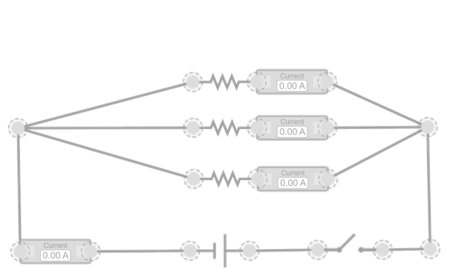
In this simulation, we use for the first time the schematic representation of circuits, which shows the components using electrical symbols instead of drawings. This format is more suitable for analyzing nodes, branches, and loops, and will allow us to apply Kirchhoff’s Laws clearly and rigorously. In this simulation, a node is represented from which three branches with different resistances depart, all powered by the same source. An ammeter placed before the node measures the total current entering, while three other ammeters record the current flowing through each branch. When you change the values of the resistances or the source voltage, you can observe how the distribution of currents changes, but it always holds that the incoming current is equal to the sum of the outgoing currents. This direct visualization helps to intuitively understand Kirchhoff’s Current Law and shows that electric charge does not accumulate at the node, but is distributed among the various available paths. Check that the sum of currents measured at the node matches the prediction of Kirchhoff’s Current Law (KCL).
Kirchhoff’s Voltage Law (KVL)
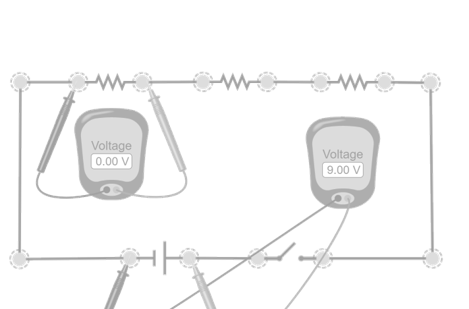
In this simulation, a simple loop is built formed by a voltage source and several resistors connected in series. Using two voltmeters, you can measure the voltage drop across each resistor and check that their sum matches the total voltage supplied by the source. By changing the values of the resistors or the source voltage, you can see how the individual drops change, but it always holds that the algebraic sum of all voltages in the closed loop is zero. This experience allows you to directly visualize Kirchhoff’s Voltage Law and understand that the energy delivered by the source is distributed exactly among all elements of the loop. Check that the sum of the measured voltage drops in the loop matches the voltage from the source, as established by Kirchhoff’s Voltage Law (KVL).
Double loop with shared node
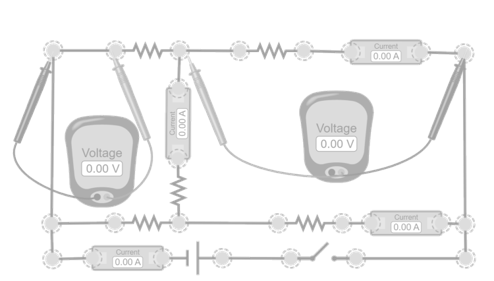
In this simulation, a circuit is presented consisting of two loops that share a central resistor, which prevents it from being simplified using equivalent resistances. Each loop includes its own path with resistors, and both are connected at a common node. Ammeters are placed in each branch to measure the currents in each loop, and voltmeters at strategic points to record the voltage drops. By changing the values of the resistors or the source voltage, you can see how the currents in each loop change and how the shared resistor influences both loops. This setup allows you to simultaneously apply the Current Law (KCL) at the node and the Voltage Law (KVL) in each loop, showing how both laws combine to analyze circuits that can no longer be solved by simplification methods. Check that the voltages and currents measured in each loop match the values obtained theoretically using Kirchhoff’s Laws.
Giants of science
“If I have seen further, it is by standing on the shoulders of giants”
Isaac Newton
Michael Faraday
–
André-Marie Ampère
–
Become a giant
Principles of Modeling, Simulations, and Control for Electric Energy Systems
Principles of Electric Circuits | 电路原理
Electrotechnique I
Electromagnetic Compatibility Essentials
Professional development for Educators
Teach computing: Moving from Scratch to Python
HP AI Teacher Academy
Teach teens computing: Developing your programming pedagogy
AI for Teacher Assistance
Giants of science
“If I have seen further, it is by standing on the shoulders of giants”
Isaac Newton
Michael Faraday
–
André-Marie Ampère
–
Become a giant
Principles of Modeling, Simulations, and Control for Electric Energy Systems
Principles of Electric Circuits | 电路原理
Electrotechnique I
Electromagnetic Compatibility Essentials
Professional development for Educators
Introduction to Data Wise: A Collaborative Process to Improve Learning & Teaching
Teaching Science and Engineering
Teach kids computing: Computing systems and networks
Teach computing: Physical computing with Raspberry Pi and Python
Test your knowledge
What are Kirchhoff’s Laws?.
What does Kirchhoff’s Current Law explain?
What does Kirchhoff’s Voltage Law describe?
How are Kirchhoff’s Laws applied in a real circuit?
What are Kirchhoff’s Laws used for in practice?
You may also be interested
Last simulations
To learn and experience
Take your knowledge to the next level with science kits and hands-on tools that connect theory with experimentation
Relativity and Quantum Physics For Beginners

Teachers essentials
Notion
Organize your notes, tasks, and projects in one place. Notion combines notes, lists, and calendars in one flexible space.
Canva
Design presentations, diagrams, and infographics with easy-to-use templates and professional results
Genially
Create interactive content, presentations, and educational games in a simple and visual way
Desmos
The most intuitive graphing calculator to explore mathematics and create dynamic classroom activities
Tinkercad
Design in 3D and simulate electronic circuits for free; it’s the perfect tool for simple robotics projects
Your Infinite Library
Enjoy the freedom to explore millions of titles and a curated selection of magazines on any device
Join Prime for students and young adults
The best series. Millions of songs. All included with your subscription.
Science made fun
Learn with the best courses
edX
Online courses from leading universities and companies. Learn practical skills and earn professional certifications
Coursera
Courses from leading universities and companies. Learn practical skills and earn professional certifications
Udemy
Thousands of online courses tailored to your level. Learn at your own pace with expert instructors