
Simulations of relationships between electrical quantities
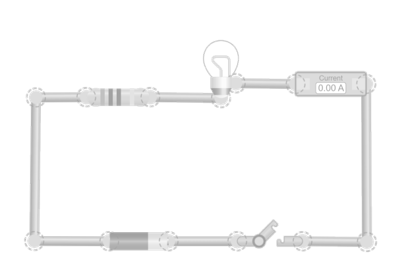
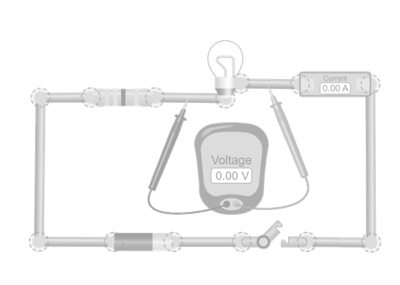
- V-I
- I-R
- V-R
- V-I-R
Voltage and current
What happens to the current when you increase the voltage? In this simulation, you can adjust the voltage of the power source and observe how the current changes. Resistance remains constant so you can focus on the relationship between these two quantities.
Current and resistance
What happens to the current when you change the resistance? This circuit is the same as in the previous simulation, but this time you’ll try different resistance values while keeping the voltage constant. Watch how the current responds as the opposition to flow increases or decreases.

Voltage and resistance
How can you keep the current constant? In this simulation, you can adjust both voltage and resistance. The challenge is to find combinations that keep the current unchanged. You’ll discover that to maintain the same current, voltage and resistance must be adjusted together.
General pattern. Ohm’s Law
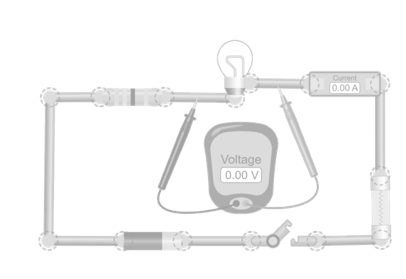
In this simulation, you’ll build a circuit with a battery, a resistor, a light bulb, and a fuse. You can change the voltage and resistance values and observe how the current changes. Pay attention to the bulb’s brightness, the fuse’s state, and the current readings. What happens when you increase the voltage? What if you change the resistance? Can you find different combinations that produce the same current? Experiment with the controls and see how the three electrical quantities are related. You’ll find that the same rule always applies: Ohm’s Law.
Giants of science
“If I have seen further, it is by standing on the shoulders of giants”
Isaac Newton
James Clerk Maxwell
1831
–
1879
James Clerk Maxwell formulated Maxwell’s equations, unifying electricity and magnetism and predicting electromagnetic waves
“Thoroughly conscious ignorance is the prelude to every real advance in science”
Michael Faraday
1791
–
1867
Michael Faraday discovered electromagnetic induction, conducted pioneering experiments in optics (Faraday effect), and established fundamental principles of electrochemistry.
“Nothing is too wonderful to be true”
Become a giant
Your path to becoming a giant of knowledge begins with these top free courses
Free mode
Principles of Modeling, Simulations, and Control for Electric Energy Systems
Free mode
Principles of Electric Circuits | 电路原理
Free mode
Electrotechnique I
Free mode
Electromagnetic Compatibility Essentials
Professional development for Educators
Your path to becoming a giant of knowledge begins with these top free courses
Free mode
Teach computing: Support SEND learners with computing
Free mode
Teach teens computing: Data representation
Free mode
Teaching With Technology and Inquiry: An Open Course For Teachers
Free mode
HP AI Teacher Academy