Generic selectors
Exact matches only
Search in title
Search in content
Post Type Selectors

Alternating current circuits (AC). Theory and practice with simulations

11/06/2026

The online AC circuit simulations on this page allow you to understand what alternating current is by directly observing how a signal changes in value and direction on a periodic basis. You’ll be able to see how voltage and current change over time and how this oscillating behavior affects the most basic operation of a circuit, before moving on to more advanced explanations.

This Thematic Unit is part of our Circuits collection

STEM OnLine mini dictionary

Current Decay

Dynamic process in which the current decreases exponentially as the inductor releases stored energy.

Current Growth

Dynamic process in which the current increases exponentially from zero to the maximum value set by the resistance.

Inductor

Passive component that stores energy in the form of a magnetic field when an electrical current flows through it.

Magnetic Energy

Energy accumulated within the magnetic field generated by the inductor during the passage of electric current.

Parallel Inductors

Configuration where inductor terminals are connected to common points, decreasing the total equivalent inductance of the circuit.

RL Circuit

Electrical configuration consisting of a resistor and an inductor in which the current evolves gradually due to the coil’s opposition to sudden changes in flow.

Series Inductors

Configuration where coils are connected one after another, directly adding their values to obtain a higher equivalent inductance.

Steady State

Final equilibrium state where the current stabilizes and the inductor ideally behaves as a short circuit.

Time Constant

Temporal parameter calculated as the ratio of inductance to resistance that defines how quickly the current responds to circuit variations.

Transient Phase

Period of time in which the circuit’s current and voltages evolve along an exponential curve before stabilizing.

What Is Alternating Current (AC)?

Alternating current is a type of electrical current in which the direction of the charge flow changes periodically. Unlike direct current, where the current always flows in the same direction, in AC the voltage and current oscillate in a repeating pattern over time. The most common form of this oscillation is the sine wave, a smooth and continuous variation that describes how the voltage shifts from positive to negative values and starts over in successive cycles. This type of current is used in residential and industrial power grids, as it allows energy to be transmitted efficiently over long distances and facilitates the use of transformers to adjust voltage levels as needed.

Fundamental parameters of an AC signal

An alternating current signal is described by a series of parameters that determine its shape and behavior over time. Among these, amplitude, period, frequency, and phase are particularly important, as they allow us to characterize how voltage or current varies over the course of each cycle. Understanding these parameters is essential for correctly interpreting any sinusoidal signal and for analyzing how the various components of a circuit will respond when operating with alternating current.

Amplitude

The amplitude of an alternating current signal indicates the maximum value reached by the voltage or current during each cycle. It is measured from the average value—which in a sinusoidal wave is zero—to the positive or negative peak. This parameter determines the “height” of the wave and is directly related to the energy the signal can carry. In practice, amplitude defines the peak and peak-to-peak values, which are useful for describing the instantaneous magnitude of the signal before introducing the concept of rms value.

Period and Frequency

The period is the time it takes for a signal to complete one full cycle of oscillation and is measured in seconds. Frequency indicates how many cycles occur in one second and is measured in hertz (Hz). These two parameters are linked by a simple inverse mathematical relationship:

f = 1 / T

T = 1 / f

This means that a signal with a short period has a high frequency, while a signal with a long period corresponds to a low frequency. This relationship is fundamental for analyzing how AC signals evolve and how they interact with the various elements of a circuit.

Phase

Phase indicates at what point in its cycle an alternating current signal is at a given instant. Two signals with the same frequency can be “in phase” or exhibit a phase shift relative to each other. This phase shift is expressed as an angle, typically in degrees, and allows us to compare the lead or lag of one signal relative to another. When two waves have the same value at every instant, we say they are in phase; if one reaches its peaks before the other, it is leading; and if it reaches them later, it is lagging. Phase is an essential parameter for analyzing how multiple signals interact within an AC circuit.

Time Domain Representation of Sinusoidal Signals

The time domain representation shows how the voltage or current of a sinusoidal signal varies over time. In this type of representation, the horizontal axis corresponds to time and the vertical axis to the instantaneous value of the electrical quantity. This view allows us to clearly identify the peaks, troughs, zero crossings, and the periodic repetition of the wave. It is the most intuitive way to understand how an AC signal evolves and serves as the foundation for introducing concepts such as instantaneous values, rms values, and waveform analysis.

Waveform and instantaneous values

The waveform shows how the voltage or current of a sinusoidal signal varies over time. Each point on the graph represents an instantaneous value—that is, the value of the electrical quantity at a specific instant. These values change continuously, following the characteristic profile of the sinusoidal wave: they rise to a maximum, fall to a minimum, and cross zero again in each cycle. Analyzing the waveform allows us to identify the moments when the signal reaches its peak values, when it changes sign, and how the pattern repeats over time.

Effective values and average value

In a sinusoidal signal, the instantaneous value changes continuously, so it is useful to define quantities that represent its overall behavior. The average value indicates the average of the signal over a complete cycle. In a pure sinusoidal wave, this value is zero, since the positive and negative parts cancel each other out.

The root mean square (RMS) value is different: it represents the equivalent direct current value that would produce the same energy effect. For a sinusoidal signal, the RMS value is obtained from the peak value using the following relationship:

Veff = Vpeak / √2

Ieff = Ipeak / √2

These values allow AC signals to be compared with DC signals and are commonly used in electrical installations and measuring equipment.


STEM OnLine mini dictionary

Current Decay

Dynamic process in which the current decreases exponentially as the inductor releases stored energy.

Current Growth

Dynamic process in which the current increases exponentially from zero to the maximum value set by the resistance.

Inductor

Passive component that stores energy in the form of a magnetic field when an electrical current flows through it.

Magnetic Energy

Energy accumulated within the magnetic field generated by the inductor during the passage of electric current.

Parallel Inductors

Configuration where inductor terminals are connected to common points, decreasing the total equivalent inductance of the circuit.

RL Circuit

Electrical configuration consisting of a resistor and an inductor in which the current evolves gradually due to the coil’s opposition to sudden changes in flow.

Series Inductors

Configuration where coils are connected one after another, directly adding their values to obtain a higher equivalent inductance.

Steady State

Final equilibrium state where the current stabilizes and the inductor ideally behaves as a short circuit.

Time Constant

Temporal parameter calculated as the ratio of inductance to resistance that defines how quickly the current responds to circuit variations.

Transient Phase

Period of time in which the circuit’s current and voltages evolve along an exponential curve before stabilizing.

Explore the exciting STEM world with our free, online, simulations and accompanying companion courses! With them you’ll be able to experience and learn hands-on. Take this opportunity to immerse yourself in virtual experiences while advancing your education – awaken your scientific curiosity and discover all that the STEM world has to offer!

AC circuit simulations

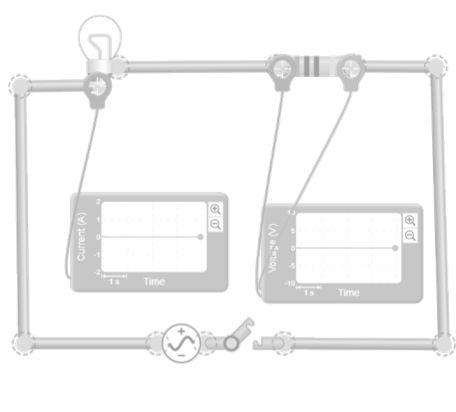
AC power source with resistor


In this circuit, an AC power source supplies power to a resistor and a light bulb. The voltage and current rise and fall simultaneously, demonstrating the simple behavior of a resistor in an AC circuit. When the resistance value is changed, the current intensity varies and the light bulb glows more or less brightly, allowing you to see directly how the resistor affects the passage of the AC signal.


Licencia de Creative Commons

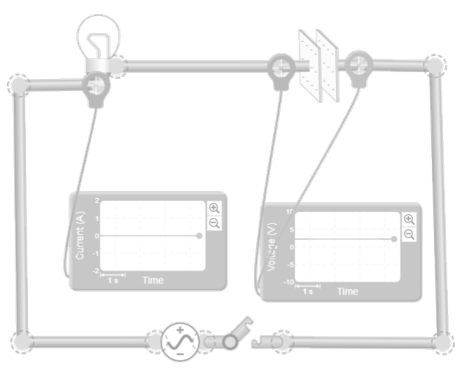
AC power source with capacitor


In this circuit, an AC source powers a capacitor and a light bulb. The voltage and current are no longer in phase: the capacitor needs to continuously charge and discharge, which alters the way the current flows. By varying the capacitance, the speed at which it responds to the AC signal changes, and the light bulb glows more or less brightly depending on the current that flows through it.


Licencia de Creative Commons

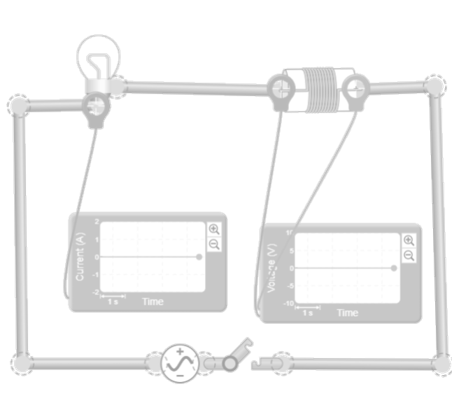
AC power source with inductor


In this circuit, an AC power source supplies a coil and a light bulb. The coil resists rapid changes in current, so the current waveform no longer matches that of the voltage. By changing the value of the inductance, the ease with which the current can vary changes: the light bulb glows more or less brightly depending on the current that flows through it, visually demonstrating how a coil responds to AC.


Licencia de Creative Commons

“If I have seen further, it is by standing on the shoulders of giants”

Isaac Newton

Your path to becoming a giant of knowledge begins with these top free courses

Test your knowledge

You may also be interested

Tools

Scientific calculator

Powered by Desmos

Scientific Dictionary

Powered by Wikipedia

2026 Best Online STEM Education Platform

Cargando clima y ubicación...

To learn and experience

Take your knowledge to the next level with science kits and hands-on tools that connect theory with experimentation

Essential for teachers and students

Learn with the best courses

You may also be interested