Generic selectors
Exact matches only
Search in title
Search in content
Post Type Selectors

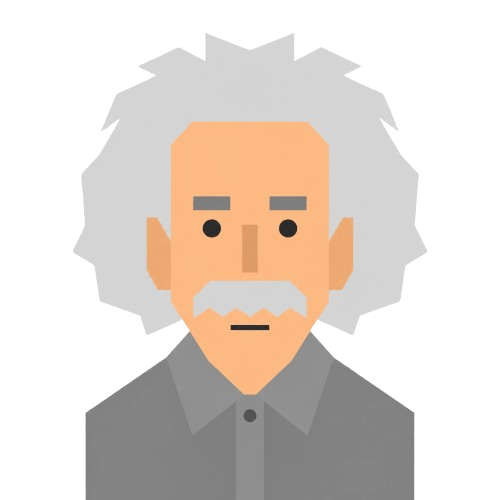
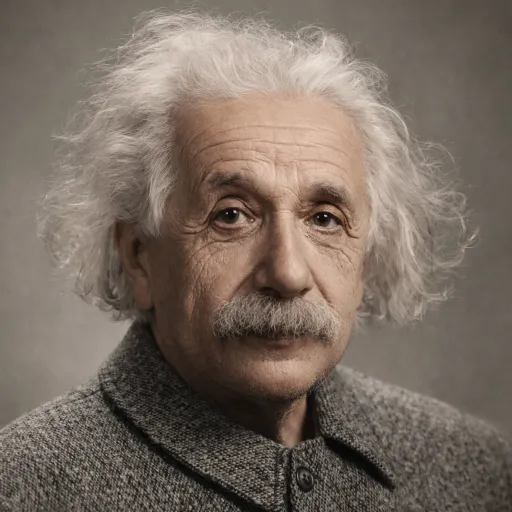
Albert Einstein

10/07/2026

🗓️

🌱March 14, 1879 – Ulm, Germany.
🍂April 18, 1955 – Princeton, New Jersey, United States.

Albert Einstein developed the special and general theory of relativity, explained the photoelectric effect, and laid the foundations of modern physics
Imagination is more important than knowledge

🧐 Did you know?

Albert Einstein was a passionate amateur violinist who found deep solace and scientific inspiration in music, once stating that he often thought in music and lived his daydreams through it. He carried his beloved violin, named Lina, everywhere he traveled, using sessions of Mozart and Bach to help him unblock complex theoretical problems when equations stalled.

❓ Who was Albert Einstein?

Albert Einstein was a German-born theoretical physicist, naturalized Swiss and American, who became the greatest scientific icon of the 20th century. Working as a humble patent clerk in Bern, he published a series of groundbreaking papers in 1905 that completely upended classical physics. His extraordinary capacity to question established dogmas led him to rewrite the laws of the universe, earning him the Nobel Prize in Physics in 1921 for his explanation of the photoelectric effect, and cementing his position as a global advocate for peace and academic freedom.


🌍 The world in their time

At the turn of the 20th century, Newtonian physics reigned supreme, describing a universe where space was a fixed stage and time flowed at a constant, unchangeable rate everywhere. However, new experiments involving the speed of light and electromagnetic radiation revealed deep contradictions that classical mechanics could not resolve, threatening the entire conceptual framework of physical science.

🔬 Scientific legacy

Albert Einstein resolved these contradictions by introducing the Theory of Special Relativity and later the Theory of General Relativity. He proved that space and time are not absolute but interwoven into a dynamic four-dimensional fabric called spacetime, which is warped and bent by mass and energy. This radical insight showed that gravity is not a mysterious pulling force, but the geometric curvature of spacetime itself.

👣 Footprint in today's world

Albert Einstein’s equations are vital to modern technology and astrophysics. Without his relativistic corrections, global positioning systems (GPS) would accumulate errors of several kilometers every single day. His theories also predicted the existence of black holes, gravitational waves, and stimulated emission, which is the foundational mechanism behind all laser technology used today.

🏃‍♂️ Passing the torch

📥 Taking the baton

The mathematical and physical foundations for Albert Einstein’s work were built upon James Clerk Maxwell’s equations of electromagnetism, which established the constant speed of light. He also drew heavy inspiration from Ernst Mach’s philosophical critiques of absolute space and the precise interference experiments conducted by Albert Michelson and Edward Morley.

📤 Passing the baton

Albert Einstein’s revolutionary ideas completely reshaped the trajectory of physics, guiding scientists like Edwin Hubble to discover the expansion of the universe. His theories continue to drive the cutting edge of contemporary cosmology, as modern physicists strive to find a unified theory that bridges general relativity with quantum mechanics.

Tools

Scientific calculator

Powered by Desmos

Scientific Dictionary

Powered by Wikipedia

2026 Best Online STEM Education Platform

Cargando clima y ubicación...

To learn and experience

Take your knowledge to the next level with science kits and hands-on tools that connect theory with experimentation

Essential for teachers and students

Learn with the best courses