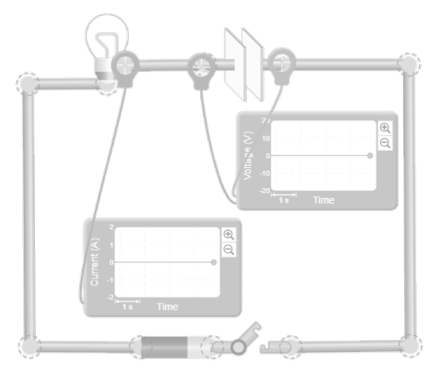
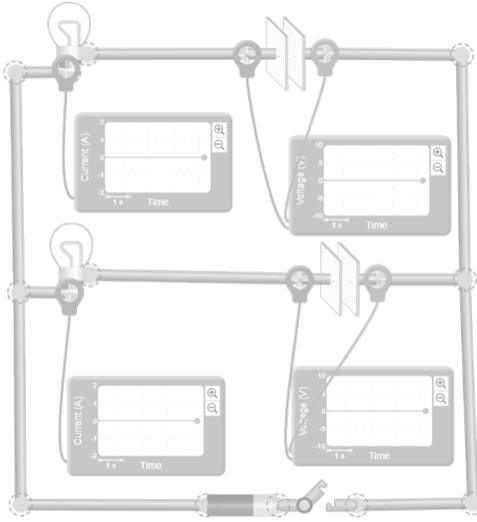
Charging and Discharging a Capacitor in an RC Circuit
In an RC circuit, the presence of the capacitor introduces a time-dependent behavior that does not occur in purely resistive circuits. When a voltage source is connected or disconnected, the capacitor does not reach its final value instantly, but rather undergoes a charging or discharging process in which the voltage and current change gradually. This transient behavior defines the circuit’s dynamics and allows us to understand how electrical charges are stored and released over time.
Charging the Capacitor
When a battery is connected to an RC circuit, the capacitor is initially discharged and its voltage is zero. At that moment, it behaves like a short circuit: the current reaches its maximum value and is limited only by the resistance of the circuit. As the capacitor accumulates charge, its voltage increases and the current decreases progressively following an exponential law. After a sufficient amount of time, the capacitor reaches the source voltage and the current drops to nearly zero, at which point the capacitor acts as an open circuit.
Capacitor Discharge
If the power source is disconnected and the capacitor is allowed to discharge through the resistor, the process occurs in reverse. The initial voltage across the capacitor is at its maximum and gradually decreases as current flows in the opposite direction to that of the charge. Both the voltage and the current decrease following an exponential curve until the capacitor is completely discharged. This discharge process reflects how the capacitor releases the energy stored during the charging phase.
The time constant τ = R·C
The time constant τ = R·C is the fundamental parameter that determines how quickly an RC circuit responds to a change. It represents the characteristic time of the capacitor’s charging or discharging process and establishes the time scale over which the voltage and current evolve. Although the complete behavior follows an exponential law, the time constant allows us to simply describe how long it takes for the circuit to approach its final state: after a time equal to 𝜏, the capacitor has reached approximately 63% of its final voltage during charging, or has dropped to 37% of its initial value during discharging.
Physical meaning of τ
From a physical standpoint, the time constant reflects the interaction between resistance—which limits the current—and capacitance—which determines how much charge the capacitor can store. A high resistance reduces the current and slows down the process; a high capacitance requires more charge to change the voltage, which also slows down the process. The product of these two quantities therefore determines the speed at which the circuit can respond to a change in the source or in the initial conditions.
How R and C affect the speed of the process
Changing the value of R or C directly alters the time constant and, consequently, the shape of the charging and discharging curves. Increasing the resistance or capacitance increases 𝜏 and slows down the process; decreasing either of them speeds it up. This relationship allows us to design circuits with controlled time delays, adjust the response of analog filters, or determine the speed at which an electronic system reacts to a signal.
Exponential Voltage and Current Curves
The time evolution of voltage and current in an RC circuit is not linear, but exponential. This means that the values do not change at a constant rate, but rather change rapidly at first and increasingly slowly as the circuit approaches its steady state. This characteristic shape of the curves is a direct consequence of the time constant 𝜏 = 𝑅⋅𝐶, which determines the rate at which the capacitor can charge or discharge. Understanding these curves is essential for correctly interpreting the circuit’s dynamics and for predicting its behavior in response to any change in the source or initial conditions.
Charging Curve
During charging, the voltage across the capacitor increases from zero to the supply voltage, following an exponentially rising curve. Initially, the increase is rapid, but as the capacitor approaches its final voltage, the rate of change decreases significantly. The current, on the other hand, starts at its maximum value and decreases exponentially until it is practically zero. This inverse relationship between voltage and current reflects how the capacitor accumulates charge and how resistance progressively limits the flow of current.
Discharge Curve
During discharge, the capacitor voltage starts at its maximum value and decreases exponentially until it reaches zero. The current flows in the opposite direction to that of the charge and also decreases exponentially. As in the charging phase, the process is rapid at first and slows down as the capacitor discharges. This curve describes how the capacitor releases the stored energy and how the resistance controls the rate of that process.
Reading and interpreting graphs
Exponential curves allow you to identify the circuit’s time constant at a glance and estimate how long it takes to reach a certain percentage of the final value. After a time equal to τ, the charge voltage has reached approximately 63% of its final value, while the discharge voltage has dropped to 37% of its initial value. These characteristic points facilitate the interpretation of the graphs and allow for an intuitive comparison of the response of different RC circuits.
Connecting capacitors in series and in parallel
The way in which multiple capacitors are combined within a circuit determines how the charge and voltage are distributed among them, and significantly alters the total capacitance of the system. As with resistors, there are two basic configurations—series and parallel—but, unlike resistors, the resulting behavior is not interpreted based on visible currents or voltage drops, but rather on how the electrical capacitance is added or distributed. Therefore, before analyzing dynamic circuits with capacitors, it is important to clearly understand what happens in each of these two fundamental connections.
Capacitors in parallel
When capacitors are connected in parallel, they all share exactly the same potential difference across their plates. Each one stores charge independently, so that the entire assembly behaves as a single, larger capacitor. The equivalent capacitance is simply the sum of the individual capacitances, that is:
Ceq = C1 + C2 + C3 + …
This expression reflects that, in parallel, the system has a larger effective surface area for accumulating charge, which increases the total capacitance without changing the operating voltage.
Capacitors in series
A series connection results in the opposite behavior. In this configuration, all capacitors must store the same charge, since there is only a single current flowing through the branch. The total applied voltage is distributed among them in inverse proportion to their capacitances, and the assembly behaves as a capacitor smaller than any of the individual ones. Mathematically, the equivalent capacitance is given by:
1/Ceq = 1/C1 + 1/C2 + 1/C3 + …
and, in the specific case of two capacitors, it can be written as:
Ceq = (C1 · C2) / (C1 + C2)
This configuration is used when it is necessary to increase the circuit’s maximum allowable voltage, even though the total capacitance will decrease.
Practical applications of RC circuits
RC circuits are used in a wide variety of electronic systems due to their ability to generate time delays, smooth signals, and filter out specific frequencies. Their dynamic behavior, governed by the time constant τ = R⋅C, allows for control over the speed at which a circuit responds to a change. For this reason, they are used in simple timers, in low-pass and high-pass filters that attenuate specific frequency bands, and in smoothing circuits that reduce rapid variations in the signal. These applications demonstrate how an RC circuit, despite its simplicity, constitutes a fundamental building block in analog and digital electronics.