Online STEM Simulations and other interactive resources for science and technology education
Explore our thematic units of free STEM simulations and resources. You’ll find interactive experiments and educational tools of various types and levels of difficulty, ready to use, at no cost to you
Mathematics
More than 40 online simulations and interactive activities to learn and teach Mathematics in a practical and visual way
Our online interactive resources are designed to help you learn and teach effectively
Take advantage of them!
STEM Education
STEM education is an innovative educational approach that integrates science, technology, engineering, and mathematics. Its goal is to prepare students for careers related to these fields and to successfully face the social and economic challenges of the 21st century.
STEM students may face various difficulties depending on their level and experience, but some are common: limited understanding of basic concepts, difficulty applying abstract ideas to the real world, lack of critical thinking, low motivation, and little practice.
Being a STEM teacher is a significant challenge, as it requires not only highly specialized technical knowledge but also strong pedagogical and communication skills to convey these complex concepts clearly, engagingly, and effectively.
We use first-party and third-party analytics cookies subject to your consent. You can accept or configure.
Functional
Always active
The technical storage or access is strictly necessary for the legitimate purpose of enabling the use of a specific service explicitly requested by the subscriber or user, or for the sole purpose of carrying out the transmission of a communication over an electronic communications network.
Preferences
The technical storage or access is necessary for the legitimate purpose of storing preferences that are not requested by the subscriber or user.
Statistics
The technical storage or access that is used exclusively for statistical purposes.The technical storage or access that is used exclusively for anonymous statistical purposes. Without a subpoena, voluntary compliance on the part of your Internet Service Provider, or additional records from a third party, information stored or retrieved for this purpose alone cannot usually be used to identify you.
Marketing
The technical storage or access is required to create user profiles to send advertising, or to track the user on a website or across several websites for similar marketing purposes.
STEM education focuses on teaching practical and technical skills that allow students to apply scientific and mathematical concepts to solve real-world problems. Students also learn to work in teams, communicate effectively, and develop critical thinking skills.
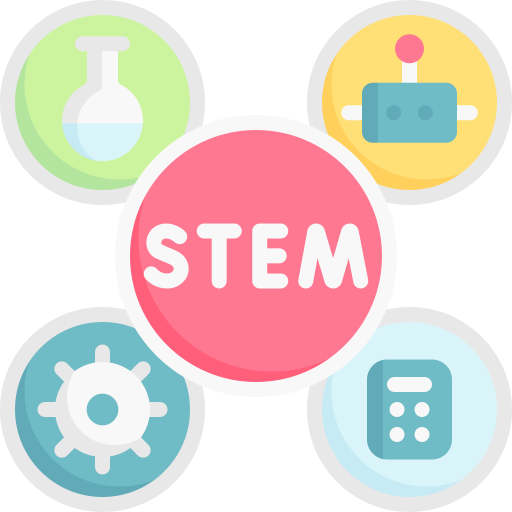
STEM education includes a wide variety of disciplines that share an interconnected vision of science, technology, engineering, and mathematics:
Science. Science focuses on the study of nature and the universe. Within STEM education, the main areas of science include biology, physics, chemistry, geology, and astronomy.
Technology. Technology focuses on the creation and use of tools and devices that help us work, communicate, and live better. Within STEM education, the main areas of technology include computer science, computer engineering, robotics, artificial intelligence, and virtual reality.
Engineering. Engineering focuses on the design, construction, and maintenance of structures, machines, devices, and complex systems. Within STEM education, the main areas of engineering include civil engineering, mechanical engineering, electrical engineering, aerospace engineering, and biomedical engineering.
Mathematics. Mathematics focuses on problem-solving and understanding numerical patterns and relationships. Within STEM education, the main areas of mathematics include algebra, geometry, calculus, statistics, and number theory.
The Importance of STEM Education
Each of these areas is essential for addressing the complex challenges our society faces and for preparing students for future careers and opportunities in STEM-related fields.
STEM education can be applied from an early age, with activities and games that foster curiosity and interest in science, up to higher levels of education, where theory and practical application in specific fields are explored in depth.
The focus on STEM education is increasingly important in today’s global economy, where careers in these areas are highly demanded and constantly evolving. Moreover, technological and scientific advances are rapidly changing the world, and STEM education is essential to prepare students to face these challenges and seize emerging opportunities.
Advantages for Students Using Online Simulations for STEM Education
To overcome these difficulties, students can work on strengthening their basic understanding, look for practical applications of what they are learning, practice regularly, and seek help from teachers and tutors. They can also find motivation in long-term goals and the personal satisfaction of mastering STEM concepts.
More specifically, online interactive resources and especially educational simulations are tools that provide many advantages for students to progress in their STEM education. Some of the most important are:
Access to Abstract Concepts. Simulations allow students to access abstract concepts that are difficult to understand with theoretical explanations alone. For example, a simulation showing how a cell divides or how an electrical circuit is formed can help students visualize and better understand these concepts.
Safe Experimentation. Simulations let students experiment with different variables and scenarios without worrying about the risks associated with real experiments. For example, in a chemical experiment simulation, students can change the amount of reactants without worrying about the danger of explosive reactions.
Flexibility and Availability. Simulations are available online and can be used anytime and anywhere, making learning more flexible and accessible for students. Additionally, simulations can be adapted to different skill and knowledge levels, and can be used both in classroom settings and online learning environments.
Interactivity and Immediate Feedback. Simulations allow students to interact directly with STEM concepts, making learning more engaging and increasing information retention. They can also provide immediate feedback on student performance, helping students identify and correct errors in real time.
In summary, simulations are a valuable tool for STEM students, as they allow access to abstract concepts, facilitate safe experimentation, are flexible and available online, and offer interactivity and immediate feedback.
Advantages for teachers using online simulations for STEM education
By addressing these challenges, STEM teachers can provide high-quality education and prepare students for the demands of the modern world. To overcome these challenges, STEM teachers may find considerable advantages in using online interactive resources such as educational simulations. Some of the most important are:
More Effective Teaching . Simulations can help teachers teach STEM concepts more effectively by providing a detailed, practical visualization of theoretical ideas. Students can see how concepts are applied in real situations and experiment with different variables and scenarios in a controlled environment.
Saving Time and Resources . Simulations can save teachers time and resources by eliminating the need for costly and dangerous lab experiments. Additionally, simulations can be repeated multiple times without using up expensive materials or equipment.
Personalization and Adaptability . Simulations can be customized and adapted to different skill and knowledge levels among students. Teachers can use simulations to challenge advanced students or provide extra support for those who need it.
Assessment and Feedback . Simulations can provide more detailed and accurate assessment and feedback on student performance than traditional tests. Teachers can observe how students interact with STEM concepts and give immediate feedback on their performance.
In summary, simulations are a valuable tool for STEM teachers as they enable more effective teaching, save time and resources, personalize and adapt learning to different skill levels, and provide more detailed assessment and feedback.