Simulations of the photoelectric effect
- Laboratory
- Effect I
- Effect II
- Experiment
Photoelectric effect I
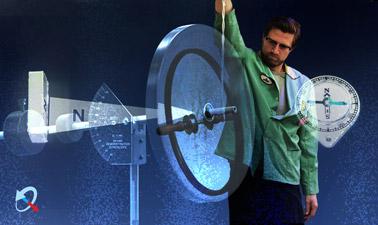
The photoelectric effect is the phenomenon whereby electrons jump when a beam of light strikes a metallic surface, causing the energy of the light to be transformed into electrical energy. This simulation allows us to understand what the photoelectric effect is. Observe the results by changing the type of light, intensity, etc.

Photoelectric effect II
See how light strikes the electrons of a metallic object, and recreate the experiment that gave rise to the field of quantum mechanics.
Photoelectric effect experiment
The photoelectric effect is the phenomenon whereby electrons jump when a beam of light strikes a metal surface, causing the energy of the light to be transformed into electrical energy. This simulation allows us better understand the characteristics of the photoelectric effect. Observe the results as the intensity, voltage, etc.
Giants of science
“If I have seen further, it is by standing on the shoulders of giants”
Isaac Newton
Michael Faraday
1791
–
1867
Michael Faraday discovered electromagnetic induction, conducted pioneering experiments in optics (Faraday effect), and established fundamental principles of electrochemistry.
“Nothing is too wonderful to be true”
Max Karl Ernst Ludwig Planck
1858
–
1947
Max Planck founded quantum theory by introducing the quantum of action, revolutionizing physics and laying the foundations for the development of quantum mechanics
“Science advances one funeral at a time”
Become a giant
Your path to becoming a giant of knowledge begins with these top free courses
Free mode
Principles of Modeling, Simulations, and Control for Electric Energy Systems
Free mode
Principles of Electric Circuits | 电路原理
Free mode
Electrotechnique I
Free mode
Electromagnetic Compatibility Essentials
Free mode
AP® Physics 1
Free mode
AP® Physics 1 – Part 4: Exam Prep
Free mode
The Basics of Transport Phenomena
Free mode
AP® Physics 1: Challenging Concepts
Professional development for Educators
Your path to becoming a giant of knowledge begins with these top free courses
Free mode
Teach computing: Support SEND learners with computing
Free mode
Teach teens computing: Data representation
Free mode
Teaching Computational Thinking
Free mode
Interdisciplinary Teaching with Museum Objects