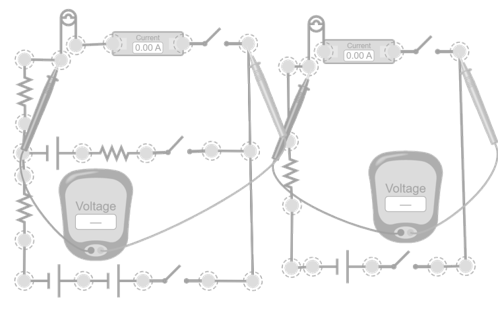
Open-circuit voltage (VTh)
VTh is the voltage across the network between the two terminals where the load will be connected when no current is flowing. In that condition, the circuit displays its “pure internal voltage,” without drops due to resistances or dissipative elements. That’s why it’s interpreted as the equivalent electromotive force with which the network pushes outward: it’s the potential difference the network tries to impose at the terminals before any load modifies its behavior. From the load’s point of view, VTh it’s the maximum voltage it could receive, because with no current there is no internal loss.
To determine this value in practice, the load is disconnected and the voltage between the terminals is measured or calculated with the circuit open. Since the current is zero in that situation, the observed voltage matches exactly the equivalent voltage source of the Thevenin model. That value, VTh, is used to replace the entire network with a single ideal source in the equivalent circuit.
Equivalent resistance seen from the terminals (RTh)
RTh represents the effective resistance offered by the network toward the two terminals where the load will be connected. It’s not a specific physical resistor, but rather the overall resistive behavior presented by the circuit when viewed from the outside. This resistance summarizes how all the passive elements are internally combined and how the sources influence the system’s response. From the load’s perspective, RTh determines how much voltage drop will occur when current flows and thus affects the final current and transferred power.
To obtain RTh in practice, the action of internal sources is eliminated: ideal voltage sources are replaced by a short circuit and ideal current sources by an open circuit. This step does not change the passive structure of the circuit, but it does neutralize any energy contributions that would distort the resistance measurement. Once the sources are nullified, the equivalent resistance between the two terminals is calculated. That value is, and it’s used in the Thevenin model to represent how the network limits current when a real load is connected.
Application of the Thevenin Equivalent to a Load
Once VTh and RTh have been determined, the entire network can be replaced by its Thevenin equivalent without the load noticing any difference. When the load is connected to this simplified model, the voltage, current, and power it receives are exactly the same as in the original circuit, because the equivalent reproduces the voltage-current relationship that the network establishes at its terminals.
The analysis becomes immediate: the current depends only on VTh, RTh, and the load resistance, and the voltage across the load is obtained using a simple divider. This allows you to see how the system’s behavior changes when you modify the load, evaluate the transferred power, or identify matching conditions without recalculating the entire internal network. In essence, the Thevenin equivalent turns a complex circuit into an elementary one, while keeping the response experienced by the load unchanged.
Importance of the Thevenin Theorem
The Thevenin theorem is fundamental because it allows any linear network to be replaced by a simple model that exactly preserves the response experienced by the load. This reduction makes analysis easier, speeds up calculations, and lets you clearly study how load changes affect the circuit’s behavior. Thanks to this equivalence, complex problems become basic configurations that keep the essential information of the system intact.