Norton’s Theorem
The online Norton theorem simulations on this page allow you to interactively explore how any electrical network, no matter how complex, can be replaced by a much simpler model—the Norton equivalent circuit—without altering the behavior seen by the load. Through a comparative setup—an original circuit with several sources and resistors versus its Norton equivalent consisting only of a current source and a resistor in parallel—you can experimentally determine the values of I N and R N , verify that both circuits deliver exactly the same voltage and current to the load, and confirm that this equivalence is maintained even when you modify the circuit’s parameters. These simulations complement the theory and help you intuitively visualize the scope and practical utility of Norton’s theorem.
This Thematic Unit is part of our Circuits collection
What is Norton’s theorem?
Norton’s theorem states that any linear circuit consisting of sources and resistors can be replaced, as seen from two terminals, by a much simpler equivalent model: a current source whose short-circuit current is I N , connected in parallel with an equivalent resistance seen from the terminals, R N . This equivalent reproduces exactly the behavior of the original circuit with respect to any load connected to those terminals. I N represents the current that the circuit would deliver if its terminals were directly connected, while R N determines how that current is distributed when a real load is connected.
Short-Circuit Current (I N )
The short-circuit current, I N , is the first fundamental parameter of the Norton equivalent. It is defined as the current delivered by the original circuit when its two output terminals are directly connected to each other, that is, when an ideal short circuit is made between them. Under this condition, the circuit shows its maximum current supply capability, as the external load has zero resistance. Measuring I N captures how the circuit behaves internally when there is no external opposition to the current flow, and forms the basis of the Norton model: a current source that exactly reproduces that value.
To obtain the short-circuit current, I N , the two terminals of the original circuit are directly connected, creating an ideal short circuit. Under this condition, the current flowing through that link is measured. That value is precisely I N , as it represents the maximum current the circuit can deliver when the external load has zero resistance.
Equivalent Resistance Seen from the Terminals (R N )
The equivalent resistance seen from the terminals, R N , represents the total resistance offered by the original circuit when viewed from its two output terminals.
To obtain it, all internal sources of the circuit are “turned off”: voltage sources are replaced by short circuits and current sources by open circuits. Once this is done, the resistance between the terminals is calculated. That value is precisely R N , and matches the equivalent resistance of Thevenin’s theorem, ensuring that both models describe the same external behavior of the circuit.
Applying the Norton Equivalent to a Load
Once I N and R N have been obtained, the entire network can be replaced by its Norton equivalent without the load perceiving any difference. When the load is connected to this simplified model, the current, voltage, and power it receives are exactly the same as in the original circuit, because the equivalent reproduces the current–voltage relationship the network establishes at its terminals.
The analysis becomes immediate: the current passing through the load depends only on , R N and the resistance of the load itself, and the voltage across the load is obtained by applying the current law at the common node. This allows you to study how the system’s behavior changes when the load is modified, evaluate transferred power, or identify matching conditions without recalculating the entire internal network. Essentially, the Norton equivalent turns a complex circuit into an elementary one, keeping the response experienced by the load intact.
Relationship Between Norton and Thevenin Theorems
The Norton and Thevenin theorems describe the same electrical reality from two different but completely equivalent representations. Any linear circuit that can be expressed by a voltage source in series with a resistor (Thevenin model) can be transformed into a current source in parallel with that same resistor (Norton model), and vice versa. The conversion between them is direct: the Norton current is obtained as I N = V Th / R Th and the equivalent resistance is the same in both models, R N = R Th . Likewise, the Thevenin equivalent is recovered from Norton’s by V Th = I N R N .
This relationship ensures that both models produce exactly the same voltage, current, and power in any load connected to the terminals. The choice between one or the other depends solely on convenience in analysis. Thevenin is more natural when you are interested in studying voltages, while Norton simplifies the study of currents and current division. In any case, both theorems are two complementary ways of representing the same external behavior of a circuit.
Importance of Norton’s Theorem
Norton’s theorem is fundamental in circuit analysis because it allows a complex network to be replaced by a much simpler model without altering the response experienced by the load. This simplification is especially useful when you want to study how current is distributed at a node, how the current in the load varies when its resistance changes, or how networks behave where current division predominates. By reducing the circuit to a current source and a resistor in parallel, analysis becomes direct and transparent, avoiding repetitive calculations on the entire network.
Explore the exciting STEM world with our free, online, simulations and accompanying companion courses! With them you’ll be able to experience and learn hands-on. Take this opportunity to immerse yourself in virtual experiences while advancing your education – awaken your scientific curiosity and discover all that the STEM world has to offer!

Norton Theorem Simulations
Norton Equivalent Circuit
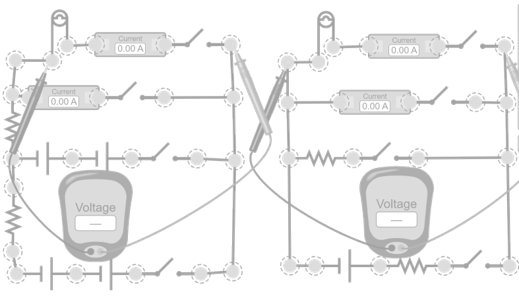
This simulation shows how any circuit, no matter how complex, can be replaced by its Norton equivalent. To do this, two setups are presented: on the left, the “original” circuit, consisting of several power sources and several resistors, to which a load represented by a lightbulb is connected; on the right, its Norton equivalent, composed of a current source in parallel with a resistor, with the same load connected to its terminals.
[Note. PhET simulations do not have a “current source” device. For this reason, to implement the current source in the simulation, a combination of elements that are available is used: an extreme battery in series with an extreme resistor. By choosing a very high voltage and a very large resistance, the resulting current is practically constant regardless of variations in the load, so this setup behaves, for practical purposes, like an ideal current source]
The exercise consists of practically determining the values of IN and RN . First, the output terminals are short-circuited in both setups and the current source of the equivalent circuit is adjusted until the readings of the ammeters match. That adjusted value corresponds to IN , as it reproduces the short-circuit current of the original circuit. Next, the load is reconnected and the resistance of the equivalent is modified until the current through the lightbulb (or, alternatively, the voltage across its terminals) is the same in both setups. The final value of that resistor is RN .
Additionally, you can freely change the values of the batteries, resistors, or the load itself and verify how, whatever the configuration of the original circuit, it is always possible to readjust the current source and the resistance of the Norton equivalent to exactly reproduce the same behavior in the load. You can even build a different circuit and check that its Norton equivalent can be found.
Giants of science
“If I have seen further, it is by standing on the shoulders of giants”
Isaac Newton
André-Marie Ampère
–
Michael Faraday
–
Become a giant
Principles of Modeling, Simulations, and Control for Electric Energy Systems
Principles of Electric Circuits | 电路原理
Electrotechnique I
Electromagnetic Compatibility Essentials
Professional development for Educators
Teaching with Physical Computing: Practical application and classroom strategies for PBL
Teach kids computing: Developing your programming pedagogy
The Science of Learning – What Every Teacher Should Know
Teach teens computing: Data representation
Giants of science
“If I have seen further, it is by standing on the shoulders of giants”
Isaac Newton
Michael Faraday
–
James Clerk Maxwell
–
Become a giant
Principles of Modeling, Simulations, and Control for Electric Energy Systems
Principles of Electric Circuits | 电路原理
Electrotechnique I
Electromagnetic Compatibility Essentials
Professional development for Educators
Teaching with Physical Computing: Practical application and classroom strategies for PBL
Teach teens computing: How computers work
Reimagining higher education teaching in the age of AI
Innovating Instruction: Learning Design in the STEM Classroom
Test your knowledge
You may also be interested
Last simulations
To learn and experience
Take your knowledge to the next level with science kits and hands-on tools that connect theory with experimentation
Calculadora científica

Teachers essentials
Notion
Organize your notes, tasks, and projects in one place. Notion combines notes, lists, and calendars in one flexible space.
Canva
Design presentations, diagrams, and infographics with easy-to-use templates and professional results
Genially
Create interactive content, presentations, and educational games in a simple and visual way
Desmos
The most intuitive graphing calculator to explore mathematics and create dynamic classroom activities
Tinkercad
Design in 3D and simulate electronic circuits for free; it’s the perfect tool for simple robotics projects
Your Infinite Library
Enjoy the freedom to explore millions of titles and a curated selection of magazines on any device
Join Prime for students and young adults
The best series. Millions of songs. All included with your subscription.
Science made fun
Learn with the best courses
edX
Online courses from leading universities and companies. Learn practical skills and earn professional certifications
Coursera
Courses from leading universities and companies. Learn practical skills and earn professional certifications
Udemy
Thousands of online courses tailored to your level. Learn at your own pace with expert instructors