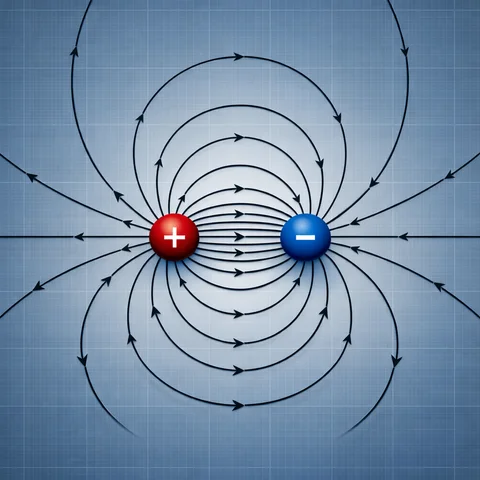
Electric charge and electric field. Theory and practice with simulations
The online electric charge and field simulations on this page will allow you to learn in a practical way how these concepts of physics act and how they relate to each other. Electric charge and electric field are fundamental concepts in physics that describe the interaction of charged particles and the electric forces that act between them. We will discover how the force between charges is generated and what is the electric field strength.
This Thematic Unit is part of our Physics collection

STEM OnLine mini dictionary
Coulomb’s Law
Law stating that the force between two charges is proportional to the product of their charges and inversely proportional to the square of the distance: F = k · (q1 · q2) / r².
Electric Charge
Intrinsic property of subatomic particles that determines their electromagnetic interaction, measured in Coulombs (C) in the SI.
Electric Field
Region of space where a charge experiences a force. It is defined by the relationship F = q · E, where force is the product of the charge and the field intensity.
Electric Field Intensity
Vector quantity that quantifies the force per unit charge (E = F / q), measured in N/C or V/m in the SI.
Field Lines
Visual representation of the direction and strength of the electric field; they originate from positive charges and terminate at negative charges.
Permittivity
Property of a material or vacuum that describes how much it allows or opposes the formation of an electric field within it.
What is electric charge in physics
Electric charge in physics is an intrinsic property of subatomic particles, such as electrons and protons. Charges can be positive (protons) or negative (electrons).
Force between charges. Coulomb’s Law
The force between electric charges is a fundamental interaction in physics; it is described by Coulomb’s Law, which states that the magnitude of the electric force between two point charges is directly proportional to the product of their charges and inversely proportional to the square of the distance separating them. Equally charged particles repel each other, while oppositely charged particles attract each other. In the International System of Units the unit of electric charge is called the coulomb (or coulomb, symbol C). The value of the constant of proportionality in this law depends on the medium in which the charges are located, but in a vacuum the value of 8.99 x 10⁹ N-m²/C² is commonly used.
What is the electric field in physics
The electric field in physics is the region of space surrounding an electric charge where an electric force is exerted on other charges. The electric field is represented by field lines, which are imaginary lines that indicate the direction and strength of the electric field at each point.
Electric field strength
The electric field strength (also called electric field intensity in some texts) is measured in units of force per charge, therefore in the International System it is measured in newtons per coulomb (N/C). The calculation of the electric field at a given point is done by applying Coulomb’s law, which states that the field is proportional to the magnitude of the charge that generates it and decreases as the distance increases.

Applications of the electric field
The electric field has numerous applications in everyday life and technology. For example, it is used in touch screens, in the charging of electronic devices, in the acceleration of particles in particle accelerators and in the generation of energy through the interaction of electric and magnetic fields in electric generators.

STEM OnLine mini dictionary
Coulomb’s Law
Law stating that the force between two charges is proportional to the product of their charges and inversely proportional to the square of the distance: F = k · (q1 · q2) / r².
Electric Charge
Intrinsic property of subatomic particles that determines their electromagnetic interaction, measured in Coulombs (C) in the SI.
Electric Field
Region of space where a charge experiences a force. It is defined by the relationship F = q · E, where force is the product of the charge and the field intensity.
Electric Field Intensity
Vector quantity that quantifies the force per unit charge (E = F / q), measured in N/C or V/m in the SI.
Field Lines
Visual representation of the direction and strength of the electric field; they originate from positive charges and terminate at negative charges.

Permittivity
Property of a material or vacuum that describes how much it allows or opposes the formation of an electric field within it.
Explore the exciting STEM world with our free, online, simulations and accompanying companion courses! With them you’ll be able to experience and learn hands-on. Take this opportunity to immerse yourself in virtual experiences while advancing your education – awaken your scientific curiosity and discover all that the STEM world has to offer!
Electric charge and field simulations
Giants of science
“If I have seen further, it is by standing on the shoulders of giants”
Isaac Newton
James Clerk Maxwell
–
Michael Faraday
–
Become a giant
Principles of Modeling, Simulations, and Control for Electric Energy Systems
Principles of Electric Circuits | 电路原理
Electrotechnique I
Electromagnetic Compatibility Essentials
The Basics of Transport Phenomena
Pre-University Physics
AP® Physics 1 – Part 1: Linear Motion
AP® Physics 1
Professional development for Educators
Teach teens computing: Developing your programming pedagogy
Higher education teaching in the age of AI
Teach teens computing: Object-oriented Programming in Python
Teach computing: Moving from Scratch to Python
Giants of science
“If I have seen further, it is by standing on the shoulders of giants”
Isaac Newton
André-Marie Ampère
–
Michael Faraday
–
Become a giant
Principles of Modeling, Simulations, and Control for Electric Energy Systems
Principles of Electric Circuits | 电路原理
Electrotechnique I
Electromagnetic Compatibility Essentials
Circuits for Beginners
Pre-University Physics
AP® Physics 1 – Part 1: Linear Motion
The Basics of Transport Phenomena
Professional development for Educators
Support kids’ projects: Programming with Scratch
Teach computing: Support SEND learners with computing
BlendedX: Blended Learning with edX
Teach teens computing: How computers work
Test your knowledge
What physical principles define electric charge as a fundamental property of matter, and how does this property manifest in particle interactions?
How does the concept of an electric field help describe the forces acting on a charge placed in space?
Why can two objects attract or repel each other without touching? Where does that force even come from?
What happens if I bring two identical charges closer and closer together? Is there a limit to how strongly they repel?
How is it possible that an object can be “charged” when it doesn’t look like anything has been added to it? Where is that charge actually stored?
You may also be interested
Last simulations
To learn and experience
Take your knowledge to the next level with science kits and hands-on tools that connect theory with experimentation
Van De Graaff generator

Teachers essentials
Notion
Organize your notes, tasks, and projects in one place. Notion combines notes, lists, and calendars in one flexible space.
Canva
Design presentations, diagrams, and infographics with easy-to-use templates and professional results
Genially
Create interactive content, presentations, and educational games in a simple and visual way
Desmos
The most intuitive graphing calculator to explore mathematics and create dynamic classroom activities
Tinkercad
Design in 3D and simulate electronic circuits for free; it’s the perfect tool for simple robotics projects
Your Infinite Library
Enjoy the freedom to explore millions of titles and a curated selection of magazines on any device
Join Prime for students and young adults
The best series. Millions of songs. All included with your subscription.


Science made fun
Learn with the best courses
edX
Online courses from leading universities and companies. Learn practical skills and earn professional certifications
Coursera
Courses from leading universities and companies. Learn practical skills and earn professional certifications
Udemy
Thousands of online courses tailored to your level. Learn at your own pace with expert instructors