Generic selectors
Exact matches only
Search in title
Search in content
Post Type Selectors

Marie Curie

Marie Curie icon
24/08/2026

🗓️

🌱November 7, 1867 – Warsaw, Poland.
🍂July 4, 1934 – Passy, France.

🌟 Main Contribution

Marie Curie discovered the elements polonium and radium, introduced the concept of radioactivity, and pioneered nuclear chemistry, demonstrating that atoms were not indivisible
“In life, there is nothing to be afraid of, only to understand”
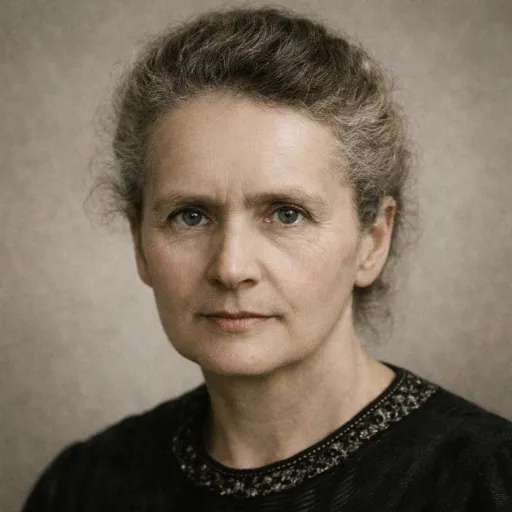
Marie Curie portrait

🧐 Did you know?

During World War I, Marie did not stay in the laboratory. Realizing that military surgeons were operating on wounded soldiers at the front blindly, without knowing where the bullets or fractures were, she decided to act. She designed the first radiological cars in history, automobiles equipped with portable X-ray machines and dynamos connected to the car’s engine to generate electricity. She learned to drive herself, acquired mechanical skills, and traveled the battle lines driving these vehicles (which soldiers affectionately called Petites Curies) to perform X-rays on more than a million wounded soldiers.

🏅 Awards and Honors

Curie received the Nobel Prize in Physics (1903) and the Nobel Prize in Chemistry (1911), becoming the first person to win two Nobel Prizes in different scientific fields.

📚 Their name in science

☢️ curie (Ci)

Historical unit of radioactivity.

🧪 curium (Cm)

Synthetic chemical element with atomic number 96.

➤ Curie’s law

Relates the magnetic susceptibility of a material to its temperature.

➤ Curie point

Temperature at which a ferromagnetic material loses its permanent magnetism.

Ad

❓ Who was Marie Curie?

Marie Curie was a Polish physicist and chemist, naturalized French, whose path to science was an obstacle race. Banned from attending university in her native Poland because she was a woman, she had to study in secrecy before emigrating to Paris with just enough to survive. There, she graduated in Physics and Mathematics with brilliant marks at the Sorbonne. Together with her husband, Pierre Curie, she transformed a poorly ventilated shed into their research laboratory. Her tireless work led her to become the first woman to teach at a French university and the only woman in history to win two Nobel Prizes: one in Physics in 1903 and another in Chemistry in 1911.

🌍 The world in their time

At the end of the 19th century, science believed that atoms were the fundamental building blocks of the universe: solid, indivisible, and immutable spheres. However, it had just been discovered that uranium emitted strange, invisible rays that no one could explain. The mystery that Marie Curie set out to solve was to find out where this mysterious energy came from. The theory of the time was useless; it was necessary to prove whether the light and energy emitted by those materials were the result of a chemical reaction or if, on the contrary, they originated from the inside of an atom that was breaking apart.

Become a giant

Your path to becoming a giant of knowledge begins with these top free courses
free quantum computing course
Free mode

Introduction to Quantum Computing for Everyone

free quantum molecular course
Free mode

Quantum Mechanics of Molecular Structures

free quantum sci & tech course
Free mode

Introduction to Quantum Science & Technology

free quantum computing course
Free mode

Introduction to Quantum Computing for Everyone

free quantum molecular course
Free mode

Quantum Mechanics of Molecular Structures

🔬 Scientific legacy

Marie Curie demonstrated that the mysterious uranium rays were a hidden property of its own atoms, and coined the term radioactivity to describe this phenomenon. To isolate the components responsible, she developed a new chemical research method that led her to discover two completely new elements for the periodic table: polonium (named in honor of her native country) and radium, an element thousands of times more radioactive than uranium.

👣 Footprint in today's world

Marie Curie’s work redefined modern medicine and 21st-century technology. Her research on radium gave rise to radiotherapy techniques that save thousands of lives in hospitals today in the fight against cancer. Furthermore, her discoveries about the nature of the atom opened the door to the development of nuclear energy, archaeological dating systems (such as Carbon-14), and medical diagnostic imaging equipment used daily around the world.

🏃‍♂️ The relay race

📥 Taking the baton

The starting point for Marie Curie’s research was the fascinating mystery of natural radioactivity, discovered by accident by French physicist Henri Becquerel upon observing that uranium salts emitted radiation capable of exposing photographic plates. To this enigma was added the recent discovery of X-rays by Wilhelm Röntgen, whose striking images of the human bone structure inspired Marie to investigate deeply which other materials in nature possessed the property of emitting invisible and spontaneous radiation.


📤 Passing the baton

Marie Curie’s legacy opened the floodgates to an unprecedented atomic revolution. On one hand, her precise findings on radium emanations allowed physicist Ernest Rutherford to bombard matter with alpha particles, a crucial experiment that led him to discover the atomic nucleus and transform physics forever. On the other hand, research continued in her own family environment through her daughter, Irène Joliot-Curie, who took up the mantle in the laboratory to achieve the discovery of artificial radioactivity, a milestone that earned her the Nobel Prize in Chemistry in 1935 and proved that humans could create new radioactive elements from stable ones.

Other giants you will want to get to know

Wolfgang Pauli

Wolfgang Pauli

1900

 –

1958
The relentless judge of quantum physics who formulated the exclusion principle and invented the ghost neutrino.
Peter Higgs

Peter Higgs

1930

 –

2024
The theoretical physicist of the mass mechanism who conceived the fundamental particle that unifies the cosmos.
William Henry

William Henry

1774

 –

1836
The physician of gaseous fluids who measured the dissolution of matter and industrialized elastic water chemistry.
Dmitri Ivánovich Mendeleyev

Dmitri Ivánovich Mendeleyev

1834

 –

1907
The genius of elements who discovered the hidden order of matter and designed the periodic table.
Dmitri Skobeltsyn

Dmitri Skobeltsyn

1892

 –

1990
The particle physics pioneer who glimpsed antimatter and cosmic rays in cloud chambers.

Tools

Scientific calculator

Powered by Desmos

Scientific Dictionary

Powered by Wikipedia

2026 Best Online STEM Education Platform

Cargando clima y ubicación...

To learn and experience

Take your knowledge to the next level with science kits and hands-on tools that connect theory with experimentation

Essential for teachers and students

Learn with the best courses