Generic selectors
Exact matches only
Search in title
Search in content
Post Type Selectors

John Dalton

John Dalton icon
17/07/2026

🗓️

🌱September 6, 1766 – Eaglesfield, England.
🍂July 27, 1844 – Manchester, England.

🌟 Main Contribution

John Dalton formulated the first atomic theory, explaining the composition of matter and the law of multiple proportions in chemical compounds.
“Science is the foundation of truth”
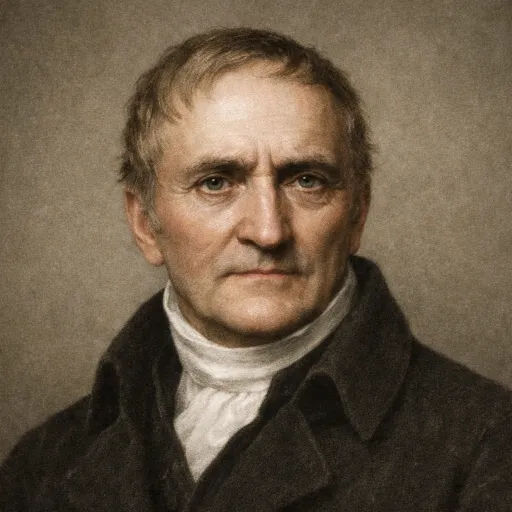
John Dalton portrait

🧐 Did you know?

John Dalton maintained a scientific routine of astonishing constancy for over fifty years, recording more than two hundred thousand meteorological observations in his personal journal until the day of his death. To investigate color blindness, he left precise instructions for his assistant to dissect his own eyes after his passing, wanting to test his hypothesis that the vitreous humor of his eyeball was tinted a bluish color that filtered out red light.

🏅 Awards and Honors

Dalton received the Royal Medal (1826) and was elected Fellow of the Royal Society. He was also a corresponding member of the French Academy of Sciences.

📚 Their name in science

⚛️ dalton (Da)

Unit of atomic mass widely used in chemistry and molecular biology.

➤ Dalton’s law

Law of partial pressures of gases.

➤ Daltonism

Color vision deficiency first scientifically described by John Dalton.

❓ Who was John Dalton?

John Dalton was an English chemist, physicist, and meteorologist, celebrated for developing the first scientifically-based modern atomic theory and for his pioneering studies on vision defects. Raised in a modest Quaker family and largely self-taught, he dedicated his life to teaching and the daily recording of atmospheric conditions. He possessed a mind of extraordinary thoroughness, capable of deducing global quantitative laws from simple but precise laboratory observations. Dalton did not view chemical elements as abstract fluids, but as aggregates of real, indivisible particles with characteristic masses, transforming chemistry into an exact science.

🌍 The world in their time

In the early 1912s, chemistry was trapped in a qualitative phase following the decline of alchemy. Although various elements and compounds were known, scientists lacked a physical model to explain why chemical substances always combined in fixed, exact weight proportions, which limited the prediction of industrial reactions.

Become a giant

Your path to becoming a giant of knowledge begins with these top free courses
free advanced synchrotrons course
Free mode

Synchrotrons and X-Ray Free Electron Lasers (part 1)

free magnetic resonance course
Free mode

Basic Steps in Magnetic Resonance

free solid state fundamentals course
Free mode

Introduction to Solid State Chemistry

free advanced synchrotrons course
Free mode

Synchrotrons and X-Ray Free Electron Lasers (part 1)

free magnetic resonance course
Free mode

Basic Steps in Magnetic Resonance

🔬 Scientific legacy

John Dalton revolutionized science by formulating his atomic theory in 1803, postulating that matter is composed of indivisible atoms and that atoms of the same element are identical in mass and properties. He created the first table of relative atomic weights and formulated the Law of Multiple Proportions, establishing that elements combine in simple numerical ratios. In medicine, he scientifically described achromatopsia in 1794, the color blindness from which he himself suffered and which is today known as daltonism in his honor. In meteorology, he determined that water evaporation is a physical process independent of barometric pressure.


👣 Footprint in today's world

The legacy of John Dalton forms the conceptual foundation of contemporary quantitative chemistry and materials science. His atomic model and tables of relative weights laid the indispensable foundations for the organization of the periodic table of elements, the development of industrial stoichiometry, and the molecular bonding models used today in the pharmaceutical and petrochemical industries.

🏃‍♂️ The relay race

📥 Taking the baton

The monumental chemical breakthroughs of John Dalton built firmly upon Antoine Lavoisier’s law of conservation of mass, Joseph Proust’s studies on definite proportions, and the gas solubility experiments conducted by Joseph Priestley.

📤 Passing the baton

The atomic theory of John Dalton permanently transformed the physical understanding of matter, serving as a springboard for Amedeo Avogadro and Jöns Jacob Berzelius to refine molecular formulas. His description of daltonism opened the gates to the scientific study of visual perception and the genetics of human sensory defects.

Other giants you will want to get to know

Antoine-Laurent de Lavoisier

Antoine-Laurent de Lavoisier

1743

 –

1794
The father of modern chemistry who proved that matter can never be destroyed.
Dmitri Ivánovich Mendeleyev

Dmitri Ivánovich Mendeleyev

1834

 –

1907
The genius of elements who discovered the hidden order of matter and designed the periodic table.
Fritz Haber

Fritz Haber

1868

 –

1934
The tragic genius of chemistry who fed the world with synthetic nitrogen and unleashed modern chemical warfare.
John Dalton

John Dalton

1766

 –

1844
The pioneer of modern chemistry who weighed invisible atoms and scientifically described color blindness.
William Henry

William Henry

1774

 –

1836
The physician of gaseous fluids who measured the dissolution of matter and industrialized elastic water chemistry.

Tools

Scientific calculator

Powered by Desmos

Scientific Dictionary

Powered by Wikipedia

2026 Best Online STEM Education Platform

Cargando clima y ubicación...

To learn and experience

Take your knowledge to the next level with science kits and hands-on tools that connect theory with experimentation

Essential for teachers and students

Learn with the best courses