Generic selectors
Exact matches only
Search in title
Search in content
Post Type Selectors

Niels Henrik David Bohr

Niels Henrik David Bohr icon
17/07/2026

🗓️

🌱October 7, 1885 – Copenhagen, Denmark.
🍂November 18, 1962 – Copenhagen, Denmark.

🌟 Main Contribution

Niels Bohr developed the Bohr atomic model, explaining energy levels in atoms and laying the foundation for quantum mechanics
“An expert is a person who has made all the mistakes that can be made in a very narrow field”
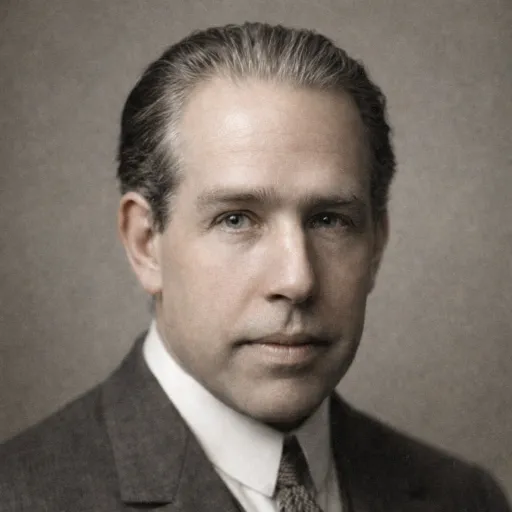
Niels Henrik David Bohr portrait

🧐 Did you know?

Niels Henrik David Bohr was famous for his markedly dialectical working method, needing to discuss his insights aloud for hours while forcing his assistants to draft and rewrite dozens of drafts for a single scientific paper. During his memorable debates with Einstein at the Solvay conferences, Bohr spent sleepless nights patiently dismantling the ingenious thought experiments that Einstein designed to try to prove quantum physics wrong, successfully refuting each of them through the rigorous use of relativity theory itself.

🏅 Awards and Honors

Recibió el Premio Nobel de Física (1922), la Medalla Copley (1938) y el Premio Átomos para la Paz (1957). Fue fundador del Instituto Niels Bohr de Copenhague.

📚 Their name in science

➤ Modelo de Bohr

Modelo atómico que explica los espectros del hidrógeno.

➤ Radio de Bohr

Constante física que representa el radio más probable del electrón en el átomo de hidrógeno.

➤ Magnetón de Bohr

Constante física utilizada en física atómica.

❓ Who was Niels Henrik David Bohr?

Niels Henrik David Bohr was a Danish theoretical physicist, widely ranked among the giants of 20th-century science for formulating the first atomic model based on quantum principles. Educated at the University of Copenhagen and director of the celebrated Institute for Theoretical Physics, he possessed a mind imbued with exceptional philosophical depth and infinite patience for debating the nature of physical reality. Bohr did not view the atom as a predictable classical mechanical system, but as a structure governed by abrupt quantum leaps and constitutive paradoxes. His intellectual charisma and hospitality transformed Copenhagen into the worldwide capital of particle physics, leading fiery epistemological debates with Albert Einstein.


🌍 The world in their time

In the early 1910s, Rutherford’s atomic model presented a lethal physical contradiction according to the laws of classical physics. An electron rotating continuously around the atomic nucleus should constantly emit electromagnetic radiation, rapidly losing energy until collapsing into the nucleus in a fraction of a second, which would make the stability of matter impossible.

Become a giant

Your path to becoming a giant of knowledge begins with these top free courses
free quantum computing course
Free mode

Introduction to Quantum Computing for Everyone

free quantum molecular course
Free mode

Quantum Mechanics of Molecular Structures

free quantum sci & tech course
Free mode

Introduction to Quantum Science & Technology

free quantum computing course
Free mode

Introduction to Quantum Computing for Everyone

free quantum molecular course
Free mode

Quantum Mechanics of Molecular Structures

🔬 Scientific legacy

Niels Henrik David Bohr revolutionized physics by formulating his Bohr atomic model in 1913, postulating mathematically that electrons can only rotate in stable, quantized circular orbits without emitting radiation. He proved that the absorption or emission of light occurs only when an electron performs a “”quantum leap”” between orbits of different energy, formulating the frequency of atomic spectra. This scientific milestone earned him the Nobel Prize in Physics in 1922. In epistemology, he formulated the Principle of Complementarity in 1927, arguing that quantum phenomena exhibit a wave-particle duality that depends strictly on the design of the laboratory experiment used to measure them.

👣 Footprint in today's world

The legacy of Niels Henrik David Bohr forms the analytical framework of contemporary nuclear physics, molecular chemistry, and spectroscopy. His models of orbital energy levels regulate the design of current semiconductor devices, the operation of computer memory chips, nuclear magnetic resonance technology, and the theoretical understanding that particle physicists use today in high-energy accelerators to analyze matter.

🏃‍♂️ The relay race

📥 Taking the baton

The monumental theoretical breakthroughs of Niels Henrik David Bohr developed from Ernest Rutherford’s atomic nucleus model, combined with the quantum constants of Max Planck and Albert Einstein.

📤 Passing the baton

The formulation of the Copenhagen interpretation achieved by Niels Henrik David Bohr established the doctrinal foundations of modern quantum mechanics, serving as an intellectual guide for Werner Heisenberg and Wolfgang Pauli. His scientific and institutional leadership protected dozens of Jewish physicists fleeing the Nazi regime in Europe and opened the path for the development of international subatomic physics.

Other giants you will want to get to know

Dmitri Skobeltsyn

Dmitri Skobeltsyn

1892

 –

1990
The particle physics pioneer who glimpsed antimatter and cosmic rays in cloud chambers.
Albert Einstein

Albert Einstein

1879

 –

1955
The revolutionary physicist who transformed our understanding of space, time, and gravity.
Erwin Schrödinger

Erwin Schrödinger

1887

 –

1961
The philosopher of physics who formulated the quantum wave equation and raised the famous cat paradox.
Peter Higgs

Peter Higgs

1930

 –

2024
The theoretical physicist of the mass mechanism who conceived the fundamental particle that unifies the cosmos.
Max Karl Ernst Ludwig Planck

Max Karl Ernst Ludwig Planck

1858

 –

1947
The father of quantum physics who discovered the microcosm constant and revolutionized the laws of energy.

Tools

Scientific calculator

Powered by Desmos

Scientific Dictionary

Powered by Wikipedia

2026 Best Online STEM Education Platform

Cargando clima y ubicación...

To learn and experience

Take your knowledge to the next level with science kits and hands-on tools that connect theory with experimentation

Essential for teachers and students

Learn with the best courses