Generic selectors
Exact matches only
Search in title
Search in content
Post Type Selectors

William Henry

William Henry icon
17/07/2026

🗓️

🌱December 12, 1774 – Manchester, England.
🍂September 2, 1836 – Pendlebury, England.

🌟 Main Contribution

William Henry formulated Henry’s Law, describing how the amount of gas dissolved in a liquid is proportional to its partial pressure
“Chemistry reveals the hidden secrets in the invisible”
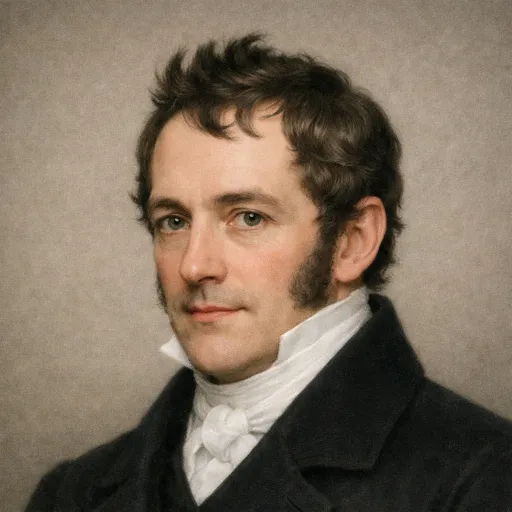
William Henry portrait

🧐 Did you know?

William Henry suffered lifelong painful, chronic physical aftereffects due to a tragic domestic accident during his childhood, when a heavy armchair collapsed on him, causing a severe bone fracture that never healed correctly. This constant physical ailment forced him to intermittently abandon his beloved direct hospital medical practice, redirecting his immense intellectual and analytical energy toward the meticulous control of glass apparatus in his private chemical laboratory, where his skill in quantitatively manipulating mercury and elastic gases compensated for general physical mobility limitations.

🏅 Awards and Honors

Recibió la Medalla Real (1830) y fue miembro de la Royal Society.

📚 Their name in science

➤ Ley de Henry

Ley que relaciona la solubilidad de un gas con su presión parcial.

❓ Who was William Henry?

William Henry was a British physician, experimental chemist, and industrialist, world-famous for formulating the law of gases dissolved in liquids that bears his name. Born into a family with an industrial chemical tradition in Manchester and graduated in medicine from the University of Edinburgh, he balanced a prestigious medical practice with rigorous quantitative investigations in his family laboratory. He possessed a mind characterized by exceptional empirical rigor for measuring gaseous masses and volumes, seeking to isolate precise mathematical regularities within fluid behavior. Henry did not view chemical solutions as arbitrary or qualitative mixtures, but as mechanical molecular equilibria strictly governed by exterior physical pressure.

🌍 The world in their time

In the early 19th century, the nascent chemical and mineral water industries lacked an exact quantitative foundation. Scientists were unaware of what physical laws regulated a liquid’s capacity to absorb or dissolve different elastic gases, which prevented precise calculations in distillation processes, carbonated water analysis, and biological fluid exchange modeling.

Become a giant

Your path to becoming a giant of knowledge begins with these top free courses
free biomaterials course
Free mode

Digital Biomaterials

free materials capstone course
Free mode

Capstone Exam – Materials for Electronic, Optical, and Magnetic Devices

free advanced synchrotrons course
Free mode

Synchrotrons and X-Ray Free Electron Lasers (part 1)

free biomaterials course
Free mode

Digital Biomaterials

free materials capstone course
Free mode

Capstone Exam – Materials for Electronic, Optical, and Magnetic Devices

🔬 Scientific legacy

William Henry revolutionized science by formulating Henry’s Law in 1803, proving mathematically that at a given temperature, the amount of a gas dissolved in a given volume of liquid is directly proportional to the partial pressure that gas exerts over the liquid ($C = k cdot P$). He conducted exhaustive experimental investigations on the composition of coal gas and pioneered analytical techniques for flammable hydrocarbon gases. In medicine and public health, he published his treatise *Elements of Experimental Chemistry* in 1799, which became the international standard chemical reference textbook in Great Britain and the United States for over three decades, and conducted pioneering studies on heat disinfection to combat epidemics such as cholera.

👣 Footprint in today's world

The legacy of William Henry forms the conceptual and analytical infrastructure of contemporary chemical process engineering, hyperbaric medicine, and the beverage industry. His fundamental physical law today regulates the technical operation of industrial carbonation in current soft drinks and beers, water purification in gas treatment plants, chemical blood-gas analysis by hospital anesthesiologists, and mathematical calculations utilized by professional divers across the planet to avoid lethal decompression sickness when ascending to the surface.

🏃‍♂️ The relay race

📥 Taking the baton

The monumental experimental breakthroughs of William Henry built firmly upon the atomic theory of matter developed by his close childhood friend John Dalton, combined with gas dissolution and calorimetry analyses previously conducted by Antoine Lavoisier and Joseph Priestley.

📤 Passing the baton

The regularization of gaseous equilibria achieved by William Henry transformed solution chemistry into an exact mathematical branch of classical fluid physics, providing the direct empirical foundation for general laws of dilute solutions formulated by Van ‘t Hoff and Raoult in the late 19th century. His experimental gas collection and controlled combustion techniques opened the direct path for developing analytical organic chemistry and modern industrial thermal control.

Other giants you will want to get to know

Dmitri Ivánovich Mendeleyev

Dmitri Ivánovich Mendeleyev

1834

 –

1907
The genius of elements who discovered the hidden order of matter and designed the periodic table.
Gilbert Newton Lewis

Gilbert Newton Lewis

1875

 –

1946
The master of the chemical bond who discovered how electrons bind matter together and redefined acids and bases.
Antoine-Laurent de Lavoisier

Antoine-Laurent de Lavoisier

1743

 –

1794
The father of modern chemistry who proved that matter can never be destroyed.

Fritz Haber

Fritz Haber

1868

 –

1934
The tragic genius of chemistry who fed the world with synthetic nitrogen and unleashed modern chemical warfare.
Robert Wilhelm Bunsen

Robert Wilhelm Bunsen

1811

 –

1899
The master of spectroscopic analysis who invented the laboratory burner and deciphered the elements’ fingerprint.

Tools

Scientific calculator

Powered by Desmos

Scientific Dictionary

Powered by Wikipedia

2026 Best Online STEM Education Platform

Cargando clima y ubicación...

To learn and experience

Take your knowledge to the next level with science kits and hands-on tools that connect theory with experimentation

Essential for teachers and students

Learn with the best courses