Generic selectors
Exact matches only
Search in title
Search in content
Post Type Selectors

Antoine-Laurent de Lavoisier

Antoine-Laurent de Lavoisier icon
17/07/2026

🗓️

🌱August 26, 1743 – Paris, France.
🍂May 8, 1794 – Paris, France.

🌟 Main Contribution

Antoine Lavoisier estableció la ley de conservación de la masa y nombró el oxígeno e hidrógeno, sentando las bases de la química moderna
“La nada no produce nada”
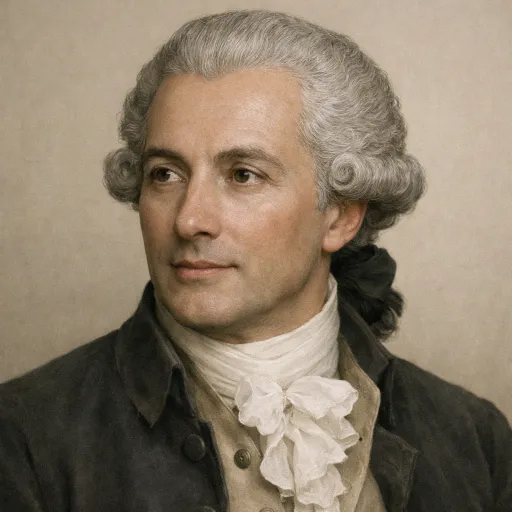
Antoine-Laurent de Lavoisier portrait

🧐 Did you know?

Antoine-Laurent de Lavoisier’s wife, Marie-Anne, was a highly skilled scientific partner who learned English to translate key research papers for him, drew detailed technical illustrations of his complex laboratory equipment, and meticulously edited his notebooks, making their work a true joint intellectual enterprise.

🏅 Awards and Honors

Lavoisier was admitted early to the prestigious French Academy of Sciences in 1768, serving as its director years later. For his public services and state scientific reforms, he received titles and honors from the French kingdom equivalent to historical accolades like the Legion of Honor.

📚 Their name in science

➤ Lavoisier’s Law

Fundamental law of chemistry (law of conservation of mass) stating that in a chemical reaction, the total mass of the reactants is equal to the total mass of the products.

❓ Who was Antoine-Laurent de Lavoisier?

Antoine-Laurent de Lavoisier was a French chemist and biologist who single-handedly dragged chemistry into the modern era. Wealthy and highly educated, he used his considerable fortune to build the most advanced laboratory in Europe, where he introduced strict quantitative measurements to chemical experimentation. Alongside his brilliant wife and collaborator, Marie-Anne Pierrette Paulze, he systematically dismantled ancient mystical alchemy. Tragically, his parallel career as a prominent tax collector made him a target during the French Revolution, leading to his execution by guillotine at the height of the Reign of Terror.

🌍 The world in their time

In the late 18th century, chemistry was still heavily anchored in alchemical traditions. The dominant theory stated that all combustible materials contained a mysterious, weightless substance called phlogiston, which was supposedly released into the air during burning, a theory that led to massive confusion and inaccurate experimental conclusions.

Become a giant

Your path to becoming a giant of knowledge begins with these top free courses
free solid state fundamentals course
Free mode

Introduction to Solid State Chemistry

curso de química de sales gratis
Modo gratis

Sales: reacciones químicas y aplicaciones

curso de química redox gratis
Modo gratis

Reacciones redox en la industria y la naturaleza

free solid state fundamentals course
Free mode

Introduction to Solid State Chemistry

curso de química de sales gratis
Modo gratis

Sales: reacciones químicas y aplicaciones

🔬 Scientific legacy

Antoine-Laurent de Lavoisier revolutionized science by establishing the Law of Conservation of Mass, proving that matter changes form but its total mass always remains identical during a reaction. He overthrew the phlogiston theory by discovering the true role of oxygen in combustion and respiration, co-authored the first systematic nomenclature for chemical elements, and correctly identified water as a compound of hydrogen and oxygen.

👣 Footprint in today's world

Antoine-Laurent de Lavoisier’s analytical methods established chemistry as a precise quantitative science. His law of conservation of mass is the starting principle for all chemical engineering, industrial manufacturing, and laboratory pharmacology worldwide, ensuring that balances and precise metrics govern our manipulation of matter.

🏃‍♂️ The relay race

📥 Taking the baton

The revolutionary work of Antoine-Laurent de Lavoisier relied heavily on the experimental discoveries of isolated gases made by British scientists Joseph Priestley, who first isolated oxygen gas, and Henry Cavendish, who discovered hydrogen, though neither could fully explain their discoveries.

📤 Passing the baton

Antoine-Laurent de Lavoisier’s modern chemical framework enabled John Dalton to develop his definite atomic theory soon after. His clear classification of elements paved the way for generations of chemists to systematically explore chemical reactions, culminating in the organization of the periodic table.

Other giants you will want to get to know

William Henry

William Henry

1774

 –

1836
The physician of gaseous fluids who measured the dissolution of matter and industrialized elastic water chemistry.
Antoine-Laurent de Lavoisier

Antoine-Laurent de Lavoisier

1743

 –

1794
The father of modern chemistry who proved that matter can never be destroyed.
Dmitri Ivánovich Mendeleyev

Dmitri Ivánovich Mendeleyev

1834

 –

1907
The genius of elements who discovered the hidden order of matter and designed the periodic table.
Robert Boyle

Robert Boyle

1627

 –

1691
The philosopher of the chemical vacuum who banished mystical alchemy and isolated the law of compressible gases.

Fritz Haber

Fritz Haber

1868

 –

1934
The tragic genius of chemistry who fed the world with synthetic nitrogen and unleashed modern chemical warfare.

Tools

Scientific calculator

Powered by Desmos

Scientific Dictionary

Powered by Wikipedia

2026 Best Online STEM Education Platform

Cargando clima y ubicación...

To learn and experience

Take your knowledge to the next level with science kits and hands-on tools that connect theory with experimentation

Essential for teachers and students

Learn with the best courses