Generic selectors
Exact matches only
Search in title
Search in content
Post Type Selectors

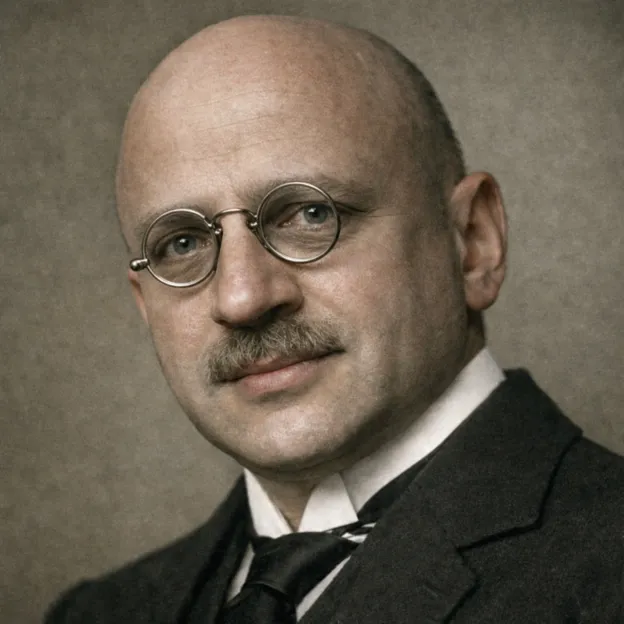
Fritz Haber

Fritz Haber icon
17/07/2026

🗓️

🌱December 9, 1868 – Basel, Switzerland.
🍂January 29, 1934 – Basel, Switzerland.

🌟 Main Contribution

Fritz Haber developed the Haber-Bosch process, enabling large-scale ammonia synthesis, revolutionizing fertilizer production and industrial chemistry
“Chemistry has the power to transform life on Earth”
Fritz Haber portrait

🧐 Did you know?

Fritz Haber firmly defended a severe, controversial ethical stance regarding the role of scientists in warfare conflicts, captured in his famous phrase: “During peace, a scientist belongs to humanity, but during war, he belongs to his fatherland.” His obsession with developing poisonous gases triggered a deep fracture with his wife, the equally brilliant chemist Clara Immerwahr, who committed suicide in protest.

🏅 Awards and Honors

Haber was awarded the Nobel Prize in Chemistry in 1918 in recognition of his momentous development of the industrial synthesis of ammonia from its constituent gaseous elements.

📚 Their name in science

➤ Haber-Bosch Process

Chemical-industrial process for the large-scale synthesis of ammonia from atmospheric nitrogen and hydrogen gas, enabling the mass production of synthetic fertilizers.

❓ Who was Fritz Haber?

Fritz Haber was a German chemist widely ranked among the most brilliant, complex, and controversial figures in the history of science. Born into an assimilated Jewish family, he possessed an exceptionally brilliant mind geared toward solving massive, large-scale industrial problems. As a professor and researcher at the Kaiser Wilhelm Institute, he achieved a colossal scientific milestone by fixing atmospheric nitrogen, rescuing billions of people from global starvation. However, his fervent nationalism during World War I led him to direct the development of massive chemical weapons, an ethical duality that destroyed his family life and international reputation.

🌍 The world in their time

In the early 20th century, humanity faced an imminent Malthusian catastrophe: global reserves of natural nitrates (such as Chilean guano), vital for fertilizing agricultural crop fields, were exhausting rapidly. Without a chemical method to obtain nitrogen on a large scale, worldwide agriculture was unable to produce enough food to sustain population growth.

Become a giant

Your path to becoming a giant of knowledge begins with these top free courses
free biomaterials course
Free mode

Digital Biomaterials

free materials capstone course
Free mode

Capstone Exam – Materials for Electronic, Optical, and Magnetic Devices

free advanced synchrotrons course
Free mode

Synchrotrons and X-Ray Free Electron Lasers (part 1)

free biomaterials course
Free mode

Digital Biomaterials

free materials capstone course
Free mode

Capstone Exam – Materials for Electronic, Optical, and Magnetic Devices

🔬 Scientific legacy

Fritz Haber revolutionized science by developing the Haber-Bosch Process in 1909, successfully synthesizing gaseous ammonia directly from atmospheric hydrogen and nitrogen under high pressures and temperatures using iron catalysts. This fundamental milestone, which earned him the Nobel Prize in Chemistry in 1918, enabled the mass manufacturing of artificial fertilizers. Tragically, he also applied his genius to military science, overseeing the first massive use of chlorine gas at the Battle of Ypres.

👣 Footprint in today's world

The impact of Fritz Haber keeps half of the contemporary human population alive today. The Haber-Bosch process forms the basis of the chemical artificial fertilizer industry that nourishes crops across the entire planet, enabling global intensive agriculture. Without his discovery, billions of people would lack food, consolidating his legacy as the man who, literally, “harvested the air to feed the world.”

🏃‍♂️ The relay race

📥 Taking the baton

The astounding chemical achievements of Fritz Haber developed upon the laws of fluid thermodynamics and chemical equilibrium formulated by Willard Gibbs and Walther Nernst, combined with the large-scale metallurgical engineering developments conducted by his collaborator Carl Bosch.

📤 Passing the baton

Fritz Haber’s ammonia synthesis method opened the doors for the advancement of 20th-century chemical engineering and industrial catalysis. However, the chemical warfare laboratories he founded developed lethal chemical compounds that, years after his death and due to the rise of the Nazi regime that forced him into exile due to his Jewish origin, were tragically used in concentration camps.

Other giants you will want to get to know

Gilbert Newton Lewis

Gilbert Newton Lewis

1875

 –

1946
The master of the chemical bond who discovered how electrons bind matter together and redefined acids and bases.
Dmitri Ivánovich Mendeleyev

Dmitri Ivánovich Mendeleyev

1834

 –

1907
The genius of elements who discovered the hidden order of matter and designed the periodic table.
Antoine-Laurent de Lavoisier

Antoine-Laurent de Lavoisier

1743

 –

1794
The father of modern chemistry who proved that matter can never be destroyed.
John Dalton

John Dalton

1766

 –

1844
The pioneer of modern chemistry who weighed invisible atoms and scientifically described color blindness.
Robert Boyle

Robert Boyle

1627

 –

1691
The philosopher of the chemical vacuum who banished mystical alchemy and isolated the law of compressible gases.

Tools

Scientific calculator

Powered by Desmos

Scientific Dictionary

Powered by Wikipedia

2026 Best Online STEM Education Platform

Cargando clima y ubicación...

To learn and experience

Take your knowledge to the next level with science kits and hands-on tools that connect theory with experimentation

Essential for teachers and students

Learn with the best courses