Types of chemical bonds
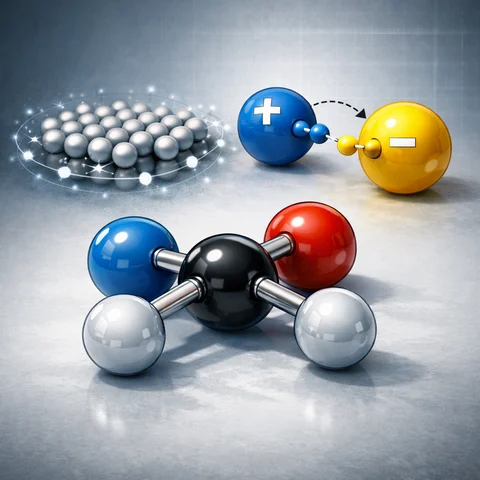
There are different types of chemical bonds, which differ in the way atoms share or transfer electrons to achieve stability. The three main types are ionic, covalent, and metallic bonds. Each has its own characteristics that determine the physical and chemical properties of the compounds formed.
Ionic bond
An ionic bond is formed when one atom gives up one or more electrons to another atom, thus generating oppositely charged ions that are electrostatically attracted to each other. This type of bond is common between metals and non-metals and gives rise to compounds called salts, such as sodium chloride (NaCl). Ionic compounds tend to have high melting points and be soluble in water.
Covalent bond
A covalent bond occurs when two atoms share one or more pairs of electrons to achieve a stable electronic configuration. This type of bond usually occurs between nonmetals and can be classified as single, double, or triple covalent, depending on the number of shared electron pairs. In addition, covalent bonds can be:
Polar. When electrons are shared unevenly due to differences in the electronegativity of atoms, generating a partial charge distribution.
Non-polar. When electrons are shared equally between atoms with similar electronegativities.
Compounds with covalent bonds tend to have lower melting and boiling points than ionic compounds and may be soluble in non-polar solvents.
Metallic bond
The metallic bond is characterized by the union between metal atoms, in which the valence electrons are delocalized and form a “cloud” of free electrons that move around a structure of positive nuclei. This free mobility of electrons is responsible for many characteristic properties of metals, such as electrical and thermal conductivity, malleability, and metallic luster.
Metallic bonds allow metals to form solid and resistant structures, making them essential for numerous materials and technological applications.
Properties of chemical bonds
Chemical bonds determine many of the physical and chemical properties of substances. Some important properties related to bonds are:
Bond strength. The energy required to break a chemical bond varies depending on its type; strong ionic and covalent bonds require more energy than weaker bonds.
Bond length. This is the average distance between the nuclei of the bonded atoms; shorter bonds tend to be stronger.
Polarity. This depends on how the electrons are distributed in the bond; it affects properties such as solubility and boiling point.
Conductivity. Metallic bonds allow electron mobility and, therefore, electrical conductivity, while ionic and covalent bonds have variable conductivities.
Melting and boiling points. Bond strength influences the temperatures at which a substance changes state.
These properties are essential for understanding how materials behave under different conditions and how they interact with their environment.
Importance and applications of chemical bonds
Chemical bonds are fundamental in many areas of science and everyday life. In biology, covalent and hydrogen bonds maintain the structure of essential molecules such as DNA and proteins, enabling living organisms to function properly. In industry and technology, metallic and ionic bonds are the basis for the manufacture of materials such as metals, ceramics, and salts, which have applications in construction, electronics, and medicine.
Understanding how chemical bonds form and behave is key to the development of new materials, medicines, and chemical processes that improve our quality of life and contribute to technological innovation.