Generic selectors
Exact matches only
Search in title
Search in content
Post Type Selectors

Leonhard Euler

Leonhard Euler icon
17/07/2026

🗓️

🌱April 15, 1707 – Basel, Switzerland.
🍂September 18, 1783 – St. Petersburg, Russia.

🌟 Main Contribution

Euler developed much of modern mathematical notation and made key contributions to analysis, topology, mechanics, and graph theory
“Nothing takes place in the universe without mathematics expressing it”
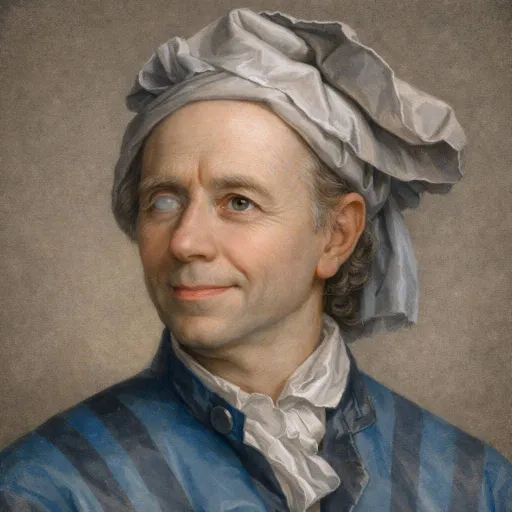
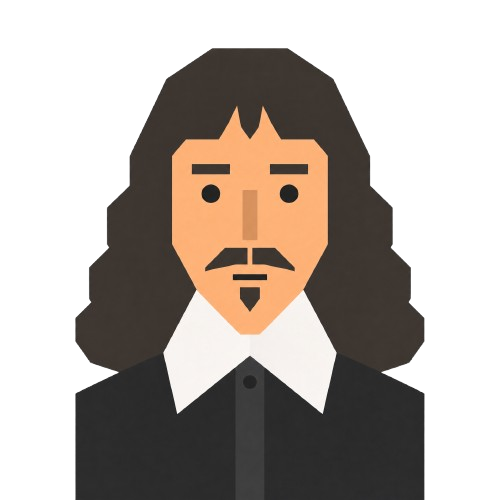
Leonhard Euler portrait

🧐 Did you know?

Leonhard Euler possessed such an astonishing capacity for concentration that he was capable of drafting his complex mathematical treatises while holding one of his children in his arms and the rest played noisily around him. After losing his sight entirely due to a cataract in his left eye and a previous illness in his right, he remarked with serenity that he would now have fewer visual distractions, successfully dictating to his assistants more than half of his gigantic scientific body of work from absolute darkness.

🏅 Awards and Honors

Euler won the Grand Prize of the Paris Academy twelve times. He was a member of the academies of sciences of Saint Petersburg, Berlin, Paris, and London, and is regarded as one of history’s greatest mathematicians.

📚 Their name in science

➤ Euler’s formula

Fundamental relationship between the complex exponential function and the trigonometric functions, regarded as one of the most important formulas in mathematics.

➤ Euler’s identity

Mathematical identity derived from Euler’s formula that relates five fundamental mathematical constants and is widely regarded as one of the most beautiful equations in mathematics.

➤ Euler’s method

Numerical method used to obtain successive approximations to the solutions of ordinary differential equations.

➤ Euler characteristic

Fundamental topological invariant describing essential properties of a surface or geometric object independently of its shape.

Ad

❓ Who was Leonhard Euler?

Leonhard Euler was a Swiss mathematician and physicist, unanimously recognized as one of the most prolific and brilliant mathematicians of all time for unifying mathematical analysis. Educated at the University of Basel under the guidance of the great Johann Bernoulli, he divided his immense and productive career between the St. Petersburg Academy of Sciences and the Berlin Academy under the royal patronage of Catherine the Great and Frederick the Great. He possessed a superhuman photographic memory and a mental calculation capacity that astonished his contemporaries, allowing him to maintain an identical rate of scientific production even after becoming completely blind during the final seventeen years of his life. Euler did not view mathematics as isolated problems, but as a continuous fabric of interconnected analytical structures.

🌍 The world in their time

In the early 18th century, mathematics lacked a standardized and universal symbology. Each scientist utilized their own characters and rudimentary nomenclatures for infinitesimal calculus, geometry, and algebra, generating great international confusion and limiting the coordinated advancement of theoretical physics and fluid engineering.

Become a giant

Your path to becoming a giant of knowledge begins with these top free courses
free quantum optomechanics course
Free mode

Cavity Quantum Optomechanics

free advanced nanophotonic course
Free mode

Nanophotonic Modeling

free materials capstone course
Free mode

Capstone Exam – Materials for Electronic, Optical, and Magnetic Devices

free quantum optomechanics course
Free mode

Cavity Quantum Optomechanics

free advanced nanophotonic course
Free mode

Nanophotonic Modeling

🔬 Scientific legacy

Leonhard Euler revolutionized science by unifying mathematical analysis and introducing most of the notation we use today, including the symbols for function $f(x)$, the base of natural logarithms ($e$), the imaginary unit ($i$), the summation ($Sigma$), and the popularization of the letter $pi$. He formulated Euler’s Identity ($e^{ipi} + 1 = 0$), widely considered the most beautiful mathematical equation in history. He founded graph theory by solving the Seven Bridges of Königsberg problem in 1736, redefined the analytical analysis of complex functions, and made monumental contributions to fluid mechanics via Euler’s equations for perfect incompressible fluids, theoretical astronomy, and solid mechanics.

👣 Footprint in today's world

The legacy of Leonhard Euler forms the mathematical and engineering infrastructure of the contemporary world. His network analysis equations underpin the development of internet algorithms, global logistical route optimization, and current social networks. In structural and civil engineering, his column buckling critical load formulas regulate the safe design of skyscrapers, bridges, and complex architectural structures across the planet.

🏃‍♂️ The relay race

📥 Taking the baton

The monumental algebraic breakthroughs of Leonhard Euler built directly upon the infinitesimal calculus of Gottfried Leibniz and Isaac Newton, combined with the methodological teachings of the Bernoulli family and classical geometric principles.

📤 Passing the baton

The analytical unification achieved by Leonhard Euler transformed mathematics into the analytical tool par excellence of physical sciences, serving as a direct foundation for the analytical mechanics of Lagrange and Laplace. His pioneering use of complex functions paved the way for the developments of Fourier analysis and 19th-century theoretical physics.

Other giants you will want to get to know

Joseph Fourier

Joseph Fourier

1768

 –

1830
The mathematician of heat theory who created the trigonometric series fundamental to the digital age.
Gottfried Wilhelm Leibniz

Gottfried Wilhelm Leibniz

1646

 –

1716
The universal genius who co-invented infinitesimal calculus and designed the binary system that powers computers.
Henri Cartan

Henri Cartan

1904

 –

2008
The master of algebraic topology who reshaped modern mathematics and structured sheaf theory.
Michael Faraday

Michael Faraday

1791

 –

1867
The wizard of electrical induction who visualized magnetic lines of force and transformed industry.
Alan Turing

Alan Turing

1912

 –

1954
The mathematical genius who laid the foundations of computing and cracked the Enigma code.

Tools

Scientific calculator

Powered by Desmos

Scientific Dictionary

Powered by Wikipedia

2026 Best Online STEM Education Platform

Cargando clima y ubicación...

To learn and experience

Take your knowledge to the next level with science kits and hands-on tools that connect theory with experimentation

Essential for teachers and students

Learn with the best courses