Generic selectors
Exact matches only
Search in title
Search in content
Post Type Selectors

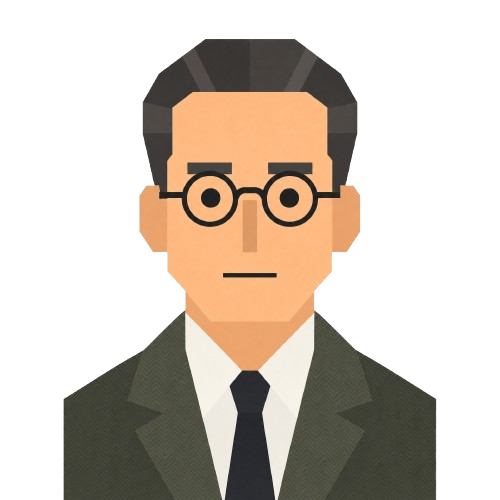
Kurt Gödel

Kurt Gödel icon
17/07/2026

🗓️

🌱April 28, 1906 – Brünn, Austria-Hungary (now Brno, Czech Republic).
🍂January 14, 1978 – Princeton, New Jersey, United States.

🌟 Main Contribution

Kurt Gödel revolutionized modern mathematics and logic with his incompleteness theorems, proving that any consistent system contains undecidable propositions
“Only those who understand logic can discover the limits of human reaso”
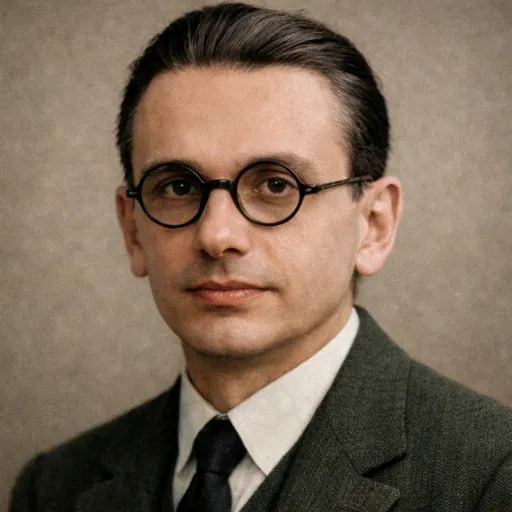
Kurt Gödel portrait

🧐 Did you know?

Kurt Gödel suffered from severe psychological conditions marked by an obsessive paranoia regarding food during his later years in Princeton. Convinced that enemy agents were attempting to poison his food, he flatly refused to eat any meal that had not been cooked and tasted beforehand by his wife Adele; when she had to be hospitalized due to illness, Gödel stopped eating entirely and tragically passed away from self-imposed starvation, weighing barely sixty-five pounds.

🏅 Awards and Honors

Gödel received the Albert Einstein Award (1951), the National Medal of Science (1974), and was a member of the Institute for Advanced Study and a Foreign Member of the Royal Society.

📚 Their name in science

➤ Gödel’s incompleteness theorems

Show that every sufficiently powerful formal system contains true statements that cannot be proved within the system.

➤ Gödel numbering

Method for encoding symbols and proofs as integers.

❓ Who was Kurt Gödel?

Kurt Gödel was an Austrian-born American logician, mathematician, and philosopher, considered the most important logician since Aristotle for shaking the foundations of mathematics with his incompleteness theorems. Educated at the University of Vienna and a participant in the celebrated Vienna Circle, he possessed a mind of obsessive, unyielding analytical rigor that sought to decipher the ultimate boundaries of formal truth. Gödel did not view mathematics as a game of mechanical rules invented by man, but as an objective mathematical reality independent of human proof capacity. His flight from a Europe besieged by Nazism led him to Princeton, where he became the closest intellectual confidant of Albert Einstein.

🌍 The world in their time

In the early 1912s, the global mathematical community led by David Hilbert desperately sought to prove that mathematics was complete, consistent, and entirely predictable. It was assumed that every true mathematical statement could be mechanically proven using a finite set of well-structured logical axioms, eliminating paradox from science forever.

Become a giant

Your path to becoming a giant of knowledge begins with these top free courses
free orthogonal algebra course
Free mode

Linear Algebra IV: Orthogonality & Symmetric Matrices and the SVD

free determinants algebra course
Free mode

Linear Algebra III: Determinants and Eigenvalues

free matrix algebra course
Free mode

Linear Algebra II: Matrix Algebra

free orthogonal algebra course
Free mode

Linear Algebra IV: Orthogonality & Symmetric Matrices and the SVD

free determinants algebra course
Free mode

Linear Algebra III: Determinants and Eigenvalues

🔬 Scientific legacy

Kurt Gödel revolutionized scientific logic by publishing his Incompleteness Theorems in 1931, proving mathematically that within any consistent formal system capable of performing elementary arithmetic, there exist true propositions that cannot be proven or disproven within the system itself. He further stated that the consistency of an axiomatic system cannot be proven using its own internal rules. In set theory, he proved the consistency of the continuum hypothesis with standard Zermelo-Fraenkel axioms. In theoretical physics, he discovered exact solutions to Einstein’s field equations in 1949 (the “Gödel universe) that allowed for the mathematical possibility of time travel through closed timelike curves.

👣 Footprint in today's world

The legacy of Kurt Gödel forms the absolute epistemological backbone of contemporary computer science, formal logic, and artificial intelligence. His mathematical work on recursive functions laid the foundations for defining the notion of a computable algorithm, establishing the absolute theoretical limits of what a modern digital computer can logically compute and what forever escapes the grasp of computing processing.

🏃‍♂️ The relay race

📥 Taking the baton

The monumental logical breakthroughs of Kurt Gödel built firmly upon David Hilbert’s axiomatic formalization program, the class logic developments of Bertrand Russell and Gottlob Frege, and classical language mathematical paradoxes.

📤 Passing the baton

The mathematical proof of incompleteness achieved by Kurt Gödel permanently altered 20th-century philosophy of science, destroying the positivist dream of an absolute, closed mathematical certainty. His revolutionary methodological conclusions directly inspired Alan Turing’s theoretical developments regarding computability and completely redefined the boundaries of human formal knowledge.

Other giants you will want to get to know

Leonhard Euler

Leonhard Euler

1707

 –

1783
The supreme titan of mathematical analysis who unified the language of calculus and mastered science without sight.
Blaise Pascal

Blaise Pascal

1623

 –

1662
The mystical genius of hydrostatic pressure who invented the mechanical calculator and measured the weight of the vacuum.
Carl Friedrich Gauss

Carl Friedrich Gauss

1777

 –

1855
The prince of mathematics who tamed the normal curve of errors and instrumented terrestrial magnetism.
Pierre-Simon Laplace

Pierre-Simon Laplace

1749

 –

1827
The French Newton of celestial mechanics who systematized probability and banished mystical hypotheses.

Henri Poincaré

Henri Poincaré

1854

 –

1912
The last universalist who discovered deterministic chaos and revolutionized topology and celestial mechanics.

Tools

Scientific calculator

Powered by Desmos

Scientific Dictionary

Powered by Wikipedia

2026 Best Online STEM Education Platform

Cargando clima y ubicación...

To learn and experience

Take your knowledge to the next level with science kits and hands-on tools that connect theory with experimentation

Essential for teachers and students

Learn with the best courses