Generic selectors
Exact matches only
Search in title
Search in content
Post Type Selectors

Carl Friedrich Gauss

Carl Friedrich Gauss icon
17/07/2026

🗓️

🌱April 30, 1777 – Brunswick, Germany.
🍂February 23, 1855 – Göttingen, Germany.

🌟 Main Contribution

Carl Friedrich Gauss developed fundamental methods in algebra, number theory, and statistics, consolidating the foundation of modern mathematics.
“Mathematics is the queen of the sciences and number theory its queen”
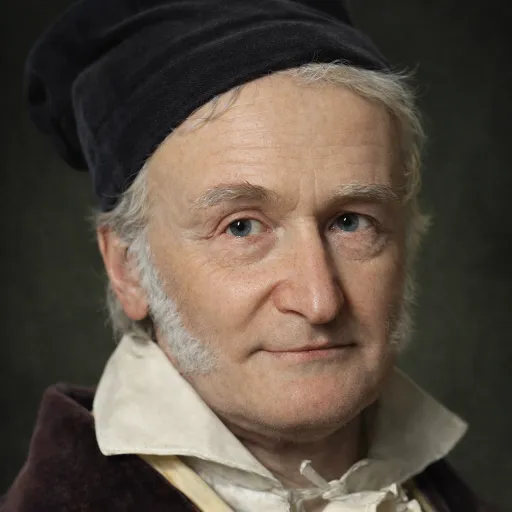
Carl Friedrich Gauss portrait

🧐 Did you know?

Carl Friedrich Gauss demonstrated a prodigious and intuitive mathematical genius when he was barely three years old, spontaneously and verbally correcting a numerical calculation error his father had made on paper while preparing the weekly payroll for the construction workers under his charge. During his school years, when the teacher punished the entire class by forcing them to add all integers from 1 to 100, expecting to keep them busy for hours, the young Gauss, under ten years old, found the exact mathematical solution in a few seconds ($5050$), placing his slate on the teacher’s desk upon realizing instantly that the numerical series formed symmetrical pairs adding up to 101 ($1+100, 2+99…$).

🏅 Awards and Honors

Gauss was awarded the prestigious Copley Medal by the Royal Society of London in 1838 in recognition of his monumental advances in mathematics and applied physics. Additionally, he was elected a foreign Fellow of the Royal Society of London (1804) and a Member of the French Academy of Sciences (1820).

📚 Their name in science

🔆 Gauss (G)

Unit of measurement of magnetic flux density or magnetic induction in the centimetre-gram-second (CGS) system of units, commonly used in magnet characterization.

➤ Gauss’s Law

Fundamental law of electromagnetism relating the electric flux through a closed surface to the net electric charge enclosed by that surface.

➤ Gaussian Distribution

Symmetrical, bell-shaped probability function (Gaussian curve) that describes the distribution of a wide variety of random variables in nature and statistics.

➤ Gaussian elimination

Algebraic method used to solve systems of linear equations and compute matrix inverses by performing elementary row operations.

➤ Gaussian curvature

Fundamental concept in differential geometry that describes the intrinsic curvature of a surface at each of its points.

Ad

❓ Who was Carl Friedrich Gauss?

Carl Friedrich Gauss was a German mathematician, astronomer, and physicist, unanimously recognized as the “”Prince of Mathematics”” and one of the most monumental geniuses in history for his revolutionary contributions to number theory, statistics, and electromagnetism. Born into a humble, working-class family in Brunswick, his astonishing intellectual precocity caught the attention of the Duke of Brunswick, who fully funded his university studies at Göttingen. He possessed a mind characterized by absolute analytical rigor, an obsession with formal perfection, and an extreme aversion to publishing unfinished theories, guided by his famous motto “”Few, but ripe.”” Gauss did not view mathematics as mere numerical abstractions, but as the queen of all sciences and the fundamental language to decipher the physical order of the Earth and the cosmos.

🌍 The world in their time

In the late 18th century, number theory lacked a unified algebraic structure and observational astronomy faced the impossibility of calculating precise planetary orbits from scattered data, due to the lack of analytical tools to correct experimental measurement errors.

Become a giant

Your path to becoming a giant of knowledge begins with these top free courses
free orthogonal algebra course
Free mode

Linear Algebra IV: Orthogonality & Symmetric Matrices and the SVD

free determinants algebra course
Free mode

Linear Algebra III: Determinants and Eigenvalues

free matrix algebra course
Free mode

Linear Algebra II: Matrix Algebra

free orthogonal algebra course
Free mode

Linear Algebra IV: Orthogonality & Symmetric Matrices and the SVD

free determinants algebra course
Free mode

Linear Algebra III: Determinants and Eigenvalues

🔬 Scientific legacy

Carl Friedrich Gauss revolutionized science by publishing his masterpiece *Disquisitiones Arithmeticae* in 1801, where he invented modular arithmetic and unified modern number theory. In statistics and astronomy, he developed the Method of Least Squares and popularized the Gaussian Distribution (the famous Gauss bell curve) to model measurement errors exactly, achieving the international milestone of calculating the orbit of the dwarf planet Ceres in 1801 based on scarce optical observations. In physics, he formulated Gauss’s Law for electric and magnetic fields in 1835, mathematically unifying the flux of vector fields with their charge sources, and co-invented the first operational electromagnetic telegraph with Wilhelm Weber in 1833.

👣 Footprint in today's world

The legacy of Carl Friedrich Gauss forms the analytical, statistical, and instrumental infrastructure of contemporary telecommunications engineering, satellite geodesy, theoretical physics, and data science. His normal probability distribution today regulates industrial quality control in factories across the planet, statistical analysis of current medical clinical trials, artificial intelligence algorithms within modern computing, and the technical design of communication antennas and magnetic shielding in global electrical engineering.

🏃‍♂️ The relay race

📥 Taking the baton

The monumental algebraic breakthroughs of Carl Friedrich Gauss built directly upon the infinitesimal calculus of Isaac Newton and Gottfried Leibniz, combined with Leonhard Euler’s polynomial identities and Joseph-Louis Lagrange’s analytical theorems.

📤 Passing the baton

The unification of mathematics and physics achieved by Carl Friedrich Gauss transformed experimental data analysis into an exact science of relentless mathematical precision, sweeping away ancient qualitative methods. His investigations on non-Euclidean geometry and curved surfaces laid the indispensable geometric and analytical foundations for later mathematicians to develop Riemannian geometry and for Albert Einstein to formulate the general theory of relativity in the 20th century.

Other giants you will want to get to know

Johannes Kepler

Johannes Kepler

1571

 –

1630
The mathematical astronomer who shattered celestial geometric perfection by discovering the elliptical orbits of planets.
Euclides

Euclides

300 a.C.

 –

?
The father of geometry who structured humanity’s logical thinking through his mathematical axioms.
Carl Friedrich Gauss

Carl Friedrich Gauss

1777

 –

1855
The prince of mathematics who tamed the normal curve of errors and instrumented terrestrial magnetism.
William Rowan Hamilton

William Rowan Hamilton

1805

 –

1865
The astronomer of quaternionic algebra who unified physical mechanics calculus and anticipated optical space.
Pierre-Simon Laplace

Pierre-Simon Laplace

1749

 –

1827
The French Newton of celestial mechanics who systematized probability and banished mystical hypotheses.

Tools

Scientific calculator

Powered by Desmos

Scientific Dictionary

Powered by Wikipedia

2026 Best Online STEM Education Platform

Cargando clima y ubicación...

To learn and experience

Take your knowledge to the next level with science kits and hands-on tools that connect theory with experimentation

Essential for teachers and students

Learn with the best courses