Generic selectors
Exact matches only
Search in title
Search in content
Post Type Selectors

Joseph Fourier

Joseph Fourier icon
17/07/2026

🗓️

🌱March 21, 1768 – Auxerre, France.
🍂May 16, 1830 – Paris, France.

🌟 Main Contribution

Fourier developed the Fourier series, allowing the representation of periodic functions and modeling phenomena like heat, sound, and waves. He transformed applied calculus and mathematical statistics

“The profound analogy between heat and light guides scientific research”
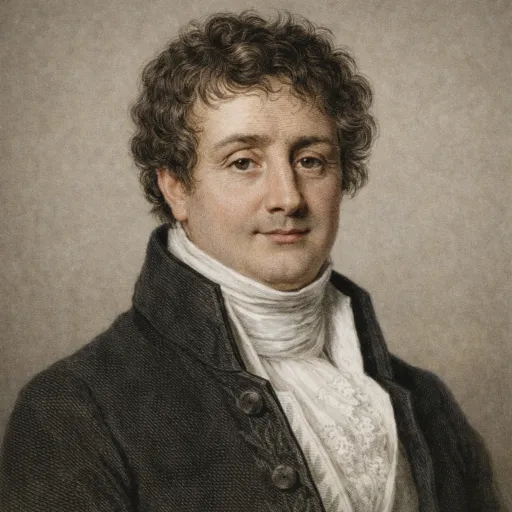
Joseph Fourier portrait

🧐 Did you know?

Joseph Fourier developed an extreme physical and medical obsession with heat during his final years of life after returning from the desert campaigns of Egypt. Convinced that heat was the absolute source of health and that cold caused all human illness, he kept the rooms of his Paris home hermetically sealed and heated to suffocating temperatures, wearing heavy wool coats even in the middle of summer.

🏅 Awards and Honors

Recibió el Premio de Matemáticas del Instituto de Francia (1812) por su teoría de la propagación del calor. Fue miembro de la Academia Francesa de Ciencias y secretario perpetuo de la institución desde 1822.

📚 Their name in science

➤ Transformada de Fourier

Transformación matemática que descompone una señal en sus componentes de frecuencia.

➤ Serie de Fourier

Representación de una función periódica como suma de funciones seno y coseno.

➤ Ley de Fourier

Ley fundamental de la conducción del calor.

❓ Who was Joseph Fourier?

Joseph Fourier was a French mathematician and physicist, chiefly remembered for his investigations into heat propagation and for developing one of the most powerful mathematical tools in engineering. Orphaned at an early age and educated at a military school, he experienced the tumults of the French Revolution firsthand and participated in the Napoleonic campaign in Egypt, where he served as a diplomat and public administrator. He possessed a mind of extraordinary analytical rigor, capable of finding continuous harmonic patterns behind the thermal flows of matter. Fourier did not view physics as qualitative descriptions, but as a set of dynamic flows governed by continuous differential equations.

🌍 The world in their time

In the early 19th century, physics lacked an efficient mathematical method to describe how heat propagated through irregular solids. Mathematicians did not know how to solve complex differential equations that presented physical discontinuities, which limited the design of industrial thermal machinery and the study of Earth’s temperature.

Become a giant

Your path to becoming a giant of knowledge begins with these top free courses
free online regression analysis course
Free mode

Data Science: Linear Regression

free Python statistics course
Free mode

Probability and Statistics in Data Science using Python

free online probability foundations course
Free mode

Fat Chance: Probability from the Ground Up

free online regression analysis course
Free mode

Data Science: Linear Regression

free Python statistics course
Free mode

Probability and Statistics in Data Science using Python

🔬 Scientific legacy

Joseph Fourier revolutionized science by publishing *Théorie analytique de la chaleur* in 1822, where he formulated the law of heat conduction and proved mathematically that any periodic function, no matter how complex or discontinuous, can be decomposed into an infinite sum of simple trigonometric functions (sines and cosines), a method known today as Fourier series. In Earth sciences, he was the first scientist to mathematically describe the atmospheric greenhouse effect in 1824, explaining how the atmosphere retains solar heat to keep the planet habitable.

👣 Footprint in today's world

The legacy of Joseph Fourier forms the abstract mathematical engine of contemporary technology and the digital age. His series and the Fourier transform are the tools used daily across the planet for digital signal processing, the compression of MP3 audio and JPEG image files, the operation of wireless telecommunications (Wi-Fi and 5G), noise cancellation, and magnetic resonance medical imaging.

🏃‍♂️ The relay race

📥 Taking the baton

The monumental analytical breakthroughs of Joseph Fourier built firmly upon the differential calculus of Isaac Newton and Gottfried Leibniz, combined with Joseph-Louis Lagrange’s work on equations and initial thermal laws by Amontons.

📤 Passing the baton

The formulation of Fourier series permanently expanded the boundaries of mathematical analysis, forcing subsequent mathematicians to redefine the formal concept of a function. His discoveries regarding atmospheric heat retention laid the foundational bases for the modern study of climatology and physical models of global climate change.

Other giants you will want to get to know

Alan Turing

Alan Turing

1912

 –

1954
The mathematical genius who laid the foundations of computing and cracked the Enigma code.
Joseph Fourier

Joseph Fourier

1768

 –

1830
The mathematician of heat theory who created the trigonometric series fundamental to the digital age.
John von Neumann

John von Neumann

1903

 –

1957
The brilliant polymath who designed modern computer architecture and founded game theory.
Kurt Gödel

Kurt Gödel

1906

 –

1978
The titan of mathematical logic who shattered absolute certainty by proving the limits of formal proof.
Joseph-Louis Lagrange

Joseph-Louis Lagrange

1736

 –

1813
The master of analytical mechanics who unified physics without geometry and located space equilibrium zones.

Tools

Scientific calculator

Powered by Desmos

Scientific Dictionary

Powered by Wikipedia

2026 Best Online STEM Education Platform

Cargando clima y ubicación...

To learn and experience

Take your knowledge to the next level with science kits and hands-on tools that connect theory with experimentation

Essential for teachers and students

Learn with the best courses