Generic selectors
Exact matches only
Search in title
Search in content
Post Type Selectors

Joseph-Louis Lagrange

Joseph-Louis Lagrange icon
17/07/2026

🗓️

🌱January 25, 1736 – Turin, Italy.
🍂April 10, 1813 – Paris, France.

🌟 Main Contribution

Joseph-Louis Lagrange formulated the Lagrangian equations, key in classical mechanics to describe motion. He also founded variational calculus, applying it to algebra and mathematical physics
“As soon as a mathematical truth is established, it always serves as a starting point for new truth”
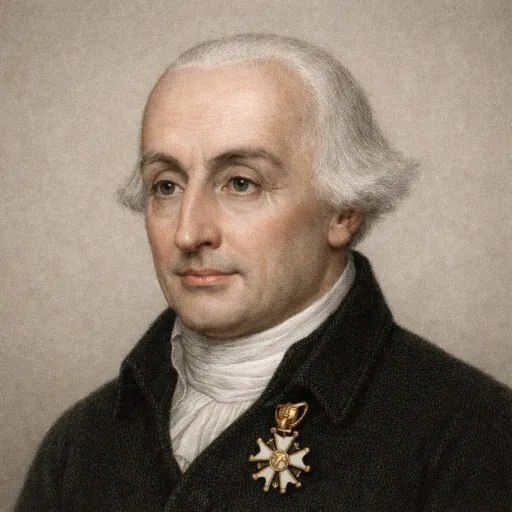
Joseph-Louis Lagrange portrait

🧐 Did you know?

Joseph-Louis Lagrange took such deep methodological pride in the abstract, mathematical nature of his work that he openly boasted in the preface of his *Analytical Mechanics* that not a single diagram, drawing, or rudimentary geometric scheme would be found within its hundreds of pages, defending that the entire physics of motion could be cleanly deduced through pure algebraic analysis without resorting to visual aids.

🏅 Awards and Honors

Recibió el Gran Premio de la Academia de Berlín (1764) y fue miembro de las academias de ciencias de Berlín, París, Turín y Londres. Napoleón lo nombró conde del Imperio y senador.

📚 Their name in science

➤ Multiplicadores de Lagrange

Método para optimizar funciones sujetas a restricciones.

➤ Ecuaciones de Lagrange

Ecuaciones fundamentales de la mecánica lagrangiana.

➤ Puntos de Lagrange

Posiciones de equilibrio gravitatorio en un sistema de dos cuerpos.

➤ Polinomio de Lagrange

Método de interpolación polinómica ampliamente utilizado en análisis numérico.

Ad

❓ Who was Joseph-Louis Lagrange?

Joseph-Louis Lagrange was an Italian-born French mathematician, physicist, and astronomer, who reformulated classical physics by endowing it with a mathematical formalism of extraordinary beauty and precision. Born in Turin and displaying marked mathematical precocity, he directed the Berlin Academy of Sciences before moving to Paris, managing to survive unscathed the tumults of the French Revolution due to his immense intellectual prestige. He possessed a mind of supreme abstract elegance, capable of reducing physical mechanical problems to pure algebraic calculus operations. Lagrange did not view mechanics as a collection of rigid geometric diagrams, but as a map of continuous equations governed by universal variational principles.

🌍 The world in their time

In the late 18th century, the study of classical mechanics depended entirely on complex geometric diagrams and graphic constructions introduced by Newton. Physicists lacked a purely algebraic analytical method allowing them to solve complex solid and fluid dynamics problems in a unified way, which limited the advancement of computational astronomy.

Become a giant

Your path to becoming a giant of knowledge begins with these top free courses
free quantum optomechanics course
Free mode

Cavity Quantum Optomechanics

free orthogonal algebra course
Free mode

Linear Algebra IV: Orthogonality & Symmetric Matrices and the SVD

free determinants algebra course
Free mode

Linear Algebra III: Determinants and Eigenvalues

free quantum optomechanics course
Free mode

Cavity Quantum Optomechanics

free orthogonal algebra course
Free mode

Linear Algebra IV: Orthogonality & Symmetric Matrices and the SVD

🔬 Scientific legacy

Joseph-Louis Lagrange revolutionized physical sciences by publishing his masterpiece *Mécanique analytique* in 1788, where he unified classical mechanics using the calculus of variations and formulated Lagrange’s equations, allowing a physical system’s motion to be described via energy magnitudes independent of bonding forces. In mathematical astronomy, he discovered the three-dimensional gravitational equilibrium points within a two-body orbiting system, known today as “Lagrange points.” In pure mathematics, he made fundamental contributions to equation theory, continued fractions, and the foundation of differential calculus.

👣 Footprint in today's world

The legacy of Joseph-Louis Lagrange forms the indispensable mathematical foundation of contemporary quantum physics, fluid mechanics, and aerospace engineering. Lagrangian equations are the standard tool used today across the planet to formulate quantum mechanics and quantum field theory, while his gravitational equilibrium points (especially L1 and L2) are used daily by space agencies like NASA and the ESA to position advanced space telescopes like the James Webb stably.

🏃‍♂️ The relay race

📥 Taking the baton

The monumental deductive breakthroughs of Joseph-Louis Lagrange built directly upon the infinitesimal calculus of Gottfried Leibniz, the mechanical laws of Isaac Newton, and variational developments conducted by his mentor Leonhard Euler.

📤 Passing the baton

The analytical physical unification achieved by Joseph-Louis Lagrange liberated the discipline from the constraints of classical geometry, serving as a fundamental pillar for William Rowan Hamilton to expand analytical quantum mechanics in the 19th century. His computational methods in astronomy permanently transformed the calculation of planetary perturbations and paved the way for modern theoretical physics.

Other giants you will want to get to know

Daniel Bernoulli

Daniel Bernoulli

1700

 –

1782
The master of hydrodynamics who discovered the principle explaining how airplanes fly and fluids flow.
Galileo Galilei

Galileo Galilei

1564

 –

1642
The father of modern science who aimed his telescope at the heavens and challenged the world defending heliocentrism.
Alan Turing

Alan Turing

1912

 –

1954
The mathematical genius who laid the foundations of computing and cracked the Enigma code.
Henri Cartan

Henri Cartan

1904

 –

2008
The master of algebraic topology who reshaped modern mathematics and structured sheaf theory.
Gaspard-Gustave de Coriolis

Gaspard-Gustave de Coriolis

1792

 –

1843
The mechanical engineering genius who discovered the inertial force governing Earth’s cyclones and currents.

Tools

Scientific calculator

Powered by Desmos

Scientific Dictionary

Powered by Wikipedia

2026 Best Online STEM Education Platform

Cargando clima y ubicación...

To learn and experience

Take your knowledge to the next level with science kits and hands-on tools that connect theory with experimentation

Essential for teachers and students

Learn with the best courses