Generic selectors
Exact matches only
Search in title
Search in content
Post Type Selectors

Georg Cantor

Georg Cantor icon
17/07/2026

🗓️

🌱March 3, 1845 – St. Petersburg, Russia.
🍂January 6, 1918 – Halle, Germany.

🌟 Main Contribution

Georg Cantor created set theory, developed transfinite numbers, and laid the foundation of modern mathematics
“The essence of mathematics lies in the infinite diversity of its sets”
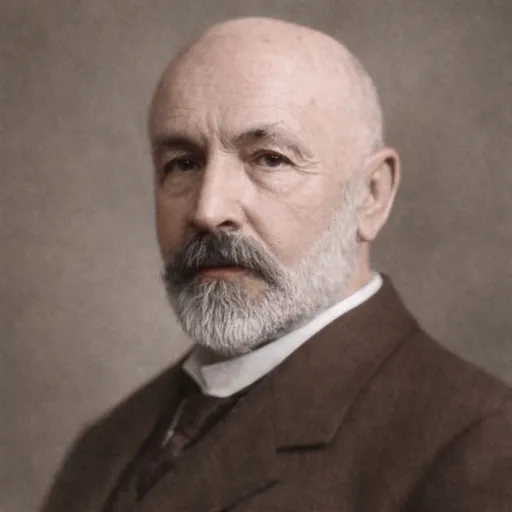
Georg Cantor portrait

🧐 Did you know?

Georg Cantor faced such a destructive and personal academic harassment from established mathematicians like Leopold Kronecker, who went as far as publicly calling him a “corruptor of youth” and a scientific charlatan, that the intellectual isolation severely aggravated his cyclical depression crises, forcing him to seek refuge temporarily in philosophy and theology to defend his infinities’ validity.

🏅 Awards and Honors

Cantor was decorated with the celebrated Sylvester Medal of the Royal Society of London in 1904 for his revolutionary contributions to the development of set theory and pure mathematics.

📚 Their name in science

➤ Cantor’s Set Theory

Fundamental mathematical theory studying the properties and relations of collections of objects, mathematically introducing the concept of infinities of varying magnitudes.

Ad

❓ Who was Georg Cantor?

Georg Cantor was a German mathematician born in Russia whose astonishing conceptual originality redefined the very foundations of mathematical logic. Gifted with a brilliant mind oriented toward the deepest abstraction, he trained in Berlin and spent most of his career as a professor at the University of Halle. Cantor dared to challenge millennia-old philosophical and theological notions regarding the nature of the uncountability, an intellectual daring that brought upon him fierce hostility from his most influential contemporaries. Despite suffering severe nervous breakdowns triggered by academic rejection and spending his final years in sanatoriums, his unwavering dedication to mathematical truth birthed a new scientific era.

🌍 The world in their time

In the late 19th century, mathematics regarded the concept of “infinity” as a vague notion, a sort of unreachable limit or philosophical paradox that could not be measured or broken down into rigorous logical structures, limiting the mathematical analysis of the continuous numerical fabric.

Become a giant

Your path to becoming a giant of knowledge begins with these top free courses
free orthogonal algebra course
Free mode

Linear Algebra IV: Orthogonality & Symmetric Matrices and the SVD

free determinants algebra course
Free mode

Linear Algebra III: Determinants and Eigenvalues

free matrix algebra course
Free mode

Linear Algebra II: Matrix Algebra

free orthogonal algebra course
Free mode

Linear Algebra IV: Orthogonality & Symmetric Matrices and the SVD

free determinants algebra course
Free mode

Linear Algebra III: Determinants and Eigenvalues

🔬 Scientific legacy

Georg Cantor revolutionized mathematics by creating Set Theory, which became the absolute unifying language of all modern mathematics. Through his famous Cantor’s diagonal argument, he mathematically proved that infinity is not unique, but that there exist different “sizes” of infinity (transfinite numbers), proving that the infinity of real numbers is strictly larger than that of integers. He also formulated the Continuum Hypothesis.

👣 Footprint in today's world

The legacy of Georg Cantor forms the structural baseline of contemporary logic, topology, and computer science. His set theory stands as the formal foundation upon which all numerical systems and algebras used in advanced programming algorithm design are built. His genius was recognized universally posthumously, summarized in David Hilbert’s famous phrase: “No one shall expel us from the paradise that Cantor has created for us.”

🏃‍♂️ The relay race

📥 Taking the baton

The monumental analytical breakthroughs of Georg Cantor were initially inspired by the space continuity and trigonometric series studies developed by his colleague Richard Dedekind and by Karl Weierstrass, combined with logical discussions surrounding the paradoxes of the infinite.

📤 Passing the baton

The revolutionary set theory of Georg Cantor forced thinkers of the caliber of Bertrand Russell, Gottlob Frege, and Ernst Zermelo to completely restructure the logical foundations of mathematics to resolve paradoxes derived from his work, opening the way for 20th-century computational theories.

Other giants you will want to get to know

Gottfried Wilhelm Leibniz

Gottfried Wilhelm Leibniz

1646

 –

1716
The universal genius who co-invented infinitesimal calculus and designed the binary system that powers computers.
Henri Poincaré

Henri Poincaré

1854

 –

1912
The last universalist who discovered deterministic chaos and revolutionized topology and celestial mechanics.
Joseph Fourier

Joseph Fourier

1768

 –

1830
The mathematician of heat theory who created the trigonometric series fundamental to the digital age.
Joseph-Louis Lagrange

Joseph-Louis Lagrange

1736

 –

1813
The master of analytical mechanics who unified physics without geometry and located space equilibrium zones.
Andrey Kolmogorov

Andrey Kolmogorov

1903

 –

1987
The mathematical master who brought order and certainty to the laws of probability.

Tools

Scientific calculator

Powered by Desmos

Scientific Dictionary

Powered by Wikipedia

2026 Best Online STEM Education Platform

Cargando clima y ubicación...

To learn and experience

Take your knowledge to the next level with science kits and hands-on tools that connect theory with experimentation

Essential for teachers and students

Learn with the best courses