Generic selectors
Exact matches only
Search in title
Search in content
Post Type Selectors

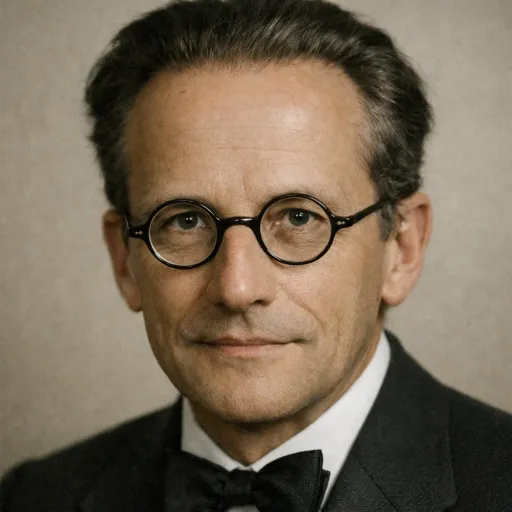
Erwin Schrödinger

Erwin Schrödinger icon
17/07/2026

🗓️

🌱August 12, 1887 – Vienna, Austria.
🍂January 4, 1961 – Vienna, Austria.

🌟 Main Contribution

Erwin Schrödinger developed the wave equation of quantum mechanics, describing particle behavior, and created the famous Schrödinger’s cat thought experiment
“The chief task of physics is to discover the underlying mathematical structure in nature”
Erwin Schrödinger portrait

🧐 Did you know?

Erwin Schrödinger formulated his famous wave equation during a winter vacation in an isolated alpine cabin in Arosa, Switzerland. Seeking absolute concentration away from the world’s noise, the physicist placed wax earplugs in his ears to isolate himself entirely from his surroundings while writing the complex mathematical deductions that changed the history of modern physics.

🏅 Awards and Honors

Schrödinger was awarded the Nobel Prize in Physics in 1933, shared with Paul Dirac, for the discovery of new productive forms of atomic theory through the development of wave mechanics. He also received the Max Planck Medal in 1937.

📚 Their name in science

➤ Schrödinger Equation

Partial differential equation in quantum mechanics describing how the quantum state of a physical system changes over time.

❓ Who was Erwin Schrödinger?

Erwin Schrödinger was an Austrian physicist and theorist who permanently reshaped the foundations of science by developing wave mechanics. Possessing an encyclopedic cultural background, a deeply philosophical mind, and an absolute mastery of mathematical analysis, he trained at the University of Vienna. Schrödinger did not view physics as mere isolated numbers, but as a representation of reality, leading him to hold intense debates with other founders of quantum physics regarding the interpretation of matter. His outright rejection of the Nazi regime forced him to leave his homeland, spending much of his career exiled in Ireland, where he also made pioneering contributions to theoretical biology.

🌍 The world in their time

In the early 1920s, physics faced an unprecedented theoretical crisis. The traditional atomic model could not explain the dual behavior of electrons, which acted simultaneously as particles and waves. Existing quantum theories were extremely complex and abstract, lacking a continuous mathematical equation capable of describing precisely how a quantum system evolved in space and time.

Become a giant

Your path to becoming a giant of knowledge begins with these top free courses
free quantum computing course
Free mode

Introduction to Quantum Computing for Everyone

free quantum molecular course
Free mode

Quantum Mechanics of Molecular Structures

free quantum sci & tech course
Free mode

Introduction to Quantum Science & Technology

free quantum computing course
Free mode

Introduction to Quantum Computing for Everyone

free quantum molecular course
Free mode

Quantum Mechanics of Molecular Structures

🔬 Scientific legacy

Erwin Schrödinger revolutionized science in 1926 by publishing his famous Schrödinger Equation ($ihbarfrac{partial}{partial t}Psi = hat{H}Psi$), the fundamental mathematical formula of quantum mechanics describing the time evolution of a particle’s wave function. This scientific milestone, which earned him the Nobel Prize in 1933, allowed for the precise calculation of atomic energy levels. In popular science, he conceived the Schrödinger’s cat paradox to question mystical interpretations of quantum physics, and authored the influential book *What is Life?*.


👣 Footprint in today's world

The work of Erwin Schrödinger forms the absolute backbone of contemporary quantum physics and computational chemistry. His equation is used daily across the planet for designing semiconductors, microchips, laser technologies, nanotechnology, and developing new pharmaceutical materials, while his biological book directly inspired the discovery of DNA’s structure.

🏃‍♂️ The relay race

📥 Taking the baton

The monumental theoretical concepts of Erwin Schrödinger built directly upon the brilliant wave-particle duality hypothesis raised by Louis de Broglie, combined with the statistical mechanics formulations of Ludwig Boltzmann and Albert Einstein’s theory of relativity.

📤 Passing the baton

The wave mechanics of Erwin Schrödinger unified competing quantum theories, proving that his mathematical approach was equivalent to the matrix mechanics developed by Werner Heisenberg. His legacy directly inspired Max Born’s work on the probabilistic interpretation of the wave function and guided the advancement of modern subatomic physics.

Other giants you will want to get to know

Niels Henrik David Bohr

Niels Henrik David Bohr

1885

 –

1962
The philosopher of the quantum atom who designed orbital energy levels and established complementarity.
Enrico Fermi

Enrico Fermi

1901

 –

1954
The architect of the nuclear age who achieved the first controlled chain reaction and mastered both theoretical and experimental physics.
John von Neumann

John von Neumann

1903

 –

1957
The brilliant polymath who designed modern computer architecture and founded game theory.
Werner Karl Heisenberg

Werner Karl Heisenberg

1901

 –

1976
The philosopher of quantum uncertainty who dismantled mechanical determinism through matrix algebra.
Albert Einstein

Albert Einstein

1879

 –

1955
The revolutionary physicist who transformed our understanding of space, time, and gravity.

Tools

Scientific calculator

Powered by Desmos

Scientific Dictionary

Powered by Wikipedia

2026 Best Online STEM Education Platform

Cargando clima y ubicación...

To learn and experience

Take your knowledge to the next level with science kits and hands-on tools that connect theory with experimentation

Essential for teachers and students

Learn with the best courses