Generic selectors
Exact matches only
Search in title
Search in content
Post Type Selectors

John von Neumann

John von Neumann icon
17/07/2026

🗓️

🌱December 28, 1903 – Budapest, Hungary.
🍂February 8, 1957 – Washington D.C., United States.

🌟 Main Contribution

John von Neumann developed the modern computer architecture, contributed to game theory, quantum mechanics, and statistics, transforming mathematics and computer science
“Truth is, at best, a hypothesis”
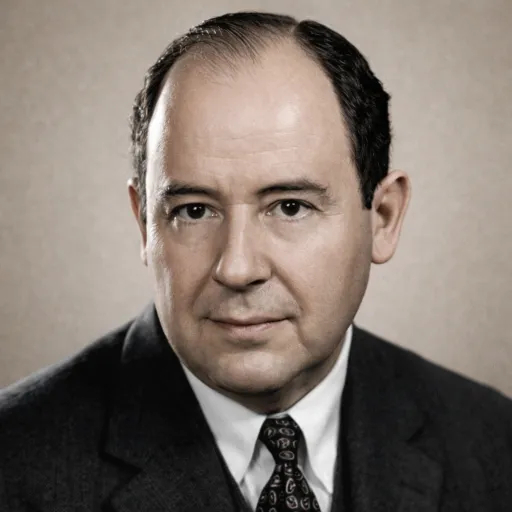
John von Neumann portrait

🧐 Did you know?

John von Neumann possessed a prodigious photographic memory that allowed him to recite from heart entire pages of books he had read years prior and translate classical ancient Greek texts instantaneously. He thoroughly enjoyed working in noisy and festive environments; he frequently drafted his complex mathematical theorems concerning computer science in his living room while keeping the television on at full volume and his family hosted social cocktail parties around him.

🏅 Awards and Honors

Recibió la Medal for Merit (1947), el Premio Enrico Fermi (1956) y fue miembro de la National Academy of Sciences, la American Academy of Arts and Sciences y la Royal Society (miembro extranjero).

📚 Their name in science

➤ Arquitectura de von Neumann

Modelo de diseño de ordenadores en el que programas y datos comparten la misma memoria.

➤ Álgebra de von Neumann

Estructura algebraica de operadores utilizada en mecánica cuántica y análisis funcional.

➤ Entropía de von Neumann

Medida de la información cuántica asociada a un estado cuántico.

❓ Who was John von Neumann?

John von Neumann was a Hungarian-born American mathematician, whose prodigious intellectual capabilities revolutionized fields ranging from quantum physics to economics and computer science. Educated at the universities of Budapest and Berlin, he possessed a mind with superhuman mental calculation speed and an analytical clarity that astonished his contemporaries. Von Neumann did not view mathematics as an isolated abstract discipline, but as the operative language capable of modeling and solving the structural problems of civilization. His participation in major government and military projects during World War II made him a key figure of the modern technological era.

🌍 The world in their time

In the early 1940s, computing was in an embryonic phase based on rigid electromechanical machines. Each computer was built to perform a single specific mathematical task and required the physical reconnection of thousands of manual cables to alter its programming, which prevented the development of fast and universal data processing systems.

Become a giant

Your path to becoming a giant of knowledge begins with these top free courses
free quantum computing course
Free mode

Introduction to Quantum Computing for Everyone

free quantum molecular course
Free mode

Quantum Mechanics of Molecular Structures

free quantum sci & tech course
Free mode

Introduction to Quantum Science & Technology

free quantum computing course
Free mode

Introduction to Quantum Computing for Everyone

free quantum molecular course
Free mode

Quantum Mechanics of Molecular Structures

🔬 Scientific legacy

John von Neumann revolutionized technology by designing the “Von Neumann architecture” in 1945, introducing the fundamental concept of storing programs and data within the machine’s same internal memory, which enabled the birth of the modern programmable computer. In mathematics and economics, he founded game theory by publishing *Theory of Games and Economic Behavior* alongside Oskar Morgenstern in 1944. In physics, he provided the first rigorous mathematical foundation of quantum mechanics using linear operators. Furthermore, he participated in the mathematical design of the Manhattan Project and developed autonomous cellular automata.

👣 Footprint in today's world

The legacy of John von Neumann forms the computing infrastructure and analytical framework of the contemporary world. All personal computers, mobile phones, high-performance supercomputers, and modern artificial intelligence systems continue to use the memory, control, and processing unit structure he designed. His game theory models regulate the economic strategies of current multinationals and international geopolitics analyses.

🏃‍♂️ The relay race

📥 Taking the baton

The monumental, multifaceted breakthroughs of John von Neumann built upon the mathematical logic of David Hilbert, the theoretical computing concepts of Alan Turing, and the quantum developments of Werner Heisenberg and Max Born.

📤 Passing the baton

The computational architecture of John von Neumann enabled the transition into the information age, allowing subsequent engineers to develop silicon microchips and modern software. His economic theories permanently transformed the analysis of financial markets and laid the foundations for the mathematical study of complex systems and cybernetics.

Other giants you will want to get to know

Johannes Kepler

Johannes Kepler

1571

 –

1630
The mathematical astronomer who shattered celestial geometric perfection by discovering the elliptical orbits of planets.
Joseph Fourier

Joseph Fourier

1768

 –

1830
The mathematician of heat theory who created the trigonometric series fundamental to the digital age.
Pierre-Simon Laplace

Pierre-Simon Laplace

1749

 –

1827
The French Newton of celestial mechanics who systematized probability and banished mystical hypotheses.
Henri Poincaré

Henri Poincaré

1854

 –

1912
The last universalist who discovered deterministic chaos and revolutionized topology and celestial mechanics.
Henri Cartan

Henri Cartan

1904

 –

2008
The master of algebraic topology who reshaped modern mathematics and structured sheaf theory.

Tools

Scientific calculator

Powered by Desmos

Scientific Dictionary

Powered by Wikipedia

2026 Best Online STEM Education Platform

Cargando clima y ubicación...

To learn and experience

Take your knowledge to the next level with science kits and hands-on tools that connect theory with experimentation

Essential for teachers and students

Learn with the best courses