Generic selectors
Exact matches only
Search in title
Search in content
Post Type Selectors

Wolfgang Pauli

Wolfgang Pauli icon
17/07/2026

🗓️

🌱April 25, 1900 – Vienna, Austria.
🍂December 15, 1958 – Zürich, Switzerland.

🌟 Main Contribution

Wolfgang Pauli stated the Pauli exclusion principle, essential to explain the electronic structure of atoms and the behavior of matter
“God made the world so subtle that we describe it with mathematics, but not so subtle that we cannot understand it”
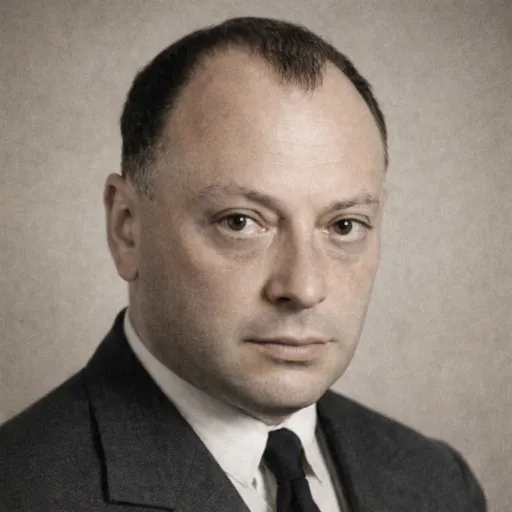
Wolfgang Pauli portrait

🧐 Did you know?

Wolfgang Pauli possessed such an overwhelming personality and abstract analytical genius that his experimental colleagues joked about the existence of the “”Pauli Effect,”” a supposed real parapsychological phenomenon whereby any delicate laboratory equipment or apparatus broke down, exploded, or ceased to function mysteriously by the mere fact of Pauli entering the room or stepping off a train in the city station. He despised the lack of analytical rigor in his contemporaries’ scientific papers so much that he coined the celebrated devastating phrase: “”That is not only not right, it is not even wrong!””, sweeping away vague arguments with relentless theoretical lucidity.

🏅 Awards and Honors

Recibió el Premio Nobel de Física (1945), la Medalla Lorentz (1931) y la Medalla Max Planck (1958). Fue miembro de la Royal Society.

📚 Their name in science

➤ Principio de exclusión de Pauli

Principio que establece que dos fermiones idénticos no pueden ocupar simultáneamente el mismo estado cuántico.

➤ Matrices de Pauli

Conjunto de matrices fundamentales en mecánica cuántica.

➤ Efecto Pauli

Consecuencias físicas derivadas del principio de exclusión.

❓ Who was Wolfgang Pauli?

Wolfgang Pauli was an Austrian theoretical physicist, later an American and Swiss citizen, universally recognized as one of the intellectual giants of 20th-century quantum physics for formulating the exclusion principle explaining matter’s atomic structure. Educated at the University of Munich under Arnold Sommerfeld and a celebrated professor at ETH Zürich, he possessed a mind endowed with fierce analytical rigor, legendary caustic wit, and incorruptible intellectual honesty, earning the nickname “”the whip of God”” of physics for his devastating critiques of imprecise theories. Pauli did not view theoretical physics as vague approximations, but as pure mathematical truths subject to absolute quantum symmetry laws.

🌍 The world in their time

In the early 1920s, quantum physics was incapable of analytically explaining why all electrons in an atom did not collapse into the lowest, innermost energy level, or what law governed the periodic distribution of chemical elements in the periodic table of stable matter.

Become a giant

Your path to becoming a giant of knowledge begins with these top free courses
free quantum computing course
Free mode

Introduction to Quantum Computing for Everyone

free quantum molecular course
Free mode

Quantum Mechanics of Molecular Structures

free quantum sci & tech course
Free mode

Introduction to Quantum Science & Technology

free quantum computing course
Free mode

Introduction to Quantum Computing for Everyone

free quantum molecular course
Free mode

Quantum Mechanics of Molecular Structures

🔬 Scientific legacy

Wolfgang Pauli revolutionized science by formulating the Pauli Exclusion Principle in 1925, proving mathematically that two electrons (and generally any two identical fermions) within the same quantum system cannot simultaneously occupy the same quantum state, introducing a fourth quantum number representing the particle’s intrinsic angular momentum, termed electronic “”spin.”” This fundamental milestone, indispensable for understanding the molecular stability of the universe, earned him the Nobel Prize in Physics in 1945. In 1930, to save the law of conservation of energy in beta decay, he brilliantly and boldly proposed the existence of a new neutral, invisible, and incredibly light particle that Enrico Fermi would later name the “”neutrino.”” In quantum mathematics, he introduced the famous Pauli matrices to describe electron spin.

👣 Footprint in today's world

The legacy of Wolfgang Pauli forms the conceptual and analytical infrastructure of contemporary nuclear physics, stellar astrophysics, quantum chemistry, and semiconductor materials science. His fundamental exclusion principle today regulates the theoretical understanding of electron behavior in current computer silicon chips, the physical design of lattice superconducting materials, industrial spectroscopic analysis, and astrophysical models that cosmologists utilize to calculate the collapse limit of white dwarf and neutron stars in the deep universe.

🏃‍♂️ The relay race

📥 Taking the baton

The monumental theoretical breakthroughs of Wolfgang Pauli built directly upon Niels Bohr’s quantum atomic model, combined with Albert Einstein’s special relativity analytical laws and Arnold Sommerfeld’s orbital spectroscopic developments.

📤 Passing the baton

The introduction of the exclusion principle and the quantum notion of spin achieved by Wolfgang Pauli unified atomic theory with the mathematical structure of fermionic fields, serving as a fundamental pillar for the subsequent development of the 20th-century standard model of elementary particles. His bold theoretical prediction of the neutrino opened a new analytical field in modern observational astrophysics and weak interaction physics, permanently transforming our understanding of the fundamental symmetries governing the cosmos’s intimate mass.

Other giants you will want to get to know

Werner Karl Heisenberg

Werner Karl Heisenberg

1901

 –

1976
The philosopher of quantum uncertainty who dismantled mechanical determinism through matrix algebra.
Dmitri Skobeltsyn

Dmitri Skobeltsyn

1892

 –

1990
The particle physics pioneer who glimpsed antimatter and cosmic rays in cloud chambers.

Paul Dirac

Paul Dirac

1902

 –

1984
The mystic of the relativistic quantum equation who predicted the existence of antimatter through mathematical beauty.
Erwin Schrödinger

Erwin Schrödinger

1887

 –

1961
The philosopher of physics who formulated the quantum wave equation and raised the famous cat paradox.
Niels Henrik David Bohr

Niels Henrik David Bohr

1885

 –

1962
The philosopher of the quantum atom who designed orbital energy levels and established complementarity.

Tools

Scientific calculator

Powered by Desmos

Scientific Dictionary

Powered by Wikipedia

2026 Best Online STEM Education Platform

Cargando clima y ubicación...

To learn and experience

Take your knowledge to the next level with science kits and hands-on tools that connect theory with experimentation

Essential for teachers and students

Learn with the best courses