
Generic selectors
Exact matches only
Search in title
Search in content
Post Type Selectors

Earth’s atmosphere. Atmospheric model

13/03/2026

The online simulations of the Earth’s atmosphere on this page will help you to better understand what the Earth’s atmosphere is like. We will discover its composition and structure, what an atmospheric model is and how it can be used to better understand how the Earth’s atmosphere works.

What is the terrestrial atmosphere

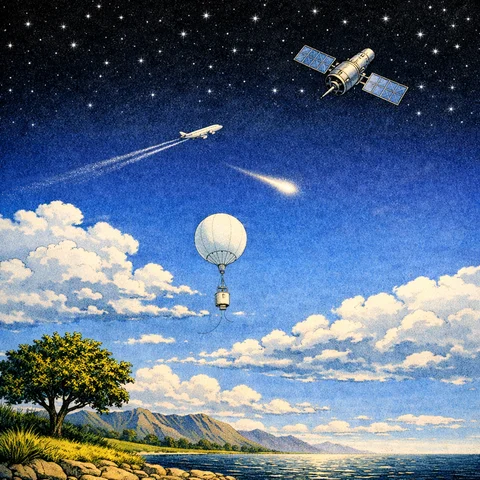
The Earth’s atmosphere is the gaseous layer surrounding the Earth. This gaseous layer is essential for life on Earth because, in addition to containing the gases necessary for life, it protects the planet’s surface from harmful solar radiation and regulates the temperature at the surface.

Composition of the terrestrial atmosphere

The Earth’s atmosphere is composed mainly of nitrogen (78%), oxygen (21%), and other gases, such as argon, carbon dioxide and water vapor.

Structure of the terrestrial atmosphere

The structure of the Earth’s atmosphere is made up of several layers, each with unique characteristics and properties.

Troposphere

The layer closest to the surface is the troposphere, which reaches up to about 10 km in altitude. It is where most meteorological phenomena occur.

Stratosphere

This is followed by the stratosphere, which reaches up to about 50 km altitude. Within the stratosphere is the ozone layer, which protects the Earth from excess ultraviolet radiation.

Mesosphere

Next comes the mesosphere, which reaches up to 90 km altitude. The next layer is the thermosphere, which reaches up to 400 km. It is characterized by a composition formed by ionized gases.

Exosphere

The last layer is the exosphere, which reaches up to 580 km, at which point outer space is reached.

Atmospheric model

An atmospheric model is a mathematical and computational representation that allows the processes and behaviors of the atmosphere to be simulated. Atmospheric models use equations based on physics, chemistry and gas dynamics to predict variables such as temperature, pressure, humidity and the movement of air masses at different altitudes and regions of the planet. By incorporating observed data and applying physical laws, atmospheric models help to understand and anticipate phenomena such as weather, the formation of atmospheric fronts, storms or abrupt changes in meteorological conditions.

Importance of the terrestrial atmosphere

The study of the Earth’s atmosphere is crucial to understanding climate and meteorology. Scientists use very sophisticated simulation models and observations to understand how the atmosphere works.

The online simulations of the Earth’s atmosphere on this page are a good model of the behavior of the Earth’s atmosphere, very useful to understand it better. Try them, they will help you for sure!

Explore the exciting STEM world with our free, online, simulations and accompanying companion courses! With them you’ll be able to experience and learn hands-on. Take this opportunity to immerse yourself in virtual experiences while advancing your education – awaken your scientific curiosity and discover all that the STEM world has to offer!

Simulations of the Earth's atmosphere

Atmospheric model. Pressure and temperature


This simulation shows a simplified atmospheric model of the variation of pressure and temperature of the atmosphere with altitude.

Atmospheric front


This 3D image allows us to see different parts of an atmospheric front. Rotate the image and observe the situation of the atmosphere on either side of the front.


To learn and experience

Take your knowledge to the next level with science kits and hands-on tools that connect theory with experimentation

“If I have seen further, it is by standing on the shoulders of giants”

Isaac Newton

Your path to becoming a giant of knowledge begins with these top free courses

Test your knowledge

he atmosphere is the layer of gases surrounding Earth, acting as a protective, regulatory, and life‑supporting system. It is composed mainly of nitrogen and oxygen, with smaller amounts of argon, carbon dioxide, and water vapor. Its importance lies in its ability to regulate temperature, shield the surface from harmful solar radiation, enable weather and climate, burn up incoming meteoroids, support the water cycle, and provide the gases necessary for biological processes. Without the atmosphere, Earth would experience extreme temperature swings, lack liquid water stability, and be exposed to intense radiation and high‑energy particles from space. It is the environmental buffer that makes the planet habitable.
The atmosphere is divided into distinct layers, each with unique physical properties and roles: – Troposphere: The lowest layer, where weather occurs and where most of the atmospheric mass is concentrated. – Stratosphere: Contains the ozone layer, which absorbs harmful ultraviolet radiation. – Mesosphere: Burns up most meteoroids due to friction with its thin but active gases. – Thermosphere: Includes the ionosphere, where high‑energy radiation is absorbed and auroras occur. – Exosphere: The outermost layer, gradually transitioning into space. Together, these layers protect life, regulate energy flow, and support the physical and chemical processes that shape Earth’s climate and environment.
The atmosphere stays bound to Earth because of gravity. Even though gases naturally spread out, Earth’s gravitational pull is strong enough to keep most atmospheric molecules from escaping into space. Lighter particles can slowly drift away over long timescales, but the vast majority remain trapped. Without gravity, Earth would be completely airless.
Not necessarily. What warms the air is not proximity to the Sun but how much radiation the air absorbs and how dense the air is. In the troposphere, the ground absorbs sunlight and warms the air from below. As you go higher, the air becomes thinner and holds less heat, so temperatures drop. In the thermosphere, temperatures rise again because the few molecules present absorb high‑energy radiation, but since there are so few of them, it doesn’t feel warm in a human sense. Temperature and “felt heat” are not the same in these extreme conditions.
The Sun provides the energy, but the atmosphere is what distributes, regulates, and moderates that energy. Without an atmosphere, there would be no winds, no clouds, no humidity, and no natural greenhouse effect to keep temperatures within a habitable range. Day‑night temperature differences would be extreme, and seasonal patterns would be far more violent or nonexistent. The atmosphere is the engine that makes climate possible, not just a passive layer of air.

You may also be interested

Cargando clima y ubicación...

You may also be interested