Resonance in RLC Circuits
The online RLC circuit resonance simulations on this page allow you to observe how RLC circuits behave as the frequency of the alternating signal approaches, reaches, and moves away from the resonance frequency. Through various series and parallel configurations, you can see how the inductor and capacitor exchange energy, how the resistor determines the selectivity, and how well-defined peaks or troughs appear in the circuit’s response. These simulations provide a visual and direct demonstration of why resonance is a key phenomenon for tuning, filtering, and the precise selection of AC signals.
This Thematic Unit is part of our Circuits collection

STEM OnLine mini dictionary
Current Decay
Dynamic process in which the current decreases exponentially as the inductor releases stored energy.
Current Growth
Dynamic process in which the current increases exponentially from zero to the maximum value set by the resistance.
Inductor
Passive component that stores energy in the form of a magnetic field when an electrical current flows through it.
Magnetic Energy
Energy accumulated within the magnetic field generated by the inductor during the passage of electric current.
Parallel Inductors
Configuration where inductor terminals are connected to common points, decreasing the total equivalent inductance of the circuit.
RL Circuit
Electrical configuration consisting of a resistor and an inductor in which the current evolves gradually due to the coil’s opposition to sudden changes in flow.
Series Inductors
Configuration where coils are connected one after another, directly adding their values to obtain a higher equivalent inductance.
Steady State
Final equilibrium state where the current stabilizes and the inductor ideally behaves as a short circuit.
Time Constant
Temporal parameter calculated as the ratio of inductance to resistance that defines how quickly the current responds to circuit variations.
Transient Phase
Period of time in which the circuit’s current and voltages evolve along an exponential curve before stabilizing.
What is resonance in RLC circuits
Resonance in an RLC circuit is the state in which the inductor and capacitor are exactly balanced, so that their opposing effects on the current cancel each other out. The inductor tends to lag the current, and the capacitor tends to lead it, but at a very specific point, these two effects cancel each other out, and the circuit ceases to behave as inductive or capacitive. At that moment, the total reactance is zero, and only the resistance remains to oppose the flow of current.
This balance does not occur arbitrarily, but only when the AC signal oscillates at a precise frequency called the resonance frequency. Resonance is one of the most characteristic and useful behaviors of alternating current circuits because it allows for signal selection, amplification of responses within a narrow band, and the rejection of unwanted frequencies. From this point on, frequency ceases to be merely a parameter of the source and becomes the variable that determines whether the circuit responds with gain, rejection, or indifference.
Resonance frequency
The resonance frequency is the specific frequency at which an RLC circuit reaches equilibrium between the effects of the capacitor and the inductor. When the alternating signal oscillates at exactly that frequency, the inductive reactance and the capacitive reactance are equal in magnitude and cancel each other out. The circuit ceases to behave as if it were inductive or capacitive and begins to respond solely based on its resistance.
In a series RLC circuit, this condition causes the current to reach its maximum possible value for the components used, since the total opposition to the flow of current is reduced to a minimum. In a parallel RLC circuit, the opposite occurs, and the current drawn from the source becomes minimal because the internal currents between the inductor and the capacitor cancel each other out, and hardly any current flows from the generator. In both cases, the phenomenon is the same: energy oscillates between the inductor and the capacitor naturally and without reactive losses, as if the circuit were entering a natural oscillation mode.
The resonance frequency does not depend on the signal amplitude, but rather on the values of L and C. It is a natural property of the circuit, just like the natural frequency of a vibrating mechanical system. At this frequency, the circuit’s behavior changes, shifting from predominantly capacitive to predominantly inductive, which allows us to clearly identify the resonance point and analyze how the response evolves as the frequency deviates from that value.
Resonance frequency in a series RLC circuit
In a series RLC circuit, the resonance frequency is the point at which the inductive reactance and the capacitive reactance are equal in magnitude and cancel each other out. When this occurs, the total opposition to the flow of current is reduced to the resistance alone, causing the current to reach its maximum possible value for the components used.
At frequencies below the resonance frequency, the circuit behaves as if the capacitor were dominant, and the current leads the voltage. At frequencies above the resonance frequency, the inductor dominates, and the current lags the voltage. Resonance marks the exact moment when the circuit ceases to be capacitive or inductive and begins to respond in a purely resistive manner. This behavior is reflected in a very distinct current peak when the frequency is swept.
This resonance point does not occur arbitrarily but is determined by the values of the inductor and the capacitor. Mathematically, the resonance frequency is:
ω = 1 / √L·C
where
ω is the angular resonance frequency
L is the inductance of the inductor (in henries)
C is the capacitance of the capacitor (in farads)
From this, the frequency in hertz is obtained as
f = 1 / (2 π √L·C)
These expressions show that resonance depends solely on L and C. If either of these values increases, the resonance frequency decreases; if they decrease, the resonance shifts toward higher frequencies.
Resonance frequency in a parallel RLC circuit
In a parallel RLC circuit, resonance also occurs when the inductive and capacitive reactances are equal, but the observable effect is different from that of a series circuit. In this case, the current flowing from the source reaches a minimum because the internal currents flowing between the coil and the capacitor almost completely cancel each other out.
At low frequencies, the circuit behaves capacitively and draws more current from the source. At high frequencies, it becomes inductive, and the current drawn also increases. Only at the resonance frequency does the balance occur that reduces the external current to a minimum. This phenomenon makes the parallel RLC circuit a highly effective notch filter, capable of blocking a specific frequency while allowing the rest to pass.
As with the series circuit, this resonance point does not occur arbitrarily but is determined by the values of the inductor and the capacitor. Mathematically, the resonance frequency is:
ω = 1 / √L·C
where
ω is the angular resonance frequency
L is the inductance of the inductor (in henries)
C is the capacitance of the capacitor (in farads)
From this, the frequency in hertz is obtained as
f = 1 / (2 π √L·C)
These expressions show that resonance depends solely on L and C. If either of these values increases, the resonance frequency decreases; if they decrease, the resonance shifts toward higher frequencies.
Selectivity and Q-factor
The selectivity of an RLC circuit describes its ability to respond with significant amplitude only to a narrow range of frequencies and to attenuate the rest. This property depends directly on how losses are distributed throughout the circuit and on how much energy the combination of the inductor and capacitor is capable of storing and returning. When the resistance is low, energy oscillates between L and C for a longer time, and the response is concentrated in a very narrow band around the resonant frequency. When the resistance is higher, the oscillations dampen quickly, and the response broadens.
The Q-factor is the quantitative measure of this selectivity. A high Q-factor indicates a narrow, pronounced resonance peak, meaning that the circuit precisely discriminates between nearby frequencies. A low Q-factor produces a broader, less defined curve, with a reduced ability to select a specific frequency. The Q-factor also determines the circuit’s bandwidth and the rate at which the phase changes as it passes through resonance, making Q an essential parameter for understanding the response of any RLC circuit.
Amplitude versus Frequency curve
The amplitude-versus-frequency curve shows how an RLC circuit responds when an alternating signal spans a wide range of frequencies. Around the resonance frequency, a very distinct peak appears in series circuits and a very pronounced trough appears in parallel circuits. The shape of this curve depends on the resistance, which determines how much the oscillations between the inductor and the capacitor are damped. A small resistance produces a narrow, pronounced peak, while a larger resistance results in a broader, less selective curve. This representation is essential for visualizing at a glance the circuit’s ability to discriminate between frequencies and for accurately identifying resonance.
Bandwidth and its relationship to Q
Bandwidth is the range of frequencies within which the circuit’s amplitude remains at a significant level around the resonance frequency. In a series circuit, it is measured between the points where the current drops to a specific value below the maximum, while in a parallel circuit, it is measured between the points where the current rises from the minimum. The Q factor directly relates the resonance frequency to this bandwidth and indicates how selective the circuit is. A high Q value implies a narrow bandwidth and a very precise response, while a low Q value indicates a broader and less selective response. This relationship allows us to quantify selectivity and compare different RLC circuits objectively.
Applications of resonance
Resonance transforms RLC circuits into tools capable of selecting, amplifying, or rejecting signals based on their frequency. When a circuit operates near its resonance frequency, its response becomes particularly sensitive, allowing it to precisely distinguish between signals that are very close to one another. This property is essential in radio systems, communications, filtering, and any application where it is necessary to isolate a specific frequency within a broader range.
In a series RLC circuit, resonance allows for a high current at a specific frequency, which is used to tune in to desired signals and amplify their presence within the circuit. In a parallel RLC circuit, resonance is used to block a specific frequency and allow the rest to pass, acting as a highly effective rejection filter. In both cases, the ability to alternately store energy between the coil and the capacitor makes resonance a key phenomenon in the design of selective, high-precision systems.
Tuning and selective filtering
Resonance allows an RLC circuit to respond strongly only to a specific frequency, making it a fundamental element of tuning. In a radio receiver, for example, the RLC circuit is tuned so that its resonance frequency matches the frequency of the desired station. When this occurs, the circuit amplifies that signal and attenuates all others, acting as an extremely selective filter. This same principle is used in communications systems, instrumentation, and precision electronics, where it is necessary to isolate a specific frequency within a broad spectrum of signals. An RLC circuit’s ability to discriminate between frequencies depends directly on its Q factor and associated bandwidth.
Practical examples of RLC circuits
RLC circuits are found in a wide variety of real-world applications where selectivity and frequency response are essential. In audio filters, they are used to boost or attenuate specific frequency bands, allowing for precise sound shaping. In electronic oscillators, they are part of the system that determines the output frequency, utilizing resonance to generate stable signals. In power systems, they are used to compensate for reactance and improve the power factor, adjusting the system’s response to the grid frequency. They are also found in sensors, antennas, spectrum analyzers, and any device that requires working with AC signals in a controlled manner. In all these cases, resonance is the mechanism that enables precise and predictable behavior.


STEM OnLine mini dictionary
Current Decay
Dynamic process in which the current decreases exponentially as the inductor releases stored energy.
Current Growth
Dynamic process in which the current increases exponentially from zero to the maximum value set by the resistance.
Inductor
Passive component that stores energy in the form of a magnetic field when an electrical current flows through it.
Magnetic Energy
Energy accumulated within the magnetic field generated by the inductor during the passage of electric current.
Parallel Inductors
Configuration where inductor terminals are connected to common points, decreasing the total equivalent inductance of the circuit.
RL Circuit
Electrical configuration consisting of a resistor and an inductor in which the current evolves gradually due to the coil’s opposition to sudden changes in flow.
Series Inductors
Configuration where coils are connected one after another, directly adding their values to obtain a higher equivalent inductance.
Steady State
Final equilibrium state where the current stabilizes and the inductor ideally behaves as a short circuit.
Time Constant
Temporal parameter calculated as the ratio of inductance to resistance that defines how quickly the current responds to circuit variations.
Transient Phase
Period of time in which the circuit’s current and voltages evolve along an exponential curve before stabilizing.
Explore the exciting STEM world with our free, online, simulations and accompanying companion courses! With them you’ll be able to experience and learn hands-on. Take this opportunity to immerse yourself in virtual experiences while advancing your education – awaken your scientific curiosity and discover all that the STEM world has to offer!
Resonance simulations in RLC circuits
Series RLC circuit
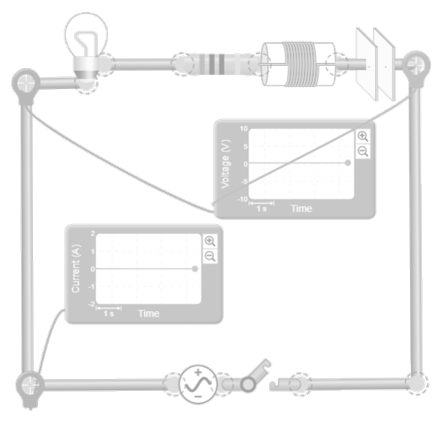
This simulation features a series RLC circuit with a resistor, an inductor, a capacitor, and a light bulb connected to the same branch. The light bulb serves as a visual indicator of the current, while the in-series ammeter and the voltmeter connected to the power source allow you to accurately track how the electrical quantities vary as the frequency changes.
Start by selecting any frequency and observe the brightness of the light bulb and the ammeter reading. At low frequencies, the circuit behaves capacitively and the current is small; the light bulb barely glows. If you increase the frequency, you’ll see that the brightness changes slowly until, at a very specific point, the light bulb glows much more brightly. That point corresponds to the resonance frequency, where the inductive and capacitive reactances balance each other out and the current reaches its maximum value.
Parallel RLC circuit
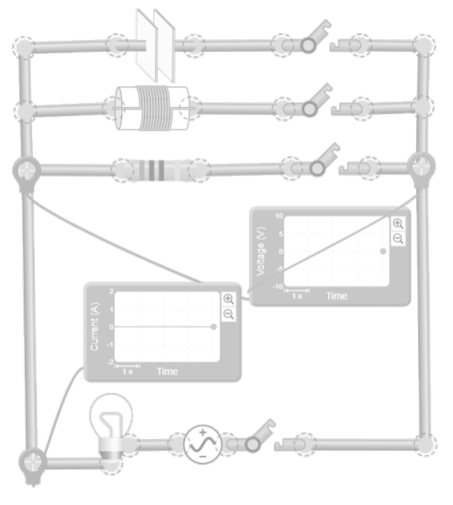
This simulation shows a parallel RLC circuit powered by an AC source. The resistor, inductor, and capacitor are connected in separate branches, and a light bulb is placed in the main branch along with an ammeter. The light bulb acts as a visual indicator of the total current that the source must supply: the more current flowing through the main branch, the brighter it will glow. The voltmeters allow you to monitor the voltage common to all branches.


Start by selecting any frequency and observe the brightness of the light bulb. At low frequencies, the capacitor dominates and the source must supply a significant current, so the light bulb shines brightly. If you increase the frequency, you will see that the brightness changes slowly until, at a very specific point, the light bulb dims noticeably. That point corresponds to the resonance frequency of the parallel circuit: the internal currents of the coil and the capacitor almost completely cancel each other out, and the power source barely has to supply any current. The light bulb thus becomes a visual indicator of the minimum current—exactly the opposite of what happens in a series circuit.
Giants of science
“If I have seen further, it is by standing on the shoulders of giants”
Isaac Newton
James Clerk Maxwell
–
André-Marie Ampère
–
Become a giant
Principles of Modeling, Simulations, and Control for Electric Energy Systems
Principles of Electric Circuits | 电路原理
Electrotechnique I
Electromagnetic Compatibility Essentials
Professional development for Educators
Get started with your Raspberry Pi computer
HP AI Teacher Academy
Teach kids computing: Computing systems and networks
How to Learn Online
Giants of science
“If I have seen further, it is by standing on the shoulders of giants”
Isaac Newton
Michael Faraday
–
André-Marie Ampère
–
Become a giant
Principles of Modeling, Simulations, and Control for Electric Energy Systems
Principles of Electric Circuits | 电路原理
Electrotechnique I
Electromagnetic Compatibility Essentials
Professional development for Educators
STEM Outside
Innovating Instruction: Learning Design in the STEM Classroom
Support kids’ projects: Web development
Teaching Computational Thinking
Test your knowledge
What is resonance in an RLC circuit and why is it such an important phenomenon in AC systems?
What determines the resonant frequency and how does the circuit’s behavior change around that point?
Why does a series RLC circuit show such a sharp current peak at the resonant frequency?
Why does a parallel RLC circuit act as a notch filter at the resonant frequency?
How can I interpret the resonance curve and understand the selectivity of an RLC circuit?
You may also be interested
Last simulations
To learn and experience
Take your knowledge to the next level with science kits and hands-on tools that connect theory with experimentation
Calculadora científica

Essential for teachers and students
Notion
Organize your notes, tasks, and projects in one place. Notion combines notes, lists, and calendars in one flexible space.
Canva
Design presentations, diagrams, and infographics with easy-to-use templates and professional results
Genially
Create interactive content, presentations, and educational games in a simple and visual way
Desmos
The most intuitive graphing calculator to explore mathematics and create dynamic classroom activities
Tinkercad
Design in 3D and simulate electronic circuits for free; it’s the perfect tool for simple robotics projects
Your Infinite Library
Enjoy the freedom to explore millions of titles and a curated selection of magazines on any device
Join Prime for students and young adults
The best series. Millions of songs. All included with your subscription.
Science made fun
Learn with the best courses
40% off!
Coursera
Courses from leading universities and companies. Learn practical skills and earn professional certifications
edX
Online courses from leading universities and companies. Learn practical skills and earn professional certifications
Udemy
Thousands of online courses tailored to your level. Learn at your own pace with expert instructors