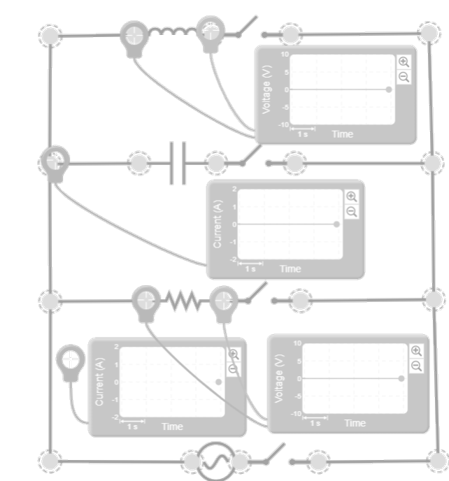
Reactance and impedance in AC circuits
This constant variation makes frequency the variable that controls how an AC circuit actually responds. Not all components can keep up with these changes equally well. A resistor always behaves the same way, because its resistance to current flow does not depend on the signal’s frequency. In contrast, a capacitor and an inductor do react differently when the signal oscillates faster or slower, because they store energy in an electric or magnetic field and need time to charge or discharge. When the frequency is low, they have that time; when it is high, the signal changes so quickly that their response changes significantly.
From this interaction between frequency and the response characteristics of each component, two fundamental concepts in AC emerge: reactance and impedance.
Reactance in an AC circuit
Reactance is the opposition to the flow of alternating current due exclusively to capacitors and inductors. It depends directly on frequency. Capacitive reactance decreases as frequency increases, while inductive reactance increases with frequency.
Impedance of an AC circuit
Impedance is the total opposition of the circuit and combines resistance—which dissipates energy—with reactance, which only stores and returns energy. Impedance determines both the amount of current flowing and the phase shift between voltage and current.
Resistor. Frequency-Independent behavior
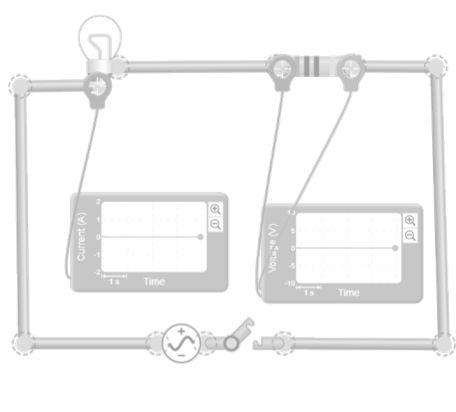
A resistor behaves the same way in both direct current and alternating current because its resistance to the flow of current does not depend on the rate at which the signal changes direction. The resistor converts part of the electrical energy into heat, and its value remains constant regardless of how many cycles per second the signal has. Therefore, in an AC circuit, the current and voltage across a resistor are always in phase: when the voltage rises, the current rises; when the voltage falls, the current falls. It does not store energy, does not return energy, and does not introduce phase shift. Its role is purely dissipative and stable at any frequency.
In a pure resistor, the current responds instantaneously to any change in voltage. It does not need time to “charge” or “discharge” anything, because it does not store energy in any field. Therefore, in AC, the current and voltage reach their maximum and minimum values at the same time; they are in phase. The current waveform is an exact copy of the voltage waveform, simply scaled by the resistance value according to Ohm’s law. This direct and simultaneous relationship is what makes the resistor the simplest component to analyze in alternating current.
Capacitor. Frequency-Dependent behavior
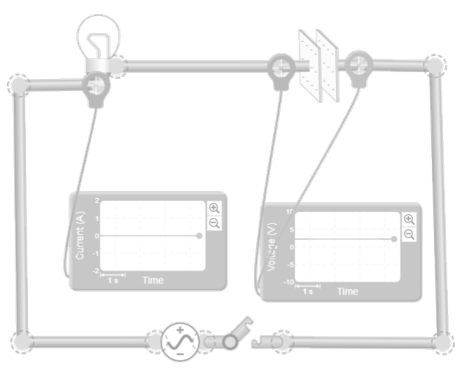
A capacitor stores energy in the form of an electric field between its plates, and this ability to accumulate and release charge means that its AC behavior depends directly on the frequency. When the AC signal changes slowly, the capacitor has time to charge and discharge almost completely during each cycle, which limits the current. As the frequency increases, the voltage reverses direction before the capacitor has time to fully charge, and the resistance decreases. This relationship between the signal’s rate of change and the capacitor’s ability to keep up with it is the basis of its behavior in alternating current.
Effects of frequency change on a capacitor
The current in a capacitor depends on how quickly the voltage changes. At low frequencies, the voltage varies slowly and the capacitor charges easily, so the current is small. At high frequencies, the voltage changes so quickly that the capacitor is constantly adjusting its charge, resulting in larger currents. This effect is not arbitrary: the current is proportional to the rate of change of the voltage, so the faster the signal oscillates, the more current the capacitor draws in an attempt to keep up with it.
Capacitive reactance
The opposition a capacitor presents to the flow of alternating current is called capacitive reactance and is inversely proportional to frequency. At low frequencies, the reactance is high because the capacitor has time to fully charge and blocks the current. At high frequencies, the reactance decreases because the voltage changes direction before a significant charge can build up between the plates. This inverse relationship explains why a capacitor can behave almost like an open circuit at low frequencies and almost like a short circuit at high frequencies.
Frequency sweep of a capacitor
When a capacitor is analyzed using a frequency sweep, it can be observed that its reactance decreases progressively as the signal oscillates faster. In the low-frequency range, the current is minimal, and the capacitor barely allows any signal to pass through. As the frequency increases, the current grows, and the voltage drop across the capacitor decreases. In a wide-range sweep, this transition appears as a continuous slope that reflects the decrease in capacitive reactance. This response is essential for understanding filters, couplings, and any circuit in which a capacitor selects or attenuates specific frequencies.
Coil. Frequency-Dependent behavior
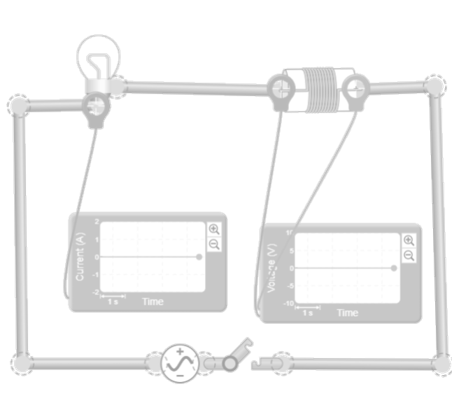
A coil stores energy in the form of a magnetic field when current flows through it, and this ability to store and release energy means that its AC behavior depends directly on the frequency. When the AC signal changes slowly, the current has time to rise and fall without significant opposition. But as the frequency increases, the current attempts to change more rapidly, and the coil resists these changes, generating an induced voltage that limits the current. This relationship between the rate of change of the current and the induced voltage is the basis of the coil’s behavior in an alternating current circuit.
Effects of frequency change on a coil
The current in a coil depends on how quickly it tries to change. At low frequencies, the current changes slowly and the coil generates almost no induced voltage, so the resistance is small and the current can increase easily. At high frequencies, the current tries to change very quickly, and the coil responds by generating a voltage that opposes this change, thereby reducing the current. This effect causes the coil to allow less and less current to flow as the frequency increases, exhibiting behavior opposite to that of a capacitor.
Inductive reactance
The opposition that a coil presents to the flow of alternating current is called inductive reactance, and it increases with frequency. At low frequencies, the reactance is small because the current changes slowly and the induced voltage is minimal. As the frequency increases, the current attempts to change more rapidly, and the coil generates a greater voltage that opposes that change, thereby increasing the reactance. At very high frequencies, this opposition can become so great that the coil acts practically as an open circuit. This direct relationship between frequency and inductive reactance is fundamental to understanding its role in filters, choke coils, and AC response control.
Frequency sweep in a coil
During a frequency sweep, the coil exhibits an increasing response: at low frequencies, it allows current to flow easily, but as the frequency increases, the current decreases progressively. In the mid-frequency range, the voltage drop across the coil increases, reflecting the rise in inductive reactance. At high frequencies, the current decreases so much that the coil behaves almost like a blocking element. This continuous evolution is the characteristic signature of the coil in AC circuits and explains its use in circuits where the passage of fast signals needs to be attenuated or blocked.
The importance of frequency in AC circuits
Frequency is not just a signal parameter, but a tool that allows us to control how components—and, by extension, entire circuits—behave. In practice, frequency determines which part of a signal passes through, which is attenuated, and how energy is distributed among the circuit elements. For this reason, many electrical and electronic systems are designed with an eye toward how resistors, capacitors, and inductors react when the signal oscillates faster or slower.
In filtering applications, frequency determines which signals pass through a circuit and which are blocked. A capacitor passes high frequencies and attenuates low ones, while an inductor does exactly the opposite, allowing for the construction of high-pass, low-pass, or more complex filters. In power supply and power electronics systems, frequency influences efficiency and component size, since operating at higher frequencies allows for reducing the reactance of capacitors and increasing that of inductors as needed. In communications, frequency defines channels, bands, and the ability to transmit information without interference, taking advantage of the fact that each component responds differently depending on the signal’s frequency.
In all these cases, the principle is the same as the one studied in this unit: resistance remains constant, while the capacitor and inductor change their opposition to the flow of current as the frequency changes. This relationship makes it possible to select, shape, or limit signals, and makes frequency an essential variable in the design and operation of any alternating current circuit.