Key electrical quantities
Voltage
Voltage, also called electric potential difference, tells us how much energy is delivered to electric charges so they can move through the circuit. The higher the voltage, the more energy each charge receives, and the more easily current can flow. In a circuit with a fixed resistance, increasing the battery voltage will also increase the current. Lowering the voltage will reduce the current. This relationship between voltage and current is key to understanding how electric circuits behave.
Voltage is measured in volts (V).
Electric current
Electric current measures how many electric charges pass through a point in the circuit per second. It tells us how much current is flowing at a given moment, and it’s measured in amperes (A). In the simulations, you’ll see how current depends on other factors in the circuit. For example, if the voltage source provides more energy, or if the resistance changes, the amount of charge flowing will also change. Understanding how current varies is essential for interpreting how any electric circuit works.
Current is measured in amperes (A).
Electrical resistance
Resistance indicates how much opposition the current encounters as it flows through a material or component. The higher the resistance, the harder it is for charges to move, and the lower the current will be. In circuits, we use resistors to control how much current flows. Some materials, like metals, offer little resistance and allow current to flow easily. Others, like plastic or ceramic, strongly oppose current flow and may even block it completely.
Resistance is measured in ohms (Ω).
Measuring electrical quantities
Measuring an electrical quantity means assigning it a numerical value using the appropriate instrument. This is essential for understanding how a circuit works—it’s not enough to know that current is flowing or that there’s a voltage difference; we need to know the actual values. For that, we use instruments designed for each quantity. In this unit, we’ll focus on two of them: the voltmeter, which measures voltage between two points, and the ammeter, which measures the current flowing through a conductor. Learning how to use them correctly and interpret their readings is a key step in studying electric circuits.
The ammeter: measuring current
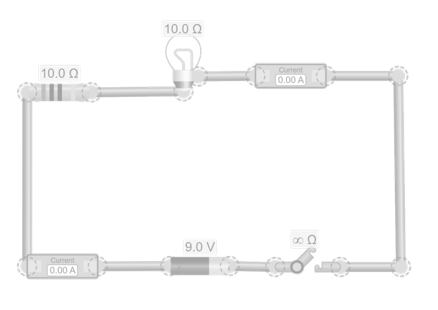
The ammeter measures the current flowing through a conductor. To get a reading, it must be connected in series with the component you want to measure. In the simulation, just break the wire and place the ammeter in the path. Its display will show the current value in amperes.
The voltmeter: measuring voltage
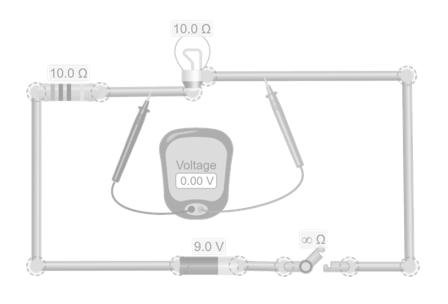
The voltmeter measures the voltage between two points in a circuit. To get a reading, it must be connected in parallel with the component you want to analyze—that is, its two terminals must be connected to the ends of the component. In the simulation, simply place the voltmeter’s terminals on those points, and the voltage value will appear on its display.
Important notes on measurement
To get accurate readings, it’s essential to connect the instruments correctly. The voltmeter must be connected in parallel, and the ammeter in series. If you reverse these connections, the circuit may stop working or show incorrect values. Also, remember that instruments are not neutral: even though this may not be noticeable in simulations, in real life they can affect the circuit if not properly designed or connected. That’s why learning to measure correctly is just as important as understanding what you’re measuring.