Generic selectors
Exact matches only
Search in title
Search in content
Post Type Selectors
post
page
cursos
gigante

Richard Feynman

Richard Feynman icon
26/11/2026

🗓️

🌱May 11, 1918 – Queens, New York, United States.
🍂February 15, 1988 – Los Angeles, California, United States.

🌟 Main Contribution

Richard Feynman formulated the path integral in quantum mechanics, developed Feynman diagrams for quantum electrodynamics (QED), and contributed pioneering ideas on superfluidity and quantum computing.
“Probability amplitudes over all possible histories unify quantum mechanics”
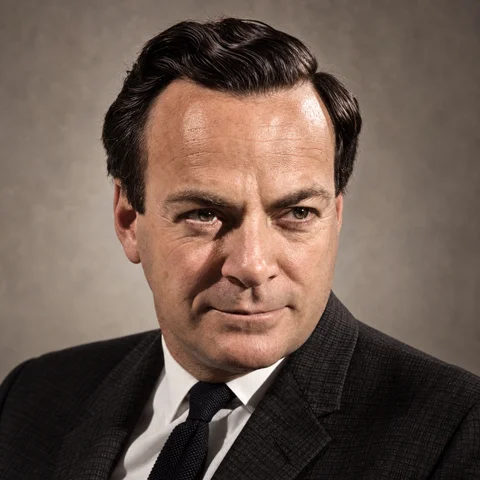
Richard Feynman portrait

🧐 Did you know?

Following the Space Shuttle Challenger disaster in 1986, Richard Feynman served on the investigative commission and demonstrated in a televised session how a rubber O-ring lost its elasticity in ice water, directly illustrating a technical cause of the failure.

🏅 Awards and honors

He shared the Nobel Prize in Physics (1965) with Julian Schwinger and Sin-Itiro Tomonaga, and received the Albert Einstein Medal and the United States National Medal of Science.

📚 Their name in science

➤ Feynman diagrams

Pictorial graphical representation of subatomic particle interactions and their associated probability amplitudes, originally developed within the framework of quantum electrodynamics.

➤ Feynman path integral

A formulation of quantum mechanics that calculates the transition amplitude between two states by summing the contributions of all possible paths or histories that connect both points.

Ad

Ad

Help your kid build real STEAM skills – at their own pace. GameU Orbit is a self-paced virtual program for kids. Try free for 7 days.

❓ Who was Richard Feynman?

Richard Phillips Feynman was one of the most influential and charismatic American theoretical physicists of the 20th century, a Nobel laureate for his work in quantum electrodynamics. He earned his doctorate at Princeton, participated in the Manhattan Project at Los Alamos, and spent much of his academic career at Caltech. He was a brilliant, curious, and unconventional communicator, famous both for the clarity of his physics lectures and for his penchant for puzzles, percussion, and independent research.

🌍 The world in their time

At the end of the 1940s, quantum electrodynamics presented infinite divergences in perturbative calculations, and physicists needed a coherent and transparent method to describe the interaction between light and charged matter.

Become a giant

Your path to becoming a giant of knowledge begins with these top free courses
Electrical Engineering II
Free mode

Electrical Engineering II

Electrical Engineering I
Free mode

Electrical Engineering I

Electronics II
Electronics II
Free mode

Electronics II

Electrical Engineering II
Free mode

Electrical Engineering II

Electrical Engineering I
Free mode

Electrical Engineering I

🔬 Scientific legacy

Richard Feynman introduced the path integral formulation (summing amplitudes over all possible trajectories) and created Feynman diagrams, a graphical representation and calculation rule for particle interaction processes in quantum electrodynamics (alongside parallel contributions from Julian Schwinger and Sin-Itiro Tomonaga). He also proposed the parton model for the nucleon, explained aspects of the superfluidity of helium-4, and provided early suggestions for quantum simulation.

👣 Footprint in today's world

Feynman diagrams and path integrals are everyday tools in particle physics, quantum field theory, and condensed matter physics, while his Feynman Lectures on Physics and his ideas on quantum computing continue to inspire students and researchers.

🏃‍♂️ The relay race

📥 Taking the baton

Richard Feynman’s work was based on the quantum mechanics of Paul Dirac, Werner Heisenberg, and Erwin Schrödinger, Maxwell’s electromagnetism, and the principle of least action.

📤 Passing the baton

His methods influenced quantum chromodynamics, modern gauge theories, statistical field theory, and the development of quantum computing and simulation.

Other giants you will want to get to know

Augustin-Louis Cauchy

Augustin-Louis Cauchy

1789

 –

1857
The structural master who brought absolute logical rigor to mathematical analysis.
André-Marie Ampère
André-Marie Ampère

André-Marie Ampère

1775

 –

1836
The Newton of electricity who discovered the mathematical laws of electrodynamics.
Erwin Schrödinger
Erwin Schrödinger

Erwin Schrödinger

1887

 –

1961
The philosopher of physics who formulated the quantum wave equation and raised the famous cat paradox.
Marie Curie
Marie Curie

Marie Curie

1867

 –

1934
The indomitable scientist who unveiled the hidden energy at the heart of atoms.
Albert Einstein
Albert Einstein

Albert Einstein

1879

 –

1955
The revolutionary physicist who transformed our understanding of space, time, and gravity.

Tools

Scientific calculator

Powered by Desmos

Scientific Dictionary

Powered by Wikipedia

2026 Best Online STEM Education Platform

Cargando clima y ubicación...

To learn and experience

Take your knowledge to the next level with science kits and hands-on tools that connect theory with experimentation

Essential for teachers and students

Learn with the best courses