Generic selectors
Exact matches only
Search in title
Search in content
Post Type Selectors

André-Marie Ampère

André-Marie Ampère icon
17/07/2026

🗓️

🌱January 20, 1775 – Lyon, France.
🍂June 10, 1836 – Marseille, France.

🌟 Main Contribution

André-Marie Ampère formulated the theory of electromagnetism, establishing the mathematical foundations linking electricity and magnetism
“Science is the explanation of the complex by the simple”
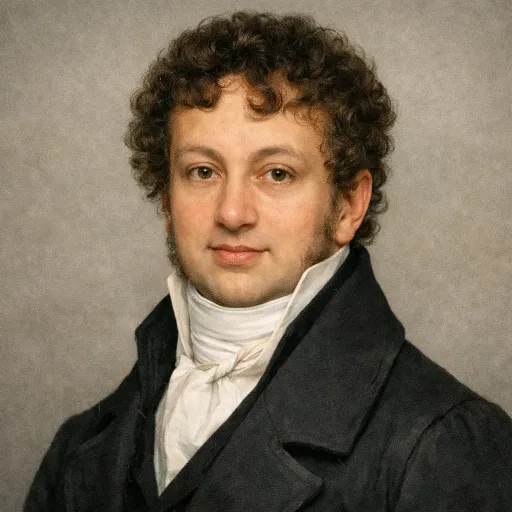
André-Marie Ampère portrait

🧐 Did you know?

André-Marie Ampère was famously absent-minded, often becoming so completely absorbed in his scientific thoughts that he forgot appointments or lost track of his surroundings. On one notable occasion, he mistook the back of a moving carriage for a blackboard and began frantically scribbling complex differential equations on it with a piece of chalk.

🏅 Awards and Honors

Ampère’s research earned him election as a Member of the French Academy of Sciences (1814) and as a foreign Fellow of the Royal Society of London (1827). Furthermore, he received the highest distinction from the French State, being appointed a Knight and later a Grand Officer of the Legion of Honor.

📚 Their name in science

🔆 Ampere (A)

Unit of measurement of electric current intensity in the International System of Units, equivalent to the flow of one coulomb of charge per second.

➤ Ampère’s Law

Physical law relating a static magnetic field to the electric current that produces it.

Ad

❓ Who was André-Marie Ampère?

André-Marie Ampère was a French physicist and mathematician who founded the science of electrodynamics. Lacking formal schooling, he educated himself using his father’s vast library, mastering advanced mathematics as a teenager. His life was marked by deep personal tragedy, including the execution of his father during the French Revolution. Despite these hardships, his intense focus and analytical genius allowed him to transform physics. He became a professor at the Ecole Polytechnique, dedicating his career to unraveling the mathematical relationships that govern electricity and magnetism.

🌍 The world in their time

In 1820, electricity and magnetism were viewed as two completely separate, unrelated phenomena. This view was shattered when Hans Christian Ørsted noticed that an electric current could deflect a magnetic compass needle, a surprising experimental result that lacked any mathematical explanation or unifying theory.

Become a giant

Your path to becoming a giant of knowledge begins with these top free courses
free EMC course
Free mode

Electromagnetic Compatibility Essentials

free materials capstone course
Free mode

Capstone Exam – Materials for Electronic, Optical, and Magnetic Devices

free electric circuits course
Free mode

Principles of Electric Circuits | 电路原理

free EMC course
Free mode

Electromagnetic Compatibility Essentials

free materials capstone course
Free mode

Capstone Exam – Materials for Electronic, Optical, and Magnetic Devices

🔬 Scientific legacy

André-Marie Ampère immediately attacked Ørsted’s discovery, developing a complete mathematical framework in just a few weeks. He formulated Ampère’s Law, which quantifies the magnetic field generated by an electric current, proved that parallel currents attract or repel each other depending on their direction, and correctly hypothesized that all magnetism is caused by moving electrical charges.

👣 Footprint in today's world

André-Marie Ampère’s name is part of everyday language as the ampere (or amp), the standard international unit used worldwide to measure electric current. His fundamental mathematical laws are essential for the operation of all modern electrical motors, generators, power grids, and electronic devices that power our world.

🏃‍♂️ The relay race

📥 Taking the baton

The sudden breakthrough of André-Marie Ampère was directly catalyzed by Hans Christian Ørsted’s experimental discovery of electromagnetism. He also drew heavily upon the rigorous mathematical techniques established by French analytical masters like Joseph-Louis Lagrange and Pierre-Simon Laplace.

📤 Passing the baton

André-Marie Ampère’s brilliant electrodynamic concepts provided the essential foundations for Michael Faraday’s experimental discoveries in electromagnetic induction. His laws were later fully integrated by James Clerk Maxwell into his definitive unified equations of electromagnetism.

Other giants you will want to get to know

Michael Faraday

Michael Faraday

1791

 –

1867
The wizard of electrical induction who visualized magnetic lines of force and transformed industry.
James Clerk Maxwell

James Clerk Maxwell

1831

 –

1879
The unifier of electromagnetism who predicted radio waves and laid the mathematical bridge to modern physics.
André-Marie Ampère

André-Marie Ampère

1775

 –

1836
The Newton of electricity who discovered the mathematical laws of electrodynamics.

Tools

Scientific calculator

Powered by Desmos

Scientific Dictionary

Powered by Wikipedia

2026 Best Online STEM Education Platform

Cargando clima y ubicación...

To learn and experience

Take your knowledge to the next level with science kits and hands-on tools that connect theory with experimentation

Essential for teachers and students

Learn with the best courses