Generic selectors
Exact matches only
Search in title
Search in content
Post Type Selectors

Nicolaus Copernicus

Nicolaus Copernicus icon
17/07/2026

🗓️

🌱February 19, 1473 – Toruń, Poland.
🍂May 24, 1543 – Frombork, Poland.

🌟 Main Contribution

Nicolaus Copernicus revolutionized astronomy by placing the Sun at the center of the planetary system; he provided precise mathematical observations.
“The Sun, not the Earth, is the center of our planetary system”
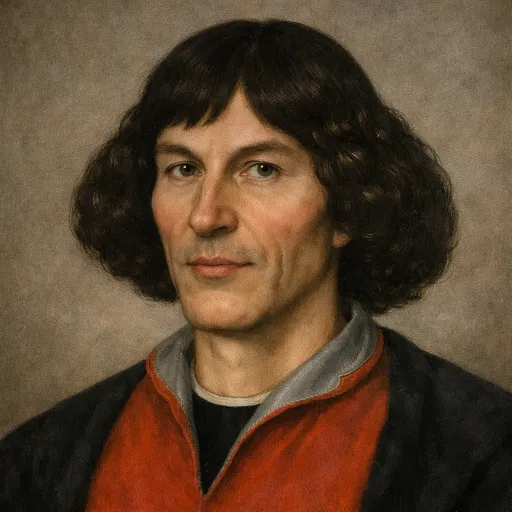
Nicolaus Copernicus portrait

🧐 Did you know?

Nicolaus Copernicus was a man of extreme prudence who delayed the publication of his revolutionary book for over thirty years out of fear of ridicule from the academic community and theological repercussions. Tradition recounts that the Polish astronomer received the first printed copy of his masterpiece directly on his deathbed on May 24, 1543, suffering a stroke just hours after holding the book that permanently changed humanity’s place in the cosmos.

🏅 Awards and Honors

Copernicus served as a canon of Warmia, and his work De revolutionibus orbium coelestium revolutionized astronomy. The element copernicium and numerous observatories and craters bear his name.

📚 Their name in science

🧪 copernicium (Cn)

Synthetic chemical element with atomic number 112.

➤ Copernican principle

Principle stating that Earth does not occupy a privileged position in the Universe.

❓ Who was Nicolaus Copernicus?

Nicolaus Copernicus was a Polish astronomer, mathematician, physician, and Catholic cleric, celebrated for formulating the heliocentric theory of the solar system which displaced the Earth from the center of the universe. Educated at the prestigious Italian universities of Kraków, Bologna, and Padua under the influence of Renaissance humanism, he dedicated his life to ecclesiastical administration at Frombork Cathedral and astronomical calculation. He possessed a mind of exceptional logical and mathematical rigor, capable of questioning centuries of dogmatic tradition through the geometric analysis of celestial orbits. Copernicus did not view the cosmos as a confined space designed exclusively for terrestrial anthropocentrism, but as a harmonic system regulated by perfect geometric proportions.

🌍 The world in their time

In the early 16th century, world astronomy was dominated by Ptolemy’s geocentric system, firmly backed by the Church. It was erroneously assumed that the Earth remained motionless at the exact center of the universe while the Sun and planets rotated around it in complex orbits full of artificial mathematical epicycles to explain retrograde motion.

Become a giant

Your path to becoming a giant of knowledge begins with these top free courses
free astrophysics enigmas course
Free mode

Greatest Unsolved Mysteries of the Universe

free exoplanets course
Free mode

Astrophysics: Exploring Exoplanets

free high-energy universe course
Free mode

Astrophysics: The Violent Universe

free astrophysics enigmas course
Free mode

Greatest Unsolved Mysteries of the Universe

free exoplanets course
Free mode

Astrophysics: Exploring Exoplanets

🔬 Scientific legacy

Nicolaus Copernicus revolutionized science by publishing his monumental work *De revolutionibus orbium coelestium* in 1543, where he mathematically formulated the heliocentric model, establishing that the Sun occupies the center of the universe and that the Earth and other planets rotate around it in circular orbits. He proved that the daily motion of celestial bodies is the result of the Earth’s rotation on its own axis and that the annual cycle is due to its translation around the Sun. Furthermore, he correctly ordered the known planets according to their distance from the sun and formulated the initial principles of the precession of the equinoxes.

👣 Footprint in today's world

The legacy of Nicolaus Copernicus is the foundational pillar of contemporary observational astronomy and the birth of the Scientific Revolution. The conceptual shift he provoked, known today as the “”Copernican Revolution,”” permanently transformed the scientific method, serving as an intellectual model for theoretical physics and liberating human thought from the bonds of traditional theological literalism to usher in modern physics.

🏃‍♂️ The relay race

📥 Taking the baton

The monumental geometric breakthroughs of Nicolaus Copernicus built upon the observational data of Islamic astronomers such as Al-Battani and initial criticisms of the Ptolemaic model formulated by 14th-century mathematicians.

📤 Passing the baton

The heliocentric unification achieved by Nicolaus Copernicus provided the indispensable frame of reference for Johannes Kepler to discover elliptical orbits and Galileo Galilei to provide the first direct telescopic proofs. His scientific treatise opened the theoretical floodgates that allowed Isaac Newton to formulate the laws of classical dynamics and universal gravitation.

Other giants you will want to get to know

Nicolaus Copernicus

Nicolaus Copernicus

1473

 –

1543
The Renaissance astronomer who moved the Earth and stopped the Sun to found modern astronomy.
Léon Foucault

Léon Foucault

1819

 –

1868
The physicist of precision who visually demonstrated Earth’s rotation and measured the speed of light.
Johannes Kepler

Johannes Kepler

1571

 –

1630
The mathematical astronomer who shattered celestial geometric perfection by discovering the elliptical orbits of planets.
Edwin Powell Hubble

Edwin Powell Hubble

1889

 –

1953
The titan of astronomy who discovered the expansion of the universe and the existence of other galaxies.
Galileo Galilei

Galileo Galilei

1564

 –

1642
The father of modern science who aimed his telescope at the heavens and challenged the world defending heliocentrism.

Tools

Scientific calculator

Powered by Desmos

Scientific Dictionary

Powered by Wikipedia

2026 Best Online STEM Education Platform

Cargando clima y ubicación...

To learn and experience

Take your knowledge to the next level with science kits and hands-on tools that connect theory with experimentation

Essential for teachers and students

Learn with the best courses