Generic selectors
Exact matches only
Search in title
Search in content
Post Type Selectors

Johannes Kepler

Johannes Kepler icon
17/07/2026

🗓️

🌱December 27, 1571 – Weil der Stadt, Germany.
🍂November 15, 1630 – Regensburg, Germany.

🌟 Main Contribution

Kepler formulated the three laws of planetary motion, establishing elliptical orbits and the relationship between planetary period and distance from the Sun
“The heavens teach the geometry that nature follows”
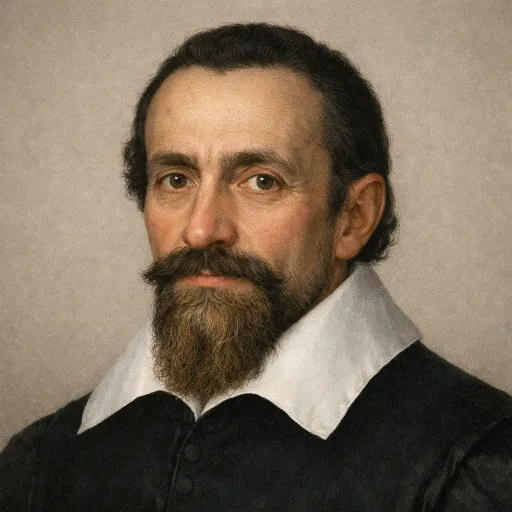
Johannes Kepler portrait

🧐 Did you know?

Johannes Kepler spent years performing thousands of grueling manual calculations to decipher the orbit of Mars based on Tycho Brahe’s analog data. Lacking tools like logarithms in his early years, he repeated a massive set of complex arithmetic operations more than seventy times, a titanic effort of concentration conducted under severe economic precocity and amidst the ravages of the Thirty Years’ War.

🏅 Awards and Honors

Kepler served as Imperial Mathematician of the Holy Roman Empire. A lunar crater, an asteroid, and numerous scientific institutions bear his name.

📚 Their name in science

➤ Kepler’s laws of planetary motion

Three laws describing the motion of planets around the Sun.

➤ Kepler conjecture

Classical problem concerning the densest possible packing of spheres.

❓ Who was Johannes Kepler?

Johannes Kepler was a German astronomer, mathematician, and astrologer, a key figure in the 17th-century Scientific Revolution, famous for discovering the laws that govern the motion of planets around the Sun. Educated at the University of Tübingen under a deep mystical and mathematical conviction, he possessed an unwavering tenacity to reconcile empirical observations with the harmony of the cosmos. Kepler did not view the universe as a space ruled by perfect circular dogmas, but as a geometric structure governed by quantifiable physical forces. His rigorous methodological approach overcame the religious persecutions and personal hardships of a turbulent Europe, guiding astronomy into modernity.

🌍 The world in their time

In the early 17th century, astronomy was divided between the traditional geocentric model and Copernicus’s heliocentric model. However, both systems erroneously assumed that planets moved in perfect circles at constant speeds, which generated irreconcilable mathematical misalignments when trying to predict the exact positions of celestial bodies in the sky.

Become a giant

Your path to becoming a giant of knowledge begins with these top free courses
free quantum optomechanics course
Free mode

Cavity Quantum Optomechanics

free astrophysics enigmas course
Free mode

Greatest Unsolved Mysteries of the Universe

free exoplanets course
Free mode

Astrophysics: Exploring Exoplanets

free quantum optomechanics course
Free mode

Cavity Quantum Optomechanics

free astrophysics enigmas course
Free mode

Greatest Unsolved Mysteries of the Universe

🔬 Scientific legacy

Johannes Kepler revolutionized astronomy by formulating his three famous laws of planetary motion between 1609 and 1619. He broke with centuries of tradition by proving in his work *Astronomia Nova* that planetary orbits are elliptical and that the Sun occupies one of their foci. He further stated that a planet’s orbital speed varies inversely with its distance from the Sun and that the square of its orbital period is proportional to the cube of its average distance. In geometric optics, he formulated the theory of refraction in the human eye and perfected the refracting telescope using two convex lenses.

👣 Footprint in today's world

The legacy of Johannes Kepler forms the cornerstone of contemporary astrodynamics and space exploration. His three elliptical laws are used daily by aerospace engineers and institutions like NASA and the ESA to calculate the exact trajectories of artificial satellites, plan interplanetary probe launches, and estimate the orbits of exoplanets discovered in distant stellar systems.

🏃‍♂️ The relay race

📥 Taking the baton

The monumental mathematical breakthroughs of Johannes Kepler built directly upon the precision astronomical observations compiled by Tycho Brahe and the theoretical heliocentric model proposed by Nicolaus Copernicus.

📤 Passing the baton

The breakdown of circular perfection achieved by Johannes Kepler provided the indispensable mathematical and inductive foundation for Isaac Newton to deduce the law of universal gravitation. His work in optics laid the foundations for developing advanced astronomical instruments and consolidated the use of the mathematical method in natural sciences.

Other giants you will want to get to know

Georg Cantor

Georg Cantor

1845

 –

1918
The bold mathematician who tamed the infinite and proved that some infinities are larger than others.
Alan Turing

Alan Turing

1912

 –

1954
The mathematical genius who laid the foundations of computing and cracked the Enigma code.
Léon Foucault

Léon Foucault

1819

 –

1868
The physicist of precision who visually demonstrated Earth’s rotation and measured the speed of light.
Daniel Bernoulli

Daniel Bernoulli

1700

 –

1782
The master of hydrodynamics who discovered the principle explaining how airplanes fly and fluids flow.
Henri Poincaré

Henri Poincaré

1854

 –

1912
The last universalist who discovered deterministic chaos and revolutionized topology and celestial mechanics.

Tools

Scientific calculator

Powered by Desmos

Scientific Dictionary

Powered by Wikipedia

2026 Best Online STEM Education Platform

Cargando clima y ubicación...

To learn and experience

Take your knowledge to the next level with science kits and hands-on tools that connect theory with experimentation

Essential for teachers and students

Learn with the best courses