Generic selectors
Exact matches only
Search in title
Search in content
Post Type Selectors

Michael Faraday

Michael Faraday icon
17/07/2026

🗓️

🌱September 22, 1791 – Newington Butts, England.
🍂August 25, 1867 – Hampton Court, England.

🌟 Main Contribution

Michael Faraday discovered electromagnetic induction, conducted pioneering experiments in optics (Faraday effect), and established fundamental principles of electrochemistry.
“Nothing is too wonderful to be true”
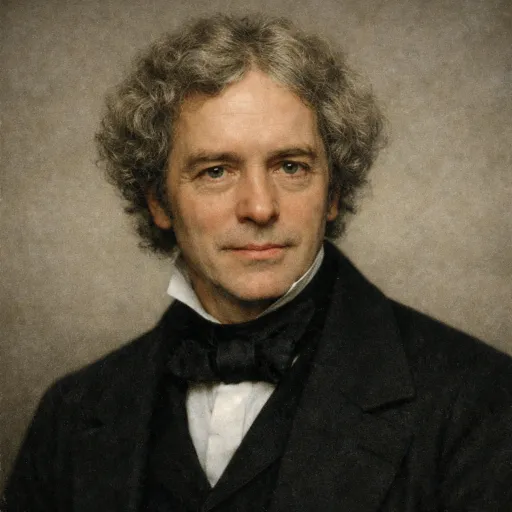
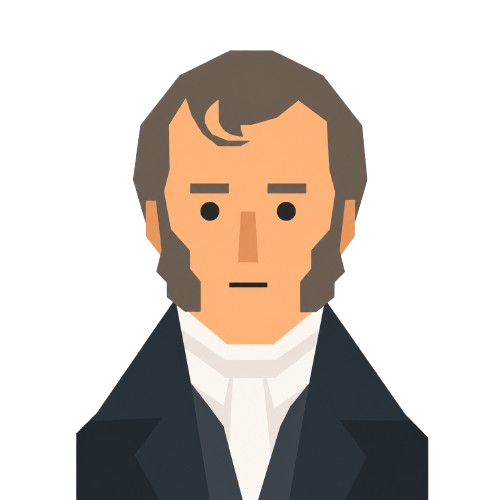
Michael Faraday portrait

🧐 Did you know?

Michael Faraday was a passionate popularizer who established the famous Royal Institution Christmas Lectures to bring science closer to children and the general public. During his public demonstrations of the Faraday cage, he constructed a gigantic cube covered in gold leaf, stepped inside with a precision electroscope, and applied discharges of thousands of volts to the exterior walls; while sparks flew outside, Faraday remained calmly seated inside reading peacefully, proving the safety of his physical principle.

🏅 Awards and Honors

Faraday received the Copley Medal (1832), the Royal Medals (1835 and 1846), and the Rumford Medal (1846) from the Royal Society. He was one of history’s greatest experimental physicists.

📚 Their name in science

🔋 farad (F)

The SI unit of electrical capacitance.

➤ Faraday’s law

Law of electromagnetic induction.

➤ Faraday cage

Conducting enclosure that shields its interior from external electric fields.

➤ Faraday constant

Electric charge carried by one mole of electrons.

❓ Who was Michael Faraday?

Michael Faraday was a British physicist and chemist, universally recognized as one of the most brilliant experimental scientists in human history for discovering electromagnetic induction. Born into a humble family and largely self-taught after starting his working life as a bookbinder’s apprentice, he became the protégé of Humphry Davy at the Royal Institution in London. Lacking formal mathematical training, he possessed an unmatched three-dimensional visual intuition that allowed him to model invisible laboratory phenomena through experiments of extraordinary elegance. Faraday did not view electricity as an abstract fluid, but as real, physical lines of force that filled space.

🌍 The world in their time

In the early 1830s, the scientific community knew that electric currents generated magnetism thanks to Oersted’s experiments, but no one had managed to achieve the reverse process: how to efficiently transform a magnet’s magnetism into a usable electric current, which limited the industrial application of energy.

Become a giant

Your path to becoming a giant of knowledge begins with these top free courses
free quantum optomechanics course
Free mode

Cavity Quantum Optomechanics

free EMC course
Free mode

Electromagnetic Compatibility Essentials

free quantum molecular course
Free mode

Quantum Mechanics of Molecular Structures

free quantum optomechanics course
Free mode

Cavity Quantum Optomechanics

free EMC course
Free mode

Electromagnetic Compatibility Essentials

🔬 Scientific legacy

Michael Faraday revolutionized physics in 1831 by discovering electromagnetic induction, proving practically that a variable magnetic field induces an electric current in a surrounding conductor, a principle known as Faraday’s Law. He designed the first electrical generator (the Faraday disk) and the first functional electric motor. In chemistry, he discovered benzene in 1825, popularized indispensable scientific terms such as “”anode,”” “”cathode,”” and “”ion,”” and formulated the Laws of Electrolysis. Furthermore, he invented the Faraday cage in 1836, proving that the electric field inside a charged conductor is zero, and discovered the Faraday effect regarding the polarization of light by magnetism.

👣 Footprint in today's world

The legacy of Michael Faraday forms the technological and industrial infrastructure of the contemporary world. His discoveries on electromagnetic induction are the physical principle used today across the planet to generate electricity in hydroelectric, wind, and thermal power plants, as well as the technical operation of industrial electric motors, grid transformers, wireless charging systems, and electromagnetic shielding systems that protect computer servers.

🏃‍♂️ The relay race

📥 Taking the baton

The monumental experimental breakthroughs of Michael Faraday built directly upon the electrochemical experiments of Humphry Davy and the initial current findings of Hans Christian Oersted and André-Marie Ampère.

📤 Passing the baton

The discovery of magnetic lines of force by Michael Faraday provided the indispensable intuitive and physical foundation for James Clerk Maxwell to formulate his famous equations of electromagnetism. His chemical and electrical shielding work laid the foundations for developing industrial electrochemistry and protecting modern telecommunication systems.

Other giants you will want to get to know

Léon Foucault

Léon Foucault

1819

 –

1868
The physicist of precision who visually demonstrated Earth’s rotation and measured the speed of light.
Johannes Kepler

Johannes Kepler

1571

 –

1630
The mathematical astronomer who shattered celestial geometric perfection by discovering the elliptical orbits of planets.
Leonhard Euler

Leonhard Euler

1707

 –

1783
The supreme titan of mathematical analysis who unified the language of calculus and mastered science without sight.
Michael Faraday

Michael Faraday

1791

 –

1867
The wizard of electrical induction who visualized magnetic lines of force and transformed industry.
James Clerk Maxwell

James Clerk Maxwell

1831

 –

1879
The unifier of electromagnetism who predicted radio waves and laid the mathematical bridge to modern physics.

Tools

Scientific calculator

Powered by Desmos

Scientific Dictionary

Powered by Wikipedia

2026 Best Online STEM Education Platform

Cargando clima y ubicación...

To learn and experience

Take your knowledge to the next level with science kits and hands-on tools that connect theory with experimentation

Essential for teachers and students

Learn with the best courses