Generic selectors
Exact matches only
Search in title
Search in content
Post Type Selectors

Galileo Galilei

Galileo Galilei icon
17/07/2026

🗓️

🌱February 15, 1564 – Pisa, Italy.
🍂January 8, 1642 – Arcetri, Italy.

🌟 Main Contribution

Galileo Galilei revolutionized astronomy by observing planets, Jupiter’s moons, and advocating heliocentrism.
“And yet it moves”
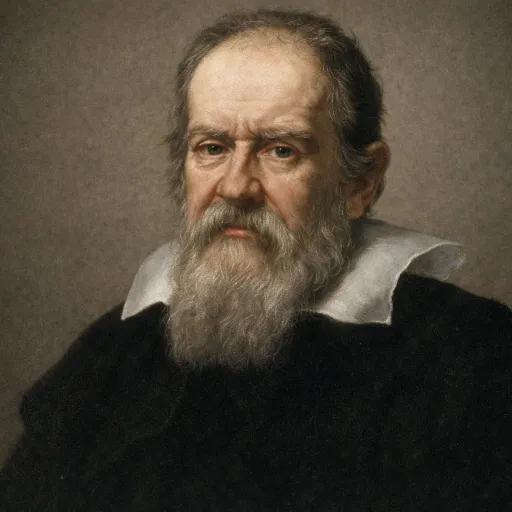
Galileo Galilei portrait

🧐 Did you know?

Galileo Galilei, after being forced to abjure on his knees before the Inquisition tribunal in 1633 and deny under threat of torture that the Earth moved around the Sun, uttered according to historical legend a famous defiant phrase in a rebellious whisper: “Eppur si muove” (*And yet it moves*), reaffirming his unshakeable faith in the evidence of his scientific observations.

🏅 Awards and Honors

Developing his work in the 16th and 17th centuries, before the establishment of modern academies and awards, Galileo received no formal institutional decorations. However, he was admitted to the historic and influential Accademia dei Lincei in Rome in 1611.

📚 Their name in science

➤ Galilean relativity

Principle of classical mechanics stating that the laws of motion are the same for all observers in inertial reference frames.
➤ Galilean transformation

Set of equations relating the coordinates of the same event as observed from different inertial reference frames in classical mechanics.

➤ Galilean telescope

Type of refracting telescope using a converging objective lens and a diverging eyepiece, based on the design developed by Galileo Galilei.

Ad

❓ Who was Galileo Galilei?

Galileo Galilei was an Italian astronomer, physicist, and mathematician whose intellectual audacity permanently reshaped human history by founding the modern scientific method based on empirical experimentation. Gifted with an exceptionally analytical mind and astonishing manual skill, he refused to accept old philosophical dogmas without laboratory proof. His astronomical discoveries confirmed that the Earth was not the motionless center of the universe, leading to a historic and inevitable clash with the Catholic Church’s Inquisition. Subjected to a famous trial and sentenced to life house arrest, his firm defense of scientific truth made him an imperishable symbol of intellectual freedom.

🌍 The world in their time

In the late 16th century, knowledge of the universe stood stagnant under Aristotelian dogma and Ptolemy’s geocentric model, which asserted that the Earth remained fixed at the cosmos center while perfect, unchangeable celestial spheres rotated around it, a vision rigidly protected by theological authorities.

Become a giant

Your path to becoming a giant of knowledge begins with these top free courses
free quantum optomechanics course
Free mode

Cavity Quantum Optomechanics

free astrophysics enigmas course
Free mode

Greatest Unsolved Mysteries of the Universe

free exoplanets course
Free mode

Astrophysics: Exploring Exoplanets

free quantum optomechanics course
Free mode

Cavity Quantum Optomechanics

free astrophysics enigmas course
Free mode

Greatest Unsolved Mysteries of the Universe

🔬 Scientific legacy

Galileo Galilei revolutionized science by perfecting the optical telescope in 1609 and training it upon the firmament, discovering the Moon’s craters, the phases of Venus, sunspots, and Jupiter’s four largest moons, providing the first destructive observational proof against geocentrism. In physics, he overturned Aristotle’s mechanical theories by formulating the law of falling bodies, proving mechanically that all objects fall with the exact same mathematical acceleration regardless of their mass in the absence of air resistance.

👣 Footprint in today's world

The legacy of Galileo Galilei forms the absolute foundation upon which contemporary physics and astronomy are built. He introduced the use of mathematics as the universal language to describe the laws of nature and established definitively that only reproducible empirical experimentation validates a scientific theory, transforming science into a rigorous discipline removed from abstract philosophy.

🏃‍♂️ The relay race

📥 Taking the baton

The monumental scientific breakthroughs of Galileo Galilei built upon the bold heliocentric theory proposed decades earlier by Nicolaus Copernicus, combined with the precise optics and lens-making techniques circulating through the Netherlands in the early 17th century.

📤 Passing the baton

Galileo Galilei’s rigorous work in mechanical physics and observational astronomy paved the direct path for Johannes Kepler to formulate his orbital laws and for Isaac Newton to develop the laws of dynamics and the law of universal gravitation, beautifully sealing the Scientific Revolution.

Other giants you will want to get to know

Albert Einstein

Albert Einstein

1879

 –

1955
The revolutionary physicist who transformed our understanding of space, time, and gravity.
René Descartes

René Descartes

1596

 –

1650
The architect of analytical geometry who unified algebra with space and established the rational method.
Christiaan Huygens

Christiaan Huygens

1629

 –

1695
The architect of the optical wavefront who invented the pendulum clock and unveiled the hidden rings of Saturn.
Tycho Brahe

Tycho Brahe

1546

 –

1601
The titan of astronomical observation who measured the sky with the naked eye and immortalized celestial mechanics data.
Edwin Powell Hubble

Edwin Powell Hubble

1889

 –

1953
The titan of astronomy who discovered the expansion of the universe and the existence of other galaxies.

Tools

Scientific calculator

Powered by Desmos

Scientific Dictionary

Powered by Wikipedia

2026 Best Online STEM Education Platform

Cargando clima y ubicación...

To learn and experience

Take your knowledge to the next level with science kits and hands-on tools that connect theory with experimentation

Essential for teachers and students

Learn with the best courses