Generic selectors
Exact matches only
Search in title
Search in content
Post Type Selectors

Archimedes

Archimedes icon
17/07/2026

🗓️

🌱c. 287 BC – Syracuse, Sicily (Magna Graecia).
🍂c. 212 BC – Syracuse, Sicily.

🌟 Main Contribution

Archimedes established fundamental principles of mechanics and hydrostatics, including the famous Archimedes’ principle of buoyancy in fluids
“Give me a place to stand, and I will move the world”
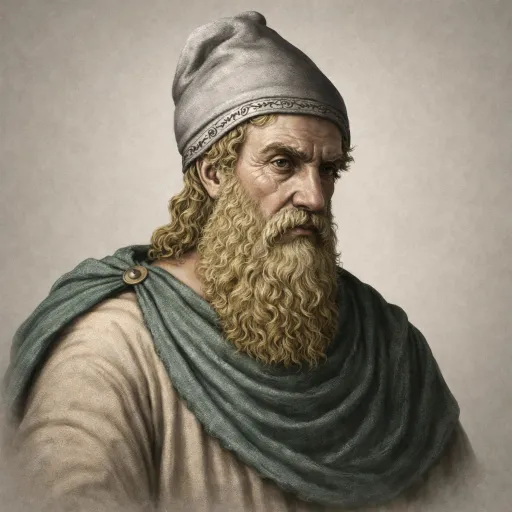
Archimedes portrait

🧐 Did you know?

The famous story of Arquímedes involves King Hiero II, who asked him to determine if a crown was solid gold or mixed with silver. While stepping into a public bath, Arquímedes noticed the water rising and realized this displacement could measure the crown’s volume, causing him to run naked through the streets shouting Eureka!

🏅 Awards and Honors

Although he lived in classical antiquity centuries before the creation of modern accolades, Archimedes’ transcendence is supremely commemorated on the Fields Medal in mathematics, which bears his engraved likeness and is considered the equivalent of the Nobel Prize for this discipline.

📚 Their name in science

➤ Archimedes’ Principle

Physical law of hydrostatics stating that any body submerged in a fluid experiences an upward buoyant force equal to the weight of the fluid displaced by the body.

❓ Who was Archimedes?

Arquímedes was a Greek mathematician, physicist, engineer, and astronomer who stands as one of the greatest intellectual figures in human history. Spending most of his life in the vibrant city-state of Syracuse, he combined profound abstract geometry with practical mechanical inventions. His analytical insights were centuries ahead of his time, utilizing methods that anticipated modern calculus to measure complex shapes. He was deeply revered by his contemporaries for designing innovative defense weapons, and his life ended tragically when he was slain by a Roman soldier during the sack of Syracuse, reportedly while absorbed in a geometric drawing.

🌍 The world in their time

In the ancient world, engineering and physics relied almost entirely on practical trial-and-error, lacking any formal mathematical laws. There was no rigorous understanding of hydrostatic pressure, fluid mechanics, or how forces balanced out in simple machines, leaving mechanical design without scientific certainty.

Become a giant

Your path to becoming a giant of knowledge begins with these top free courses
free energy & matter transfer course
Free mode

The Basics of Transport Phenomena

free quantum optomechanics course
Free mode

Cavity Quantum Optomechanics

free aerodynamics course
Free mode

Flight Vehicle Aerodynamics

free energy & matter transfer course
Free mode

The Basics of Transport Phenomena

free quantum optomechanics course
Free mode

Cavity Quantum Optomechanics

🔬 Scientific legacy

Arquímedes founded the science of hydrostatics by discovering Archimedes’ Principle, which states that a body immersed in a fluid experiences an upward buoyant force equal to the weight of the fluid it displaces. He also mathematically formalized the Law of the Lever, calculated a highly precise approximation of Pi, and developed the method of exhaustion to determine the area and volume of curved geometric shapes.

👣 Footprint in today's world

Arquímedes’ principles remain essential to modern naval architecture, mechanical engineering, and mathematics. Every ship designed today relies directly on his laws of buoyancy to remain afloat, and his geometric methods laid the historical foundation for the development of integral calculus used in all fields of engineering.

🏃‍♂️ The relay race

📥 Taking the baton

The rigorous geometric thinking of Arquímedes was deeply shaped by the mathematical traditions established by Euclid in Alexandria, Egypt, where Archimedes studied as a young man and maintained a lifelong scientific correspondence with prominent scholars.

📤 Passing the baton

Arquímedes’ preserved manuscripts were eagerly rediscovered and analyzed during the Renaissance, directly inspiring pioneers like Galileo Galilei, René Descartes, and Isaac Newton to merge mathematics with physical motion, sparking the Scientific Revolution.

Other giants you will want to get to know

Daniel Bernoulli

Daniel Bernoulli

1700

 –

1782
The master of hydrodynamics who discovered the principle explaining how airplanes fly and fluids flow.
Joseph Louis Gay-Lussac

Joseph Louis Gay-Lussac

1778

 –

1850
The daring chemist who formulated the ideal gas laws and ascended in balloons to measure the atmosphere.
Johannes Kepler

Johannes Kepler

1571

 –

1630
The mathematical astronomer who shattered celestial geometric perfection by discovering the elliptical orbits of planets.
Augustin-Louis Cauchy

Augustin-Louis Cauchy

1789

 –

1857
The structural master who brought absolute logical rigor to mathematical analysis.
Joseph-Louis Lagrange

Joseph-Louis Lagrange

1736

 –

1813
The master of analytical mechanics who unified physics without geometry and located space equilibrium zones.

Tools

Scientific calculator

Powered by Desmos

Scientific Dictionary

Powered by Wikipedia

2026 Best Online STEM Education Platform

Cargando clima y ubicación...

To learn and experience

Take your knowledge to the next level with science kits and hands-on tools that connect theory with experimentation

Essential for teachers and students

Learn with the best courses