Generic selectors
Exact matches only
Search in title
Search in content
Post Type Selectors

Series circuits

The online series circuit simulations on this page let you interactively understand how current, voltage, and equivalent resistance behave in a simple circuit. Through virtual setups with a power source, switch, light bulbs, resistors, ammeters, and voltmeters, you can see the relationship between circuit current, resistance values, and voltage drops at different points.

What are series circuits?

Series circuits are characterized by their components being connected one after another, forming a single path for current to flow. In this kind of setup, the current passing through each element is the same, while the total voltage from the source is distributed among the different components in proportion to their values. The equivalent resistance is found by directly adding up all the connected resistances, making this arrangement a clear and accessible example for understanding how current and voltage are distributed in a circuit, and a solid foundation for analyzing more complex configurations.

Formula for equivalent resistance

When several resistors are connected in series, their combined effect on the circuit can be expressed as a single equivalent resistance. This equivalent resistance is obtained by simply adding together the values of all the connected resistors:

Req = R1 + R2 + R3 +…+ Rn

The current that flows through each resistor is the same, and the total voltage applied to the circuit is divided among them. In this way, the equivalent resistance represents the total opposition to the flow of current in that single path formed by the series resistors.

Practical example

Let’s suppose we have three resistors connected in series with values of 10 Ω, 20 Ω, and 30 Ω. The equivalent resistance of the circuit is found by directly adding their values:

Req = 10 + 20 + 30 = 60 Ω

This means that, from the perspective of the power source, the set of resistors behaves like a single 60 Ω resistor. The current flowing through each resistor is the same, while the total applied voltage is shared among them in proportion to their resistance value. For example, if the source provides 12 V, the voltage drop will be 2 V across the 10 Ω resistor, 4 V across the 20 Ω resistor, and 6 V across the 30 Ω resistor, which adds up to the total 12 V.

Series circuit simulations

Constant current


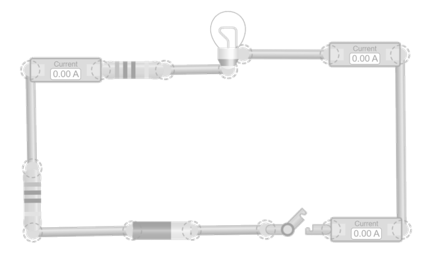
In this simulation, a circuit is built with a power source, a switch, a light bulb, and several resistors connected in series. Several ammeters are placed at different points in the circuit to check that all register the same current value. Notice how, no matter how many resistors are added or what their values are, the current that flows is always the same throughout the path. Change the values of the resistors and the battery voltage to verify that this property always holds in series connections.
Licencia de Creative Commons

Equivalent resistance in a series circuit


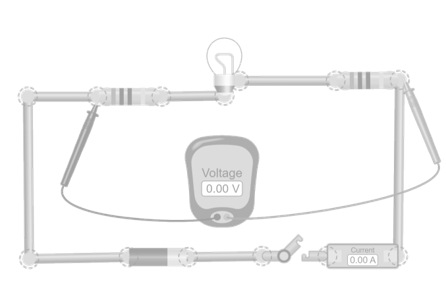
In this simulation, a circuit is built with a power source, a switch, a light bulb, and several resistors connected in series. An ammeter is placed anywhere in the circuit and a voltmeter is placed across the resistors. Calculate the equivalent resistance by measuring the total voltage and applying Ohm’s Law (Req = V/I). Check that the result matches the sum of the individual resistances. Modify the values of the resistors and the battery voltage to see that this rule always applies.
Licencia de Creative Commons

Voltage distribution in series circuits


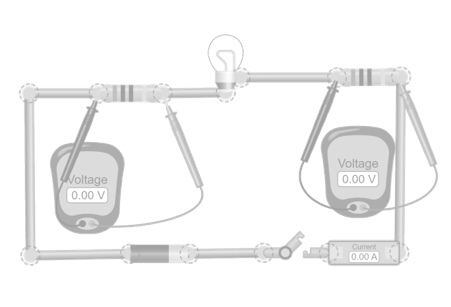
In this simulation, a circuit is built with a power source, a switch, a light bulb, and several resistors connected in series. An ammeter is placed in series with the power source to measure the current. Additionally, voltmeters are used across each resistor and across the complete set. Observe how the total battery voltage is divided among the resistors in proportion to their values, and how the sum of the partial voltage drops matches the total applied voltage. Change the values of the resistors and the battery voltage to verify that this rule is always fulfilled.
Licencia de Creative Commons

To learn and experience

Take your knowledge to the next level with science kits and hands-on tools that connect theory with experimentation

“If I have seen further, it is by standing on the shoulders of giants”

Isaac Newton

Your path to becoming a giant of knowledge begins with these top free courses

You may also be interested

Electricityfrom the Noun Project
Cargando clima y ubicación...

You may also be interested

Electricityfrom the Noun Project