Generic selectors
Exact matches only
Search in title
Search in content
Post Type Selectors

Resistive dividers

24/03/2026

Online simulations of resistive dividers on this page allow you to observe interactively how voltage is distributed in a series circuit and how current is distributed in a parallel circuit. Through various setups—basic voltage divider, divider with potentiometer, divider with load, and current divider—you can experimentally check how the values of the resistors affect the distribution of voltages and currents, and how the presence of a load changes the ideal behaviour of the divider. These simulations complement the theory and help you intuitively visualise the fundamental principles of resistive dividers.

What are resistive dividers

Resistive dividers are basic circuit configurations that allow you to obtain a fraction of the voltage or current supplied by a source. Their operation is based on the properties of series and parallel circuits, and they are a fundamental resource in electronics for adapting signals, powering sensors, or distributing currents between branches. Based on these ideas, it is possible to design circuits that distribute voltage or current in a controlled way. These dividers are used in countless applications: signal adaptation, sensing, measurement, analogue control, or protection of electronic inputs. In this unit we study three variants of the voltage divider: basic, with potentiometer, and with load, as well as the current divider.

Basic voltage divider

A voltage divider consists of two resistors connected in series to a source. As the current is the same through both resistors, the voltage drop across each depends only on its value. The output voltage is taken between the intermediate point and the negative terminal of the source. In this way, the output voltage is a fraction of the input voltage, determined by the ratio of the resistors.

Voltage divider with potentiometer

A potentiometer is a variable resistor with a movable slider that divides the total resistance into two parts. By moving the slider, the ratio between these two resistances changes continuously, and so does the output voltage. The potentiometer therefore acts as an adjustable voltage divider. This property is used in analogue controls such as volume, brightness, position, or level adjustments. The analysis is identical to the basic divider, but now the ratio between the resistances is not fixed, instead it depends on the position of the slider.

Voltage divider with load

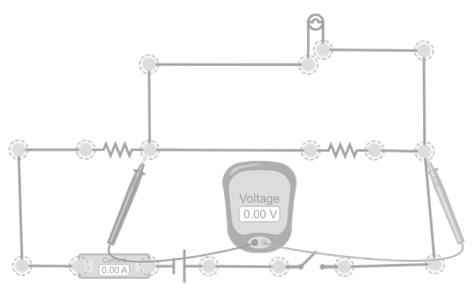
When a load is connected to the output of a voltage divider, this load is placed in parallel with the lower resistor of the divider. The equivalent resistance of this parallel is less than the original resistance, so the voltage distribution changes. As a result, the output voltage decreases compared to the ideal value predicted by the unloaded divider. This phenomenon is known as the loading effect, and is fundamental in electronic design: a divider will only work correctly if the load has a much higher resistance than the divider itself. Otherwise, the output voltage is affected and becomes unreliable.

Current divider

In a parallel circuit, the voltage is the same across all branches. Therefore, the current flowing through each branch depends only on its resistance. The current divider takes advantage of this property: the total current is distributed among the branches inversely proportional to their resistances. This allows the current to be distributed among different paths according to the needs of the circuit. The analysis is complementary to that of the voltage divider: instead of distributing voltages in series, currents are distributed in parallel.

Explore the exciting STEM world with our free, online, simulations and accompanying companion courses! With them you’ll be able to experience and learn hands-on. Take this opportunity to immerse yourself in virtual experiences while advancing your education – awaken your scientific curiosity and discover all that the STEM world has to offer!

Resistive divider simulations

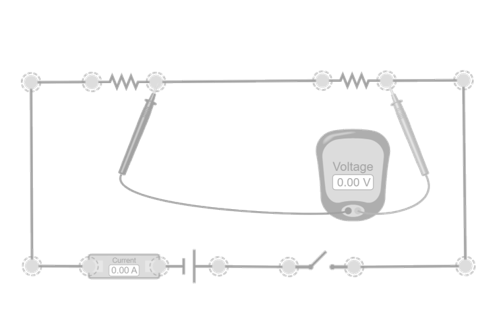
Basic voltage divider


In this simulation, the simplest voltage divider is represented: two resistors connected in series to a voltage source. The current flowing through both resistors is the same, so the voltage drop across each depends only on its value. The output voltage is taken at the intermediate point of the divider, between the two resistors. By changing the values of the resistors, you can observe how the output voltage changes. If you increase the lower resistor, the output voltage increases; if you decrease it, the output voltage drops. This behaviour directly reflects the relationship between the resistors in the divider.
Licencia de Creative Commons

Voltage divider with potentiometer


This simulation is the same as the basic voltage divider, but with a slightly different aim. As there is no element that simulates a real potentiometer with a sliding cursor, the behaviour of a potentiometer has been simulated by again using two resistors in series, manually adjusting both values in a complementary way so that their sum remains constant, as would happen in a potentiometer. The intermediate point between the two resistors acts as the potentiometer’s cursor. It is, therefore, a particular case of the basic voltage divider. By changing the values of R1 and R2 while keeping their sum fixed, the voltage measured at the intermediate node shifts continuously between 0 V and the source voltage, thus reproducing the behaviour of a voltage divider with potentiometer.
Licencia de Creative Commons

Voltage divider with connected load


This simulation analyses what happens when a load is connected to the output of a voltage divider. The load is placed in parallel with the lower resistor of the divider, so the equivalent resistance decreases and the output voltage is reduced compared to the ideal value. This phenomenon, known as the loading effect, is fundamental to understanding why a voltage divider only works properly when the load has a much higher resistance than the divider itself. Check that the output voltage decreases when the load is connected, in accordance with the equivalent resistance of the loaded divider.
Licencia de Creative Commons

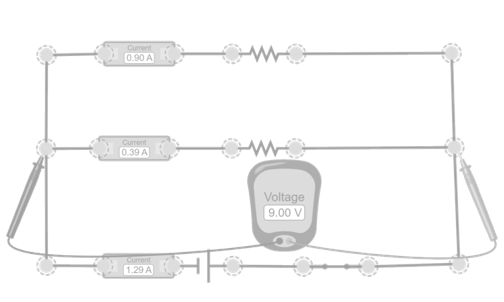
Current divider in parallel


In this simulation, it is studied how the current is distributed when two resistors are connected in parallel. In a parallel circuit, the voltage is the same across all branches, so the current flowing through each depends only on its resistance. Branches with lower resistance conduct more current, while those with higher resistance conduct less. This behaviour forms the current divider, which is complementary to the voltage divider. Check that the current in each branch matches the prediction of the current divider.
Licencia de Creative Commons

To learn and experience

Take your knowledge to the next level with science kits and hands-on tools that connect theory with experimentation

“If I have seen further, it is by standing on the shoulders of giants”

Isaac Newton

Your path to becoming a giant of knowledge begins with these top free courses

Test your knowledge

You may also be interested

Cargando clima y ubicación...

You may also be interested

Electricityfrom the Noun Project