Generic selectors
Exact matches only
Search in title
Search in content
Post Type Selectors

Vilhelm Friman Koren Bjerknes

Vilhelm Friman Koren Bjerknes icon
17/07/2026

🗓️

🌱March 14, 1862 – Oslo, Norway.
🍂April 9, 1951 – Oslo, Norway.

🌟 Main Contribution

Vilhelm Bjerknes established principles of modern weather forecasting and applied physics and mathematics to the climate
“To understand the climate is to understand our world”
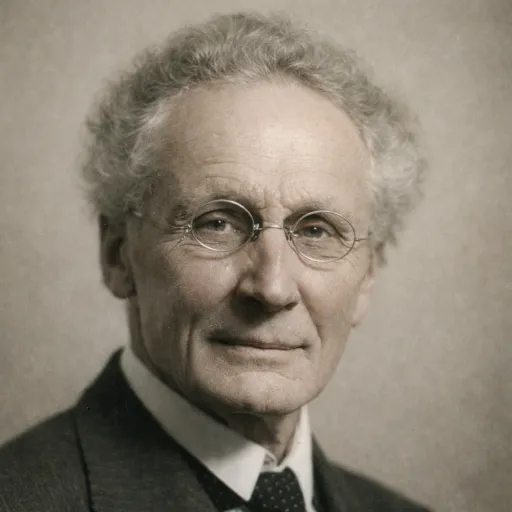
Vilhelm Friman Koren Bjerknes portrait

🧐 Did you know?

Vilhelm Friman Koren Bjerknes possessed such brilliant institutional charisma and pedagogical capacity that he successfully convinced the Norwegian government in the middle of World War I restrictions to deploy a dense network of military meteorological observation stations along the country’s entire Atlantic coast. To name the invisible thermal collision lines his barometers detected in the sky, Bjerknes drew direct analogical inspiration from the terrible and static trench lines of the battlefield fronts in central Europe devastating the era, thus introducing the military word “”front”” into the universal scientific and daily language of global meteorology.

🏅 Awards and Honors

Bjerknes received the Symons Medal (1932) and is regarded as the founder of modern physical meteorology.

📚 Their name in science

➤ Bjerknes theorem

Fundamental theorem concerning circulation in fluids.

➤ Bjerknes force

Force acting on bodies immersed in oscillating fluids.

❓ Who was Vilhelm Friman Koren Bjerknes?

Vilhelm Friman Koren Bjerknes was a Norwegian physicist and meteorologist, unanimously recognized as the father of modern dynamic meteorology for pioneering the application of hydrodynamic and thermodynamic laws to atmospheric movement. Educated at the University of Oslo and a collaborator of Heinrich Hertz in Germany, he developed a dazzling academic career founding the celebrated Bergen School of Meteorology. He possessed a mind endowed with an exceptional analytical and integrating vision, capable of unifying theoretical physics continuous fluid equations with the chaotic behavior of global weather. Bjerknes did not view weather forecasting as a descriptive empirical art based on rudimentary historical statistics, but as a rigorous physical-mathematical problem subject to calculating exact initial conditions.

🌍 The world in their time

In the early 20th century, weather forecasting was a pre-scientific discipline dominated by descriptive guessing techniques based on visual similarities to past pressure maps. Meteorologists lacked an analytical physical and dynamic framework explaining how large air masses within the lower atmosphere were born, evolved, and collided, limiting the safety of commercial maritime navigation and nascent air transport.

Become a giant

Your path to becoming a giant of knowledge begins with these top free courses
free climate modeling course
Free mode

Modeling Climate Change

free Antarctic climate course
Free mode

Antarctica in a Changing Climate

free climate change course
Free mode

Climate Change: The Science and Global Impact

free climate modeling course
Free mode

Modeling Climate Change

free Antarctic climate course
Free mode

Antarctica in a Changing Climate

🔬 Scientific legacy

Vilhelm Friman Koren Bjerknes revolutionized Earth sciences by publishing his pioneering 1904 manifesto regarding numerical weather prediction, mathematically proposing that the atmosphere is governed by a system of seven fundamental fluid equations and idealizing forecasting as an analytical problem of mathematical physics. Heading the Bergen School, he discovered and introduced the Extratropical Cyclone Model in 1919 alongside his son Jacob Bjerknes, coining international concepts of “”cold front,”” “”warm front,”” and “”occluded front”” to mathematically describe dynamic boundaries where air masses of different temperature and density collide, transforming synoptic climatology into applicable pure physics.

👣 Footprint in today's world

The legacy of Vilhelm Friman Koren Bjerknes forms the scientific, computational, and instrumental infrastructure of all contemporary climate forecasting centers, aviation, and environmental models. His forecasting approach based on differential equations is the physical pillar used today by global agency supercomputers to model planetary climate change, predict hurricane routes with millimetric precision, alert about extreme winter storms, and manage orbital weather satellites scanning Earth’s atmosphere continuously.

🏃‍♂️ The relay race

📥 Taking the baton

The monumental dynamic breakthroughs of Vilhelm Friman Koren Bjerknes built directly upon circulation theorems of perfect fluids developed by Lord Kelvin and Hermann von Helmholtz, combined with Leonhard Euler’s general classical hydrodynamic equations.

📤 Passing the baton

The analytical unification achieved by Vilhelm Friman Koren Bjerknes transformed descriptive meteorology into an exact branch of theoretical classical fluid physics, serving as a foundational guide for later scientists like Lewis Fry Richardson and Jule Charney to develop the first atmospheric simulation computer models of the 20th century. His three-dimensional front theories laid the foundations for understanding global thermal and inertial energy transfer between Earth’s equatorial regions and poles.

Other giants you will want to get to know

Alexander von Humboldt

Alexander von Humboldt

1769

 –

1859
The visionary naturalist who conceived nature as an interconnected global web.
Alfred Lothar Wegener

Alfred Lothar Wegener

1880

 –

1930
The daring meteorologist who discovered that the continents are in constant motion.
Evangelista Torricelli

Evangelista Torricelli

1608

 –

1647
The bold physicist who proved the existence of atmospheric pressure and invented the mercury barometer.
Luke Howard

Luke Howard

1772

 –

1864
The godfather of meteorology who named the clouds and scientifically ordered the chaos of the sky.
Vilhelm Friman Koren Bjerknes

Vilhelm Friman Koren Bjerknes

1862

 –

1951
The strategist of atmospheric physics who discovered meteorological fronts and founded numerical weather prediction.

Tools

Scientific calculator

Powered by Desmos

Scientific Dictionary

Powered by Wikipedia

2026 Best Online STEM Education Platform

Cargando clima y ubicación...

To learn and experience

Take your knowledge to the next level with science kits and hands-on tools that connect theory with experimentation

Essential for teachers and students

Learn with the best courses