Generic selectors
Exact matches only
Search in title
Search in content
Post Type Selectors

Isaac Newton

Isaac Newton icon
17/07/2026

🗓️

🌱December 25, 1642 – Woolsthorpe, England.
🍂March 20, 1727 – London, England.

🌟 Main Contribution

Isaac Newton formulated the law of universal gravitation and the three laws of motion, founding classical mechanics.
“If I have seen further, it is by standing on the shoulders of giants”
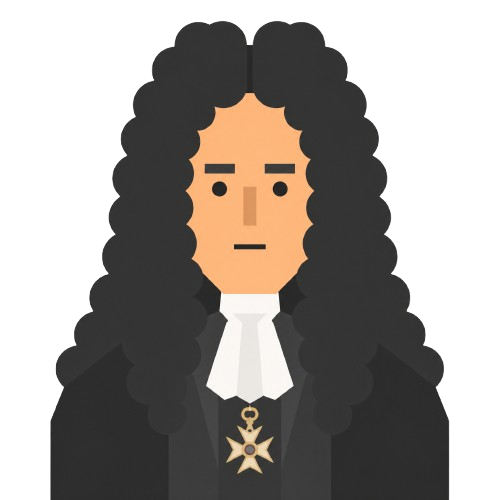
Isaac Newton portrait

🧐 Did you know?

Isaac Newton was a reclusive researcher who was intensely protective of his work and hated public disputes with other scientists. He conducted extremely dangerous optical experiments in the privacy of his room; on one occasion, he inserted a blunt bodkin needle between his eye and the bone, pressing the retina to observe firsthand how the perception of colors and shapes altered under mechanical pressure.

🏅 Awards and Honors

Newton was knighted by Queen Anne in 1705. He served as President of the Royal Society (1703–1727), was a Member of Parliament, and is regarded as one of the most influential scientists in history.

📚 Their name in science

💪 Newton (N)

The SI unit of force.

➤ Newton’s laws of motion

Three fundamental laws describing the motion of bodies.

➤ Newton’s law of universal gravitation

Law describing the gravitational attraction between masses.
➤ Newton’s method

Numerical method for approximating the roots of a function.

➤ Newtonian telescope

Reflecting telescope that uses a concave primary mirror and a flat secondary mirror to direct the light to the side of the telescope tube.

Ad

❓ Who was Isaac Newton?

Isaac Newton was an English physicist, mathematician, astronomer, and theologian, universally recognized as one of the most brilliant minds in human history for establishing the foundations of classical physics. Raised in a rural environment and educated at the University of Cambridge, he possessed an obsessive and solitary mind that sought to decipher the hidden mathematical order behind nature’s phenomena. Newton did not view the cosmos as an unpredictable chaos, but as a perfect mechanism regulated by divine and rational laws. His experimental and deductive approach marked the end of medieval scholasticism, guiding humanity into the age of reason and modern science.

🌍 The world in their time

In the mid-17th century, physics lacked a unified conceptual framework to explain the motion of bodies. Scientists did not understand why objects fell to the ground on Earth or what exact force kept planets in orbit around the Sun, assuming that celestial and terrestrial laws were governed by completely different mechanical principles.

Become a giant

Your path to becoming a giant of knowledge begins with these top free courses
free quantum optomechanics course
Free mode

Cavity Quantum Optomechanics

free astrophysics enigmas course
Free mode

Greatest Unsolved Mysteries of the Universe

free exoplanets course
Free mode

Astrophysics: Exploring Exoplanets

free quantum optomechanics course
Free mode

Cavity Quantum Optomechanics

free astrophysics enigmas course
Free mode

Greatest Unsolved Mysteries of the Universe

🔬 Scientific legacy

Isaac Newton revolutionized science by publishing the *Philosophiae Naturalis Principia Mathematica* in 1687, where he formulated the law of universal gravitation and the three laws of motion that bear his name. In mathematics, he invented infinitesimal calculus concurrently with Leibniz, providing the analytical tool necessary for advanced physics. In optics, he demonstrated through prism experiments that white light is composed of a spectrum of colors and built the first functional reflecting telescope in history, eliminating the chromatic aberration of traditional lenses.

👣 Footprint in today's world

The legacy of Isaac Newton forms the structural backbone of contemporary civil engineering, architecture, and aerospace exploration. His mechanical equations continue to be used daily for calculating architectural structures, designing industrial machinery, and drafting the gravitational trajectories that allow space agencies to place satellites and probes into orbit.

🏃‍♂️ The relay race

📥 Taking the baton

The monumental mechanical breakthroughs of Isaac Newton built firmly upon the astronomical observations of Tycho Brahe, the planetary motion laws of Johannes Kepler, and the experiments on falling bodies conducted by Galileo Galilei.

📤 Passing the baton

The physical unification achieved by Isaac Newton definitively validated Copernicus’s heliocentric model and served as an indispensable foundation for the development of 18th-century analytical mechanics. His optical and mechanical theories dominated worldwide scientific thought until the development of relativity and quantum physics expanded the boundaries of subatomic knowledge.

Other giants you will want to get to know

William Rowan Hamilton

William Rowan Hamilton

1805

 –

1865
The astronomer of quaternionic algebra who unified physical mechanics calculus and anticipated optical space.
Galileo Galilei

Galileo Galilei

1564

 –

1642
The father of modern science who aimed his telescope at the heavens and challenged the world defending heliocentrism.
Henri Cartan

Henri Cartan

1904

 –

2008
The master of algebraic topology who reshaped modern mathematics and structured sheaf theory.
Alan Turing

Alan Turing

1912

 –

1954
The mathematical genius who laid the foundations of computing and cracked the Enigma code.
Leonhard Euler

Leonhard Euler

1707

 –

1783
The supreme titan of mathematical analysis who unified the language of calculus and mastered science without sight.

Tools

Scientific calculator

Powered by Desmos

Scientific Dictionary

Powered by Wikipedia

2026 Best Online STEM Education Platform

Cargando clima y ubicación...

To learn and experience

Take your knowledge to the next level with science kits and hands-on tools that connect theory with experimentation

Essential for teachers and students

Learn with the best courses