Generic selectors
Exact matches only
Search in title
Search in content
Post Type Selectors

Gottfried Wilhelm Leibniz

Gottfried Wilhelm Leibniz icon
28/08/2026

🗓️

🌱July 1, 1646 – Hannover, Germany.
🍂November 14, 1716 – Hannover, Germany.

🌟 Main Contribution

Gottfried Wilhelm Leibniz was one of the founders of infinitesimal calculus, created modern mathematical notation, and contributed to mechanics and optics with groundbreaking theories
“Music is the hidden exercise of arithmetic of the soul, which does not know it is calculating.”
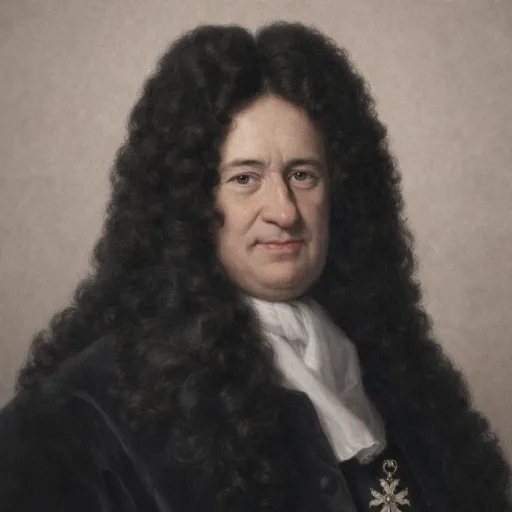
Gottfried Wilhelm Leibniz portrait

🧐 Did you know?

Gottfried Wilhelm Leibniz became embroiled in one of the bitterest and most destructive scientific disputes in the history of science against Isaac Newton over the paternity of calculus. The Royal Society of London, presided over by Newton himself, appointed an “independent” committee that falsely accused Leibniz of plagiarism, a devastating moral blow causing the German genius to spend his final years isolated, passing away in poverty and being buried in an unmarked grave attended only by his secretary.

🏅 Awards and Honors

Leibniz was admitted as a foreign Fellow of the Royal Society of London in 1673 and of the French Academy of Sciences in 1700. Additionally, he was the driving force, founder, and first president of the Prussian Academy of Sciences in 1700.

📚 Their name in science

➤ Leibniz’s Calculus

Formal system of infinitesimal calculus developed independently of Newton, introducing the practical notation for differentials and integrals used in modern mathematics.

Ad

❓ Who was Gottfried Wilhelm Leibniz?

Gottfried Wilhelm Leibniz was a German polymath, philosopher, and mathematician widely ranked among the most titanic and multidisciplinary intellects in human history. Gifted with a mind of limitless conceptual absorption and synthesis capacity, he practiced as a diplomat, lawyer, historian, and royal advisor, solving complex European political problems while revolutionizing exact sciences in his spare time. Leibniz sought untiringly a universal language, a perfect logical order capable of settling all human disputes through mathematical calculation. His perfectionism led him to design one of the earliest advanced mechanical calculators and to conceive the digital framework of computing centuries before its physical realization.

🌍 The world in their time

In the late 17th century, mathematics lacked operational tools to calculate precisely continuous rates of change, areas underneath complex curves, or the accelerated motion of celestial bodies, relying on clumsy geometric methods. At the same time, numerical systems lacked a simplified logical structure capable of automating mechanical thought.

Become a giant

Your path to becoming a giant of knowledge begins with these top free courses
free quantum optomechanics course
Free mode

Cavity Quantum Optomechanics

free advanced nanophotonic course
Free mode

Nanophotonic Modeling

free materials capstone course
Free mode

Capstone Exam – Materials for Electronic, Optical, and Magnetic Devices

free quantum optomechanics course
Free mode

Cavity Quantum Optomechanics

free advanced nanophotonic course
Free mode

Nanophotonic Modeling

🔬 Scientific legacy

Gottfried Wilhelm Leibniz revolutionized science by developing Infinitesimal Calculus independently from Isaac Newton between 1674 and 1676, introducing the perfect mathematical notation (the integral $int$ and derivative $d$ symbols) used universally today. In logic and computing, he perfected and documented the modern Binary System, proving mathematically that any arithmetic operation can be conducted utilizing exclusively zeros and ones ($0$ and $1$). He also invented the Leibniz wheel for mechanical calculating.

👣 Footprint in today's world

The legacy of Gottfried Wilhelm Leibniz forms the absolute foundation of modern engineering and the contemporary digital age. His calculus notation is the tool used daily in physics, architecture, economics, and global engineering. His binary system stands as the elementary logical language powering absolutely every modern microchip, computer, internet server, and artificial intelligence system today.

🏃‍♂️ The relay race

📥 Taking the baton

The monumental theoretical breakthroughs of Gottfried Wilhelm Leibniz developed upon the analytical geometry foundations of René Descartes, the logical studies of Blaise Pascal, and the scientific correspondences maintained with Christiaan Huygens during his years staying in Paris.

📤 Passing the baton

The brilliant analytical and infinitesimal calculus system developed by Gottfried Wilhelm Leibniz was rapidly adopted and expanded by the Bernoulli mathematical dynasty and Leonhard Euler, enabling the unfolding of 18th-century theoretical physics and rational mechanics across continental Europe.

Other giants you will want to get to know

Euclides

Euclides

300 a.C.

 –

?
The father of geometry who structured humanity’s logical thinking through his mathematical axioms.
Michael Faraday

Michael Faraday

1791

 –

1867
The wizard of electrical induction who visualized magnetic lines of force and transformed industry.
Leonhard Euler

Leonhard Euler

1707

 –

1783
The supreme titan of mathematical analysis who unified the language of calculus and mastered science without sight.
Henri Cartan

Henri Cartan

1904

 –

2008
The master of algebraic topology who reshaped modern mathematics and structured sheaf theory.
Johannes Kepler

Johannes Kepler

1571

 –

1630
The mathematical astronomer who shattered celestial geometric perfection by discovering the elliptical orbits of planets.

Tools

Scientific calculator

Powered by Desmos

Scientific Dictionary

Powered by Wikipedia

2026 Best Online STEM Education Platform

Cargando clima y ubicación...

To learn and experience

Take your knowledge to the next level with science kits and hands-on tools that connect theory with experimentation

Essential for teachers and students

Learn with the best courses