Generic selectors
Exact matches only
Search in title
Search in content
Post Type Selectors

Chemical reactions. Types, examples and simulations

25/03/2026

The online chemical reaction simulations on this page will help you to better understand how chemical reactions occur and the most important types of reactions. We will look at some important types of chemical reactions such as precipitation, neutralization and acid-base reactions.

What are chemical reactions

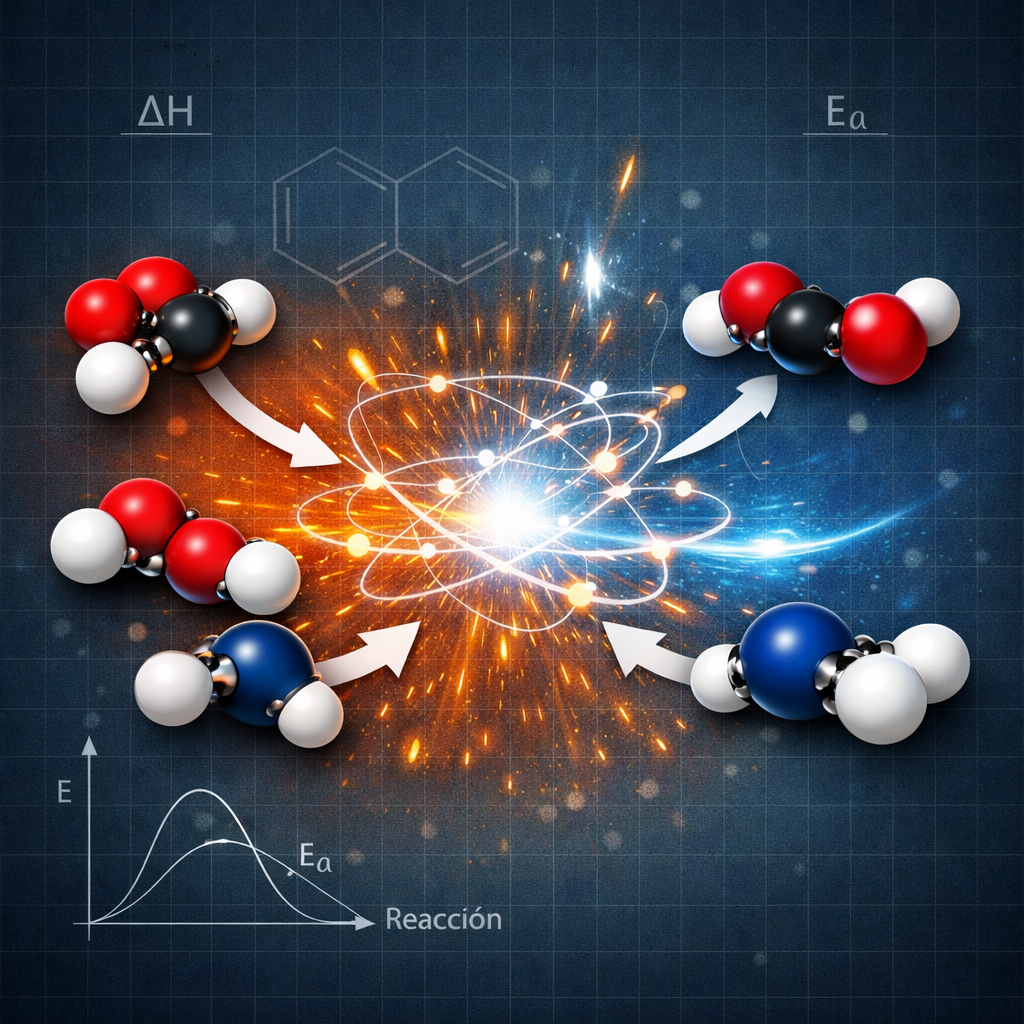
Chemical reactions are processes in which the atoms of reactants are rearranged to form new molecules or compounds. These processes are fundamental in chemistry and in everyday life.

Types of chemical reactions

A chemical reaction can be classified into different types, depending on the nature of the reactants and products, and the way in which the transformation is carried out. Some of the most common types are:

Synthesis reactions or combination reactions

In the synthesis reactions, also called combination reactions, two or more reactants combine to form a single product. For example, the synthesis of water from hydrogen and oxygen.

Decomposition reactions

A single reactant is split into two or more products. For example, the decomposition of hydrogen peroxide into water and oxygen.

Substitution or displacement reactions

One element or functional group of a reactant is replaced by another element or functional group. For example, the reaction of an acid with a metal to form a salt and release hydrogen.

Oxidation-reduction reactions

A transfer of electrons occurs between the reactants, and may involve the gain or loss of electrons. For example, the oxidation of iron in the presence of oxygen to form iron oxide.

Precipitation reactions

In precipitation reactions, a solid is formed from aqueous solutions. These reactions occur when two solutions containing soluble salts mix and form an insoluble compound, known as a precipitate. A common example is the reaction between silver nitrate and sodium chloride, which results in the formation of solid silver chloride.

Acid-base reactions

In these reactions, an acid donates protons (H⁺) and a base accepts protons. This type of reaction is fundamental in many areas, including industrial and biological chemistry. An everyday example is the neutralization of hydrochloric acid in the stomach with antacids, which contain bases such as sodium bicarbonate.

Combustion reactions

A compound reacts with oxygen to produce carbon dioxide, water and the release of energy in the form of heat. For example, the combustion of hydrocarbons in engines.

Each type of chemical reaction has specific characteristics. For example, synthesis reactions tend to be exothermic, while decomposition reactions tend to be endothermic.

Examples of chemical reactions in everyday life

Chemical reactions are present in many aspects of our daily lives.

Photosynthesis

Photosynthesis is a synthesis reaction where plants produce glucose and oxygen from carbon dioxide and water with the help of sunlight.

Hydrocarbon combustion

Another example is the combustion of hydrocarbons in car engines, an oxidation-reduction reaction in which fuel reacts with oxygen to produce carbon dioxide and water, releasing energy in the form of heat.

Reactions in cooking

We also find decomposition reactions in cooking, such as when baking a cake in the oven decomposes baking soda into carbon dioxide and water, which helps the cake rise.

Reactions in the human body

Acid-base reactions are present in our body, such as the neutralization of hydrochloric acid in the stomach by bicarbonate in the intestine. Another fundamental example is the reaction of cellular respiration. During respiration, cells convert glucose and oxygen into carbon dioxide, water and energy. This process is essential for the production of energy that our body needs to function.

Cleansing products

Precipitation reactions are common when we mix certain solutions to clean lime from pipes, forming solids that can be easily removed.


Explore the exciting STEM world with our free, online, simulations and accompanying companion courses! With them you’ll be able to experience and learn hands-on. Take this opportunity to immerse yourself in virtual experiences while advancing your education – awaken your scientific curiosity and discover all that the STEM world has to offer!

Simulations of chemical reactions

Precipitation reactions


In this first example of chemical reaction simulations, we can see a precipitation reaction. In a precipitation reaction, two soluble compounds react to form an insoluble solid that precipitates in the bottom. This simulation allows you to select several compounds and observe their reactions.


Neutralization reactions


In this new case of chemical reaction simulations, we are going to study a neutralization reaction. In a neutralization reaction, an acid and a base dissolved in water react to produce a salt that remains dissolved in the water. This simulation allows you to select various combinations of acid and base and observe their reactions.


Reaction rate


In this simulation it is possible to observe how the concentration of the initial compounds and that of the final compound vary in a reaction.


Acid-Base reactions


In the last of these online chemical reaction simulations, we are going to study acid-base reactions. How different strong and weak acids are? Use the tools in the computer lab to find out! Dip the paper or meter into the solution to measure pH, or use the electrodes to measure conductivity. Then observe how concentration and strength affect the pH Can a solution of a weak acid have the same pH as a solution of a strong acid?
Licencia de Creative Commons

“If I have seen further, it is by standing on the shoulders of giants”

Isaac Newton

Your path to becoming a giant of knowledge begins with these top free courses

Test your knowledge

A chemical reaction is a process in which initial substances called reactants interact with each other to transform into different substances called products, and during this change the atoms that make up the reactants are rearranged without creating or destroying new atoms, which means that the properties of the products can be very different from those of the original reactants. This concept is fundamental to understanding phenomena such as combustion, oxidation, the formation of new compounds, or the metabolic processes that occur in living organisms.
We know that a chemical reaction has occurred when we observe changes that cannot be explained simply by a change of physical state, such as when a mixture releases or absorbs energy in the form of heat or light, a gas is produced, a solid precipitate forms, the color of the mixture changes, or one of the original substances disappears. These changes reflect that the bonds between atoms have broken and new bonds have formed to generate products with characteristics different from the reactants.
Many times, dramatic changes like fire or foam are not visible, but that does not mean no reaction is happening, because some chemical reactions occur slowly or with very subtle changes. In those cases, more precise measurements can be used, such as observing variations in temperature, changes in pH, the consumption of a reactant, or the formation of a product through more detailed analysis, and by combining that information with theory, it is possible to confirm that a chemical reaction has indeed taken place even if it is not immediately visible.
Sometimes heat must be supplied to a mixture for a reaction to occur because the particles of the reactants need enough energy to overcome the barriers that prevent their bonds from breaking and forming new ones. This activation energy acts like a threshold that particles must surpass for the reaction to start, and the supplied heat increases the kinetic energy of the particles, raising the likelihood of effective collisions and allowing the reaction to proceed.
Not always, because simply combining substances is not enough to produce a chemical reaction; the reactants must have favorable conditions and compatibility that allow their atoms to reorganize in a stable way after breaking and forming bonds. Some mixtures remain merely as physical mixtures without chemical changes, while others require an energy spark, a catalyst, an appropriate environment, or the presence of specific molecules for the reaction to occur significantly.

You may also be interested

Cargando clima y ubicación...

You may also be interested