AC Power Source Combination
The online simulations of AC source combinations on this page allow you to immediately see how two alternating signals behave when they interact within a real circuit. To do this, we build two simple circuits—one in series and one in parallel—each with a light bulb as a visual indicator and the necessary instruments to measure what is happening. The voltmeter is always placed between the main nodes to display the voltage across the light bulb, while the ammeter is positioned at the appropriate point to record the current flowing through the circuit. From there, visitors can modify the parameters of the power sources and observe how the brightness, voltage, and current change, gaining a direct understanding of AC signal superposition without resorting to calculations.
Esta Unidad Temática es parte de nuestra colección de Circuitos

Mini diccionario STEM OnLine
Batido
Fenómeno dinámico que aparece al combinar fuentes de corriente alterna con frecuencias ligeramente diferentes, caracterizado por una fluctuación periódica de la amplitud total que crea un patrón de modulación o envolvente visual.
Combinación de fuentes
Conexión de múltiples generadores de corriente alterna en un mismo circuito eléctrico para analizar la superposición de sus señales. El resultado final de tensiones y corrientes depende simultáneamente de las amplitudes, frecuencias y relaciones de fase de cada fuente.
Corriente de circulación
Corriente eléctrica no deseada que fluye directamente entre dos fuentes conectadas en paralelo cuando existe una diferencia de tensión, fase o frecuencia entre ellas, pudiendo provocar inestabilidad o daños severos en los equipos.
Distorsión por superposición
Alteración no deseada en la forma geométrica original de una señal eléctrica en circuitos electrónicos, producida cuando múltiples ondas de corriente alterna interactúan de forma desfavorable en un nodo común del circuito.
Envolvente de señal
Curva imaginaria que une los valores máximos y mínimos de una forma de onda compleja o modulada, haciendo visible el patrón de variación periódica de la amplitud provocado por fenómenos como los batidos de frecuencia.
Interferencia constructiva
Efecto que se produce cuando dos o más ondas de corriente alterna coinciden en fase o con un desfase mínimo, provocando que sus amplitudes instantáneas se sumen y den como resultado una señal con mayor tensión o corriente total.
Interferencia destructiva
Efecto que ocurre cuando dos ondas de corriente alterna se encuentran desfasadas, lo que hace que sus amplitudes instantáneas se resten, reduciendo la magnitud total de la señal eléctrica o deformando su geometría original.
Sincronización de fuentes
Proceso obligatorio en ingeniería eléctrica que consiste en igualar la frecuencia, la fase y la amplitud de dos o más generadores antes de conectarlos en paralelo. Esto evita la aparición de corrientes de circulación destructivas entre las propias fuentes.
Suma vectorial de señales
Método matemático y geométrico utilizado en electrónica para combinar señales de corriente alterna, teniendo en cuenta tanto la magnitud de las ondas como sus respectivos ángulos de fase, en lugar de realizar una suma aritmética simple.
Superposición de ondas
Fenómeno físico y eléctrico donde dos o más ondas senoidales se combinan en cada instante de tiempo dentro de un circuito, dando lugar a una nueva forma de onda resultante que puede presentar refuerzos, atenuaciones o cancelaciones.
Ad
What is the combination of AC sources
The combination of AC sources involves connecting two or more alternating current sources within the same circuit to observe how their electrical effects add up. When multiple sources operate simultaneously, their voltages and currents do not simply add together: they depend on the amplitude, frequency, and, above all, the phase of each source.
In an AC circuit, each source generates a sinusoidal wave. When combined, these waves superimpose on one another and produce results that can be very different from those of each source individually: increases in amplitude, reductions, partial or total cancellations, and even periodic variations when the frequencies differ.
Understanding how multiple AC sources interact is essential for interpreting real-world phenomena such as interference, current sharing, beat frequencies, or unexpected behavior in electrical networks. Simulations allow us to visualize this superposition immediately and understand how small changes in phase or frequency completely alter the final result.
AC sources in series
When two AC sources are connected in series, their voltages add together according to the rules of superposition. However, this addition is not arithmetic: it depends on the amplitude, frequency, and phase of each source. If both waves are in phase, the resulting voltage increases; if they are out of phase, the combination may be reduced or even canceled out. In this configuration, the current flowing through the circuit is the same for both sources, so any difference in phase or frequency is directly reflected in the overall waveform. This allows us to observe phenomena such as constructive interference, where voltages reinforce each other, and destructive interference, where they cancel each other out.
Sum of voltages
When two AC sources are connected in series, their voltages combine according to the principle of superposition. The total voltage of the circuit is the instantaneous sum of the individual voltages, which means it depends on how the waves align at any given moment. If both sources have the same frequency and are in phase, the resulting voltage increases; if they are out of phase, the sum may be lower or even cancel out entirely.
Influence of phase
Phase is the factor that most determines the result of the combination. Two sources with the same amplitude and frequency can produce very different voltages depending on the phase difference between them. A small phase difference produces a reinforced signal; a large phase difference can reduce the total amplitude. When the phase difference reaches 180°, the voltages are completely opposed.
Constructive and destructive interference
Constructive interference occurs when waves reinforce each other, increasing the amplitude of the total voltage. Destructive interference occurs when waves cancel each other out, reducing the amplitude or distorting the waveform. In a series circuit, these effects are very clearly observed because the total voltage is the direct sum of both sources.
Cancellation due to phase shift
If two sources have the same amplitude and frequency but are out of phase by 180°, the resulting voltage is practically zero. Although each source continues to generate its own wave, the instantaneous sum cancels out. This phenomenon is particularly useful for understanding how phase can completely dominate the behavior of a circuit.
Effect of different frequencies (Beats)
When the sources have slightly different frequencies, the total voltage exhibits a characteristic pattern: beats. The amplitude appears to periodically increase and decrease, creating a visible envelope in the simulation. This effect arises from the difference between the frequencies and is a direct demonstration of how wave superposition produces dynamic phenomena even in simple circuits.
AC Sources in Parallel
Connecting two AC sources in parallel means connecting them between the same two nodes in the circuit. In this configuration, the voltage is common to all sources because they share exactly the same connection points. This implies that, in an ideal scenario, all sources should have the same instantaneous voltage, regardless of their internal characteristics. In practice, connecting different AC sources in parallel is not physically feasible unless they are perfectly synchronized. If each source attempts to impose a different voltage, enormous currents would flow between them, causing instability and potential damage. For this reason, in real-world installations, sources connected in parallel are used only when they are synchronized in frequency, phase, and amplitude—as is the case with generators in a power grid.
Sum of currents
In a parallel connection, each source attempts to impose its own current on the circuit. The total current is the instantaneous sum of the currents contributed by each source, and this sum depends on how the waves align at any given moment. If the sources are in phase, the total current increases; if they are out of phase, the sum may decrease or even be partially canceled out.
Influence of phase
Phase determines how the currents from each source interact. A small phase shift can alter the waveform of the total current, while a large phase shift can cause one source to “push” current in the opposite direction of the other. When the phase shift reaches 180°, the currents are completely opposite, resulting in a significant reduction in the total current of the circuit.
Constructive and destructive interference
Constructive interference occurs when the currents from both sources reinforce each other, increasing the total current. Destructive interference occurs when the currents cancel each other out, reducing the amplitude or distorting the waveform. In a parallel circuit, these effects are very clearly observed bec
ause each source contributes directly to the total current.
Cancellation due to phase shift
If two sources have the same amplitude and frequency but are out of phase by 180°, the total current can approach zero. Although each source continues to generate its own current, the instantaneous sum cancels out. This phenomenon is particularly useful for understanding how phase can dominate circuit behavior even when the sources are connected in parallel.
Effect of different frequencies (Beats)
When the sources have slightly different frequencies, the total current exhibits the phenomenon of beating: the amplitude of the current appears to periodically increase and decrease. The resulting envelope is clearly visible in the simulations and demonstrates how the superposition of waves with different frequencies generates dynamic variations even in simple configurations.
Real-World Applications of AC Source Combination
Although the combination of AC sources is studied under ideal conditions in educational circuits, the phenomena of superposition, interference, and phase shift constantly occur in real electrical systems. In power distribution networks, audio equipment, and electronic devices, different sources or signals interact with one another, producing amplifications, cancellations, or distortions of the waveform. Understanding these effects helps interpret behaviors that, at first glance, may seem anomalous but are a direct consequence of the superposition of alternating voltages and currents.
Interference in electrical grids
In an electrical grid, multiple generators operate in parallel to supply power. If they are not perfectly synchronized in frequency and phase, small differences may arise that cause interference in the voltage or current. These variations can manifest as fluctuations, harmonics, or waveform distortions, especially when large loads are connected or disconnected. Coordination among generators is based precisely on preventing their voltages from combining in an undesirable way.
Audio systems and signal mixing
In audio, the combination of AC signals is a constant occurrence. When two sound sources are mixed, their waves overlap and can reinforce or cancel each other out depending on their phase. This explains phenomena such as voice cancellation in some systems, phasing and flanging effects, or the occurrence of beat frequencies when two tones have closely matched frequencies. Although the context is acoustic, the mathematical behavior is identical to that of electrical sources.
Overlap in basic electronics
In electronic circuits, many AC signals are combined at common points: oscillators, modulators, filters, or amplification stages. The interaction between signals can produce interference, distortion, or amplitude variations that must be controlled to ensure the circuit functions correctly. Wave superposition is the basis for phenomena such as the vector sum of signals, the emergence of envelopes, or the generation of complex periodic patterns.

Mini diccionario STEM OnLine
Batido
Fenómeno dinámico que aparece al combinar fuentes de corriente alterna con frecuencias ligeramente diferentes, caracterizado por una fluctuación periódica de la amplitud total que crea un patrón de modulación o envolvente visual.
Combinación de fuentes
Conexión de múltiples generadores de corriente alterna en un mismo circuito eléctrico para analizar la superposición de sus señales. El resultado final de tensiones y corrientes depende simultáneamente de las amplitudes, frecuencias y relaciones de fase de cada fuente.
Corriente de circulación
Corriente eléctrica no deseada que fluye directamente entre dos fuentes conectadas en paralelo cuando existe una diferencia de tensión, fase o frecuencia entre ellas, pudiendo provocar inestabilidad o daños severos en los equipos.
Distorsión por superposición
Alteración no deseada en la forma geométrica original de una señal eléctrica en circuitos electrónicos, producida cuando múltiples ondas de corriente alterna interactúan de forma desfavorable en un nodo común del circuito.
Envolvente de señal
Curva imaginaria que une los valores máximos y mínimos de una forma de onda compleja o modulada, haciendo visible el patrón de variación periódica de la amplitud provocado por fenómenos como los batidos de frecuencia.
Interferencia constructiva
Efecto que se produce cuando dos o más ondas de corriente alterna coinciden en fase o con un desfase mínimo, provocando que sus amplitudes instantáneas se sumen y den como resultado una señal con mayor tensión o corriente total.
Interferencia destructiva
Efecto que ocurre cuando dos ondas de corriente alterna se encuentran desfasadas, lo que hace que sus amplitudes instantáneas se resten, reduciendo la magnitud total de la señal eléctrica o deformando su geometría original.
Sincronización de fuentes
Proceso obligatorio en ingeniería eléctrica que consiste en igualar la frecuencia, la fase y la amplitud de dos o más generadores antes de conectarlos en paralelo. Esto evita la aparición de corrientes de circulación destructivas entre las propias fuentes.
Suma vectorial de señales
Método matemático y geométrico utilizado en electrónica para combinar señales de corriente alterna, teniendo en cuenta tanto la magnitud de las ondas como sus respectivos ángulos de fase, en lugar de realizar una suma aritmética simple.
Superposición de ondas
Fenómeno físico y eléctrico donde dos o más ondas senoidales se combinan en cada instante de tiempo dentro de un circuito, dando lugar a una nueva forma de onda resultante que puede presentar refuerzos, atenuaciones o cancelaciones.
¡Explora el emocionante mundo STEM con nuestras simulaciones online gratis y los cursos complementarios que las acompañan! Con ellas podrás experimentar y aprender de manera práctica. Aprovecha esta oportunidad para sumergirte en experiencias virtuales mientras avanzas en tu educación. ¡Despierta tu curiosidad científica y descubre todo lo que el mundo STEM tiene para ofrecerte!
Ad
Simulations of AC source combinations
Series AC power sources
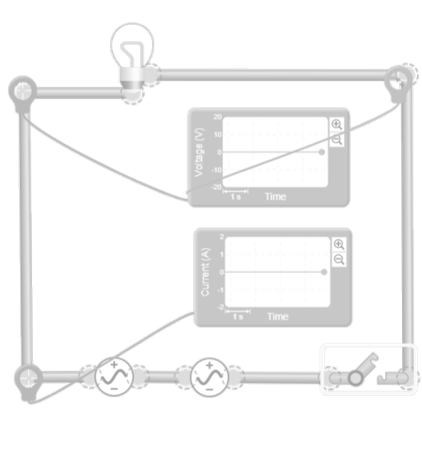
In this simulation, a circuit is constructed consisting of two alternating current sources connected in series and a light bulb located at the end of the circuit. The light bulb acts as an immediate visual indicator: when the voltage resulting from the combination increases, the brightness increases; when the combination is reduced or canceled out, the brightness decreases or disappears. This allows users to intuitively see how the sum of voltages behaves in a series connection. To allow visitors to measure what is happening, a voltmeter is placed across the terminals of the light bulb, so that it displays the total voltage generated by the superposition of both sources. In addition, an ammeter is connected in series with the circuit to record the current flowing through the light bulb and through both sources. With these two instruments, visitors can correlate the brightness with the actual electrical values.
The interactive activity involves adjusting the parameters of the power sources (voltage, phase, and frequency) and observing how the total voltage—and, consequently, the brightness of the light bulb—changes. When the power sources are in phase, the voltage is amplified and the light bulb shines brighter. When a phase shift is introduced, the resulting voltage decreases. If the phase shift reaches 180°, the light bulb practically goes out. If the frequencies are adjusted to be slightly different, the light bulb’s brightness rises and falls periodically, reflecting the phenomenon of beat frequency. The simulation graph shows how the resulting waveform matches what is displayed by the voltmeter, the ammeter, and the light bulb.
Parallel AC power sources
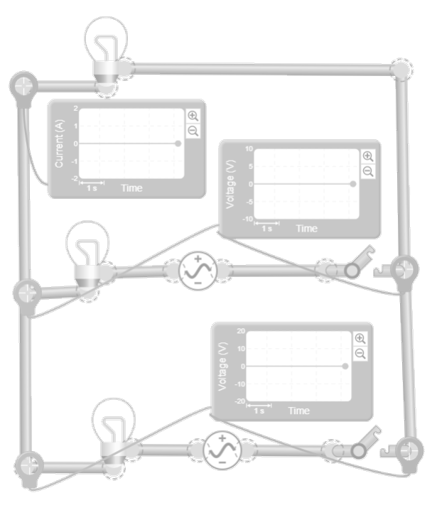
In this simulation, a circuit is built with two AC sources connected in parallel, sharing exactly the same two nodes. To visualize the effect of this combination, a light bulb is also connected between those nodes. Since the voltage is common to all branches, the light bulb acts as an indicator of the final result: if the currents supplied by the sources reinforce each other, the light bulb shines brighter; if they oppose each other, the brightness decreases. Although the voltages do not add up, the interaction between the currents modifies the power reaching the light bulb, and this is immediately reflected in its brightness. To measure what happens, a voltmeter is installed between the two main nodes, displaying the common voltage shared by the sources and the light bulb. In addition, an ammeter is placed on one of the branches, so that visitors can see the current supplied by each source and compare it with the total current flowing through the light bulb. This setup helps visitors understand that, in a parallel circuit, the voltage remains constant, but the currents do change depending on the phase and frequency of each source.
The interactive activity involves adjusting the parameters of the power sources and observing how the total current reaching the light bulb changes. When the power sources are in phase, both supply current in the same direction, and the light bulb receives more power, increasing its brightness. When a phase shift is introduced, part of the current from one source opposes that of the other, reducing the net current and causing the light bulb to dim. If the phase shift reaches 180°, the total current can approach zero, and the light bulb barely glows. If the frequencies are adjusted to be slightly different, the light bulb’s brightness rises and falls periodically, reflecting the beats in the total current. The simulation graph allows you to correlate these changes with the actual waveform flowing through the light bulb.
Gigantes de la ciencia
«Si he visto más lejos es porque estoy a hombros de gigantes»
Isaac Newton
Michael Faraday
–
André-Marie Ampère
–
Hazte gigante
Tu camino para ser un gigante del conocimiento comienza con estos cursos gratuitos de primer nivel
Principles of Modeling, Simulations, and Control for Electric Energy Systems
Principles of Electric Circuits | 电路原理
Introducción a los circuitos eléctricos
Electrotechnique I
Desarrollo profesional docente
Programas de formación orientados a fortalecer la práctica educativa en ciencias y tecnología
Teach teens computing: Cybersecurity
Teach computing: Introducing physical computing
Teaching with Physical Computing: Practical application and classroom strategies for PBL
HP AI Teacher Academy
Gigantes de la ciencia
«Si he visto más lejos es porque estoy a hombros de gigantes»
Isaac Newton
Michael Faraday
–
James Clerk Maxwell
–
Hazte gigante
Tu camino para ser un gigante del conocimiento comienza con estos cursos gratuitos de primer nivel
Principles of Modeling, Simulations, and Control for Electric Energy Systems
Principles of Electric Circuits | 电路原理
Introducción a los circuitos eléctricos
Electrotechnique I
Desarrollo profesional docente
Programas de formación orientados a fortalecer la práctica educativa en ciencias y tecnología
Higher education teaching in the age of AI
Teach teens computing: Databases and SQL
Teach Teens Computing: Understanding AI for Educators
Classroom Strategies for Inquiry-Based Learning
Pon a prueba tus conocimientos
What does it mean to combine alternating current sources and why isn’t the result a simple sum?
How does phase influence the combination of AC sources and why is it the most decisive parameter?
Why can two AC sources in series cancel each other completely even though both are operating?
Why can connecting unsynchronized AC sources in parallel be dangerous?
What are beat phenomena and why do they appear when sources have slightly different frequencies?
También te puede interesar
Ultimas simulaciones
Para aprender y experimentar
Lleva tus conocimientos al siguiente nivel con kits de ciencia y herramientas prácticas que conectan la teoría con la experimentación
Calculadora científica


Imprescindibles para profesores y estudiantes
Notion
Organiza tus apuntes, tareas y proyectos en un solo lugar. Notion combina notas, listas y calendarios en un espacio flexible
Canva
Diseña presentaciones, esquemas e infografías con plantillas fáciles de usar y resultados profesionales
Genially
Crea contenidos interactivos, presentaciones y juegos educativos de forma sencilla y visual
Desmos
La calculadora gráfica más intuitiva para explorar las matemáticas y crear actividades dinámicas en el aula
Tinkercad
Diseña en 3D y simula circuitos electrónicos de forma gratuita y sencilla, ideal para proyectos de robótica
Próximos eventos
Evento
When: September 12thEvery year on September 12th, National Video Games Day is observed to commemorate all things related to video games. Video games from Atari to Halo have brought decades of entertainment to different generations. Enjoy this day by playing...

Hora del Evento
Empieza
Termina
Evento
When: September 16thEvery year on September 16th, the United Nations commemorates the International Day for the Preservation of the Ozone Layer. The day promotes activities that raise public awareness about climate change and the risks of ozone depletion. The ozone...
Hora del Evento
Empieza
Termina
Deja volar tu imaginación
Los mejores audiolibros y Originals. Más entretenimiento. Los podcasts que buscas.
Tu biblioteca infinita
Unete a prime para estudiantes y jóvenes
Ciencia y diversión
Aprende con los mejores cursos
Coursera
Cursos de universidades y empresas líderes. Aprende habilidades prácticas y obtén certificaciones profesionales
edX
Cursos online de universidades de prestigio. Aprende a tu ritmo y consigue certificaciones reconocidas
Udemy
Miles de cursos online adaptados a tu nivel. Aprende a tu ritmo con instructores expertos
Ad