Circuits with mixed power sources (AC + DC)
The online circuit simulations with mixed power sources (AC+DC) on this page allow you to directly observe how a DC signal and an AC signal combine within a real circuit. Through the two proposed setups, visitors can see how the resulting voltage affects the measured waveform, the current flowing, and the brightness of the light bulb, and how the interaction between the two sources depends on the way they are connected. These simulations offer a clear and visual way to understand signal superposition and the behavior of circuits that simultaneously use DC and AC components.
Esta Unidad Temática es parte de nuestra colección de Circuitos

Mini diccionario STEM OnLine
Acoplamiento de señales
Fenómeno físico mediante el cual una señal de corriente alterna y un nivel de corriente continua se superponen en un mismo conductor, permitiendo que coexistan ambos flujos de energía sin cancelarse de forma destructiva.
Circuito de fuentes mixtas
Circuito eléctrico en el que actúan simultáneamente fuentes de corriente continua y corriente alterna, lo que genera una señal combinada donde la componente continua desplaza el nivel de referencia de la oscilación alterna.
Combinación de fuentes
Conexión de múltiples generadores de corriente alterna en un mismo circuito eléctrico para analizar la superposición de sus señales. El resultado final de tensiones y corrientes depende simultáneamente de las amplitudes, frecuencias y relaciones de fase de cada fuente.
Componente continua
Porción de corriente o tensión constante presente en una señal eléctrica mixta que determina su valor medio a lo largo del tiempo, desplazando la señal alterna respecto al eje de referencia de cero voltios o amperios.
Desplazamiento de onda
Efecto provocado por la introducción de una componente continua en una señal de corriente alterna, haciendo que la onda sinusoidal deje de ser simétrica respecto a cero y oscile alrededor del nivel de tensión impuesto por la fuente DC.
Envolvente de señal
Curva imaginaria que une los valores máximos y mínimos de una forma de onda compleja o modulada, haciendo visible el patrón de variación periódica de la amplitud provocado por fenómenos como los batidos de frecuencia.
Nivel base de brillo
Intensidad luminosa mínima y constante que mantiene una bombilla en un circuito mixto gracias a la energía continua de la fuente DC, sobre la cual se superpone el parpadeo o vibración visual que añade la señal alterna.
Superposición de ondas
Fenómeno físico y eléctrico donde dos o más ondas senoidales se combinan en cada instante de tiempo dentro de un circuito, dando lugar a una nueva forma de onda resultante que puede presentar refuerzos, atenuaciones o cancelaciones.
Ad
What are mixed-source (AC + DC) circuits?
Mixed-source circuits are those in which a direct current (DC) source and an alternating current (AC) source act simultaneously on the same circuit. When both signals are combined, the DC component establishes a baseline voltage or current level, while the AC component introduces a periodic variation around that level. The result is a signal that is neither purely alternating nor purely direct, but rather a superposition of both, with visible effects on light bulbs and measuring instruments.
Interaction of AC and DC signals in the same circuit
When a DC signal and an AC signal coexist in the same circuit, the result is not an “intuitive mixture,” but rather a precise electrical interaction, with each source attempting to impose its own condition on the nodes. The DC source establishes a fixed voltage level, while the AC source forces a periodic variation that superimposes on that level. This combination produces a shifted, asymmetric signal with a non-zero average value, which clearly alters the behavior of light bulbs and measuring instruments.
Signal superposition
In a circuit with mixed sources, the resulting signal is not a new waveform created “halfway” between the sources, but rather the exact sum of what each source attempts to impose. The DC source sets a constant voltage level, while the AC source adds a periodic variation on top of it. Mathematically, it is a sum; physically, the circuit nodes are simultaneously subjected to both conditions. This superposition is why the final signal appears offset, asymmetric, and with a nonzero average value.
Offset of the AC wave by the DC component
When a DC source sets a voltage level in the circuit, the AC signal stops oscillating around zero and begins to oscillate around that imposed level. This causes the sine wave to appear vertically offset on the voltmeter readings: the positive and negative halves are no longer symmetrical. This offset does not change the frequency or shape of the AC waveform, but it does alter its average value and the way circuit elements respond—especially light bulbs, which exhibit a constant baseline brightness overlaid by the alternating oscillation.
Effects on voltage and current at circuit nodes
The simultaneous presence of AC and DC clearly alters the electrical conditions at the nodes. The DC source establishes a stable potential difference, while the AC source causes that difference to rise and fall periodically. As a result, the voltage at the nodes is no longer symmetrical and acquires a nonzero average value. The current flowing through the resistor or light bulb also reflects this combination: it maintains a steady component imposed by the DC and an oscillating component imposed by the AC. This dual nature explains the base brightness plus the visible flicker in the light bulb and the offset readings on measuring instruments.
Visible effects on light bulbs and measuring instruments
When a light bulb receives both a DC and an AC component simultaneously, its behavior is no longer the typical sinusoidal flickering. The DC component establishes a stable, constant baseline brightness, while the AC component introduces a periodic fluctuation on top of that level. Measuring instruments also reflect this mixture: the voltmeter displays a shifted and asymmetric signal, and the ammeter records a current with a non-zero average value. All of this provides a very visual demonstration of how the presence of DC alters the typical response of a circuit powered solely by AC.
Average brightness and light bulb flicker
The light bulb responds directly to the instantaneous power it receives. The DC component provides constant energy that maintains a steady brightness, while the AC component causes that brightness to rise and fall periodically. The result is a light that never drops to zero but oscillates around a baseline level. The more DC voltage applied, the higher that level will be; the more AC amplitude added, the greater the visible oscillation.
Voltmeter readings in the presence of AC+DC
The voltmeter displays a signal that is no longer symmetrical about zero. The DC source shifts the AC waveform upward or downward, so that the positive and negative portions are no longer equivalent. The average value of the reading increases or decreases depending on the polarity of the DC, while the amplitude of the AC continues to indicate the periodic variation. This reading is one of the clearest ways to visualize the superposition of signals.
Ammeter readings and current with a DC component
The ammeter records a current that combines two behaviors: a steady component imposed by the DC and an oscillating component imposed by the AC. This means that the needle (or digital reading) never returns to zero but instead oscillates around a constant level. The presence of this DC component explains the base brightness of the bulb and the asymmetry of the signal measured in the circuit.
Applications of circuits with mixed AC+DC power sources
Circuits that combine a DC source and an AC source are found in a wide variety of electrical systems where it is necessary to superimpose a varying signal onto a fixed level. This combination allows for the control of devices that require periodic excitation without losing a stable reference, and it also makes it possible to transmit information, modulate signals, or adjust the behavior of elements that are sensitive to the waveform. In lighting, the simultaneous presence of AC and DC is used to maintain a minimum brightness level while introducing a periodic variation, and in power electronics, it helps stabilize the operation of loads that require a DC component to function properly. In instrumentation, the AC+DC superposition is essential for shifting signals, calibrating sensors, or generating waveforms with a defined baseline. In all these cases, the coexistence of both sources is not a side effect, but a deliberate tool for obtaining a specific response from the circuit.


Mini diccionario STEM OnLine
Acoplamiento de señales
Fenómeno físico mediante el cual una señal de corriente alterna y un nivel de corriente continua se superponen en un mismo conductor, permitiendo que coexistan ambos flujos de energía sin cancelarse de forma destructiva.
Circuito de fuentes mixtas
Circuito eléctrico en el que actúan simultáneamente fuentes de corriente continua y corriente alterna, lo que genera una señal combinada donde la componente continua desplaza el nivel de referencia de la oscilación alterna.
Combinación de fuentes
Conexión de múltiples generadores de corriente alterna en un mismo circuito eléctrico para analizar la superposición de sus señales. El resultado final de tensiones y corrientes depende simultáneamente de las amplitudes, frecuencias y relaciones de fase de cada fuente.
Componente continua
Porción de corriente o tensión constante presente en una señal eléctrica mixta que determina su valor medio a lo largo del tiempo, desplazando la señal alterna respecto al eje de referencia de cero voltios o amperios.
Desplazamiento de onda
Efecto provocado por la introducción de una componente continua en una señal de corriente alterna, haciendo que la onda sinusoidal deje de ser simétrica respecto a cero y oscile alrededor del nivel de tensión impuesto por la fuente DC.
Envolvente de señal
Curva imaginaria que une los valores máximos y mínimos de una forma de onda compleja o modulada, haciendo visible el patrón de variación periódica de la amplitud provocado por fenómenos como los batidos de frecuencia.
Nivel base de brillo
Intensidad luminosa mínima y constante que mantiene una bombilla en un circuito mixto gracias a la energía continua de la fuente DC, sobre la cual se superpone el parpadeo o vibración visual que añade la señal alterna.
Superposición de ondas
Fenómeno físico y eléctrico donde dos o más ondas senoidales se combinan en cada instante de tiempo dentro de un circuito, dando lugar a una nueva forma de onda resultante que puede presentar refuerzos, atenuaciones o cancelaciones.
¡Explora el emocionante mundo STEM con nuestras simulaciones online gratis y los cursos complementarios que las acompañan! Con ellas podrás experimentar y aprender de manera práctica. Aprovecha esta oportunidad para sumergirte en experiencias virtuales mientras avanzas en tu educación. ¡Despierta tu curiosidad científica y descubre todo lo que el mundo STEM tiene para ofrecerte!
Ad
Circuit simulations with mixed power sources (AC+DC)
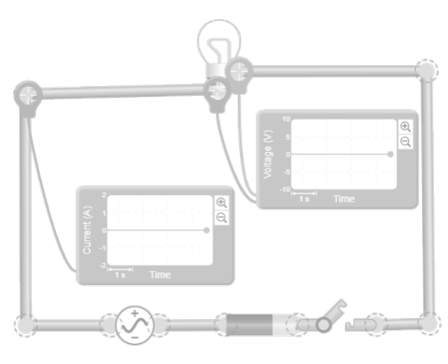
Series AC and DC power sources
In this circuit, the AC source and the DC source are connected in series with the light bulb, forming a single loop. The entire circuit is controlled by a single master switch that simultaneously opens or closes the current path through both sources and the light bulb. The voltmeter is connected in parallel with the light bulb to measure the voltage it receives, and the ammeter is connected in series with it to measure the total current in the circuit.
The user can modify the parameters of each power source. As these parameters are varied, the voltage reaching the light bulb changes immediately; the DC component shifts the AC waveform vertically, and the AC component introduces periodic oscillation on top of that level. Visitors can observe how the measured waveform changes and how the brightness of the light bulb responds to the combination of both power sources.
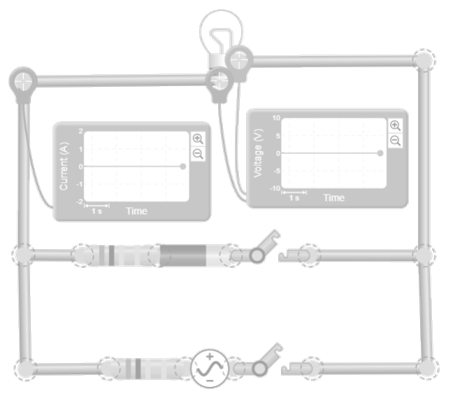
Parallel AC and DC power sources
In this circuit, the AC source and the DC source are connected in parallel, sharing the same two nodes. To prevent the sources from short-circuiting each other when they apply different voltages, each incorporates a small resistor in series. The light bulb is also connected between those two points, so that it directly receives the combined voltage that the sources apply to the node. Each source has its own switch to turn it on or off. The voltmeter is connected in parallel with the light bulb to measure the voltage it receives, and the ammeter is connected in series with it to measure the current flowing through the light bulb.
The user can adjust the settings of each source and turn each one on or off using its individual controls. As these settings are changed, the voltage at the node changes immediately: the DC component sets the level around which the AC signal oscillates, and the AC component introduces the periodic variation around that level. Visitors can observe how the measured waveform shifts and distorts depending on the combination of both sources, and how the brightness of the light bulb responds to the resulting voltage imposed by the two sources in parallel.
Gigantes de la ciencia
«Si he visto más lejos es porque estoy a hombros de gigantes»
Isaac Newton
André-Marie Ampère
–
Michael Faraday
–
Hazte gigante
Tu camino para ser un gigante del conocimiento comienza con estos cursos gratuitos de primer nivel
Principles of Modeling, Simulations, and Control for Electric Energy Systems
Principles of Electric Circuits | 电路原理
Introducción a los circuitos eléctricos
Electrotechnique I
Desarrollo profesional docente
Programas de formación orientados a fortalecer la práctica educativa en ciencias y tecnología
Teach teens computing: Programming in Python
Teach teens computing: How computers work
Interdisciplinary Teaching with Museum Objects
HP Digital Skills for Educators – Microsoft 365 Copilot
Gigantes de la ciencia
«Si he visto más lejos es porque estoy a hombros de gigantes»
Isaac Newton
Michael Faraday
–
James Clerk Maxwell
–
Hazte gigante
Tu camino para ser un gigante del conocimiento comienza con estos cursos gratuitos de primer nivel
Principles of Modeling, Simulations, and Control for Electric Energy Systems
Principles of Electric Circuits | 电路原理
Introducción a los circuitos eléctricos
Electrotechnique I
Desarrollo profesional docente
Programas de formación orientados a fortalecer la práctica educativa en ciencias y tecnología
Higher education assessing in the age of AI
Teaching Computational Thinking
Advancing Learning Through Evidence-Based STEM Teaching
Teach Teens Computing: Understanding AI for Educators
Pon a prueba tus conocimientos
What defines a mixed‑source circuit and why is its behavior not simply “AC on top of DC”?
How do AC and DC signals interact inside the circuit and what effects does this superposition produce?
Why does the AC waveform appear “shifted upward” when a DC source is added?
Why does a bulb show a constant base brightness when it receives AC and DC simultaneously?
Why does the ammeter never return to zero in a mixed‑source circuit?
También te puede interesar
Ultimas simulaciones
Para aprender y experimentar
Lleva tus conocimientos al siguiente nivel con kits de ciencia y herramientas prácticas que conectan la teoría con la experimentación
Calculadora científica


Imprescindibles para profesores y estudiantes
Notion
Organiza tus apuntes, tareas y proyectos en un solo lugar. Notion combina notas, listas y calendarios en un espacio flexible
Canva
Diseña presentaciones, esquemas e infografías con plantillas fáciles de usar y resultados profesionales
Genially
Crea contenidos interactivos, presentaciones y juegos educativos de forma sencilla y visual
Desmos
La calculadora gráfica más intuitiva para explorar las matemáticas y crear actividades dinámicas en el aula
Tinkercad
Diseña en 3D y simula circuitos electrónicos de forma gratuita y sencilla, ideal para proyectos de robótica
Próximos eventos
Evento
When: September 12thEvery year on September 12th, National Video Games Day is observed to commemorate all things related to video games. Video games from Atari to Halo have brought decades of entertainment to different generations. Enjoy this day by playing...
Hora del Evento
Empieza
Termina
Evento
When: September 16thEvery year on September 16th, the United Nations commemorates the International Day for the Preservation of the Ozone Layer. The day promotes activities that raise public awareness about climate change and the risks of ozone depletion. The ozone...
Hora del Evento
Empieza
Termina
Deja volar tu imaginación
Los mejores audiolibros y Originals. Más entretenimiento. Los podcasts que buscas.
Tu biblioteca infinita
Unete a prime para estudiantes y jóvenes
Ciencia y diversión
Aprende con los mejores cursos
Coursera
Cursos de universidades y empresas líderes. Aprende habilidades prácticas y obtén certificaciones profesionales
edX
Cursos online de universidades de prestigio. Aprende a tu ritmo y consigue certificaciones reconocidas
Udemy
Miles de cursos online adaptados a tu nivel. Aprende a tu ritmo con instructores expertos
Ad