
Generic selectors
Exact matches only
Search in title
Search in content
Post Type Selectors

Pulleys. Forces, motion and operation

01/04/2026

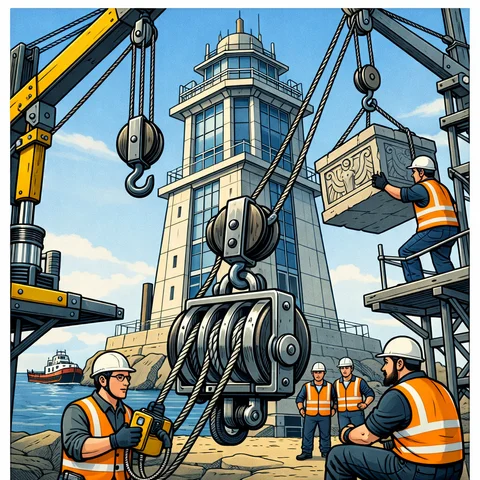
The online pulley simulations on this page will give you a better understanding of how a pulley works and how pulley systems allow heavy weights to be lifted using small forces. We will discover the most important types of pulleys and why pulleys are so important.

What is a pulley

A pulley is a mechanical device consisting of a wheel with a groove on its edge, used to change the direction and/or magnitude of force applied to a rope or cable wrapped around it. Pulleys are commonly used in pulley and cable systems to lift heavy objects or to apply forces in different directions.

Types of pulleys

There are several types of pulleys, including fixed, movable and compound pulleys.

Fixed pulleys

Fixed pulleys have a wheel that rotates on a fixed shaft

Movable pulleys

Movable pulleys have a wheel that can move along an axis.

Compound pulleys

Compound pulleys combine a fixed and a movable pulley to create an additional mechanical advantage.

The importance of pulleys in physics

Pulleys are important in physics because they can change the direction of force applied to an object and, therefore, can be used to lift heavy objects with less force. In addition, pulleys can increase the distance over which force is applied, which can also increase the resultant force.

Applications of pulleys

Pulleys are also used in engineering and construction, especially in large construction projects where heavy objects need to be lifted and moved. Cranes, for example, use pulleys to lift heavy loads effectively and safely. Pulleys are also used in heavy machinery, such as excavators and cranes, to facilitate the handling of heavy objects.

In summary, the online pulley simulations on this page will help you, in an interactive and simple way, to understand the operation of individual pulleys and pulley systems.

Explore the exciting STEM world with our free, online, simulations and accompanying companion courses! With them you’ll be able to experience and learn hands-on. Take this opportunity to immerse yourself in virtual experiences while advancing your education – awaken your scientific curiosity and discover all that the STEM world has to offer!

Pulley simulations

Introduction to pulleys


In this simulation, we will be able to check what happens when we have a system formed by two masses joined by a rope passing through a pulley. Change the masses on each side and see how they move. Can you identify and name each of the forces involved in the system?


Multiple pulleys


Multiple pulleys on a rope


The simplest type of block and tackle is one that consists of a multiple pulley system with a single cable passing through all of them. The force required to lift the mass decreases with the number of pulleys. Can you explain why? And does the energy required also decrease?






Multiple pulleys with several ropes


A somewhat more complex block and tackle is one that consists of a multiple sheave system with several cables. The force required to lift the mass decreases with the number of pulleys. Can you explain why? And does the energy required also decrease?



Pulley in equilibrium


In this simulation, two different masses are connected by a rope passing through a pulley. What force must be applied to the smaller mass to keep both masses still?


Pulleys in motion


In this simulation, we can see what happens when a system consisting of two different masses connected by a rope passing through a pulley is released. Can you identify and name each of the forces involved in the system?


“If I have seen further, it is by standing on the shoulders of giants”

Isaac Newton

Your path to becoming a giant of knowledge begins with these top free courses

Test your knowledge

A pulley is a mechanical device consisting of a wheel with a groove along its edge, through which a rope or cable passes. Its main purpose is to change the direction of an applied force and, in some cases, reduce the effort needed to lift a load. Pulleys are fundamental in physics because they illustrate how forces can be redirected, distributed and transformed within simple mechanical systems. They appear in a wide range of applications, from ancient lifting mechanisms to modern cranes, elevators and rescue equipment. Studying pulleys helps explain how mechanical advantage works and how small changes in the way a force is applied can significantly improve the efficiency and safety of a system.
Pulleys are commonly classified as fixed, movable or compound. A fixed pulley is anchored in place and only changes the direction of the applied force, making lifting more comfortable without reducing the effort required. A movable pulley, however, moves with the load and reduces the force needed because the weight is shared between multiple segments of the rope. Compound pulleys combine a fixed pulley with a movable one, providing both a change of direction and a significant reduction in effort. This combination offers greater mechanical advantage and is used in systems that must lift heavy loads safely and efficiently. Understanding these differences helps design effective mechanisms and analyze how forces are distributed in real systems.
A pulley makes lifting easier because it changes how the force is applied. Instead of pulling directly upward, you can pull downward or sideways, which is usually more comfortable. If you use a movable pulley or a system with several pulleys, the weight of the object is shared among different rope segments. This means you do not need to apply as much force to lift it. The object does not become lighter, but the effort is distributed more effectively.
A fixed pulley only changes the direction of the force. This means the effort required is the same, but pulling downward is more comfortable than lifting directly. A movable pulley, on the other hand, moves with the load and reduces the effort needed because the weight is shared between multiple rope segments. In practice, a fixed pulley provides convenience, while a movable pulley provides mechanical advantage. This is why they are often combined in more complex systems.
Pulleys appear in many everyday machines and devices. They are found in elevators, blinds, cranes, gyms, traditional wells and even some toys. Their purpose is to make lifting or moving loads easier, either by changing the direction of the force or by reducing the effort required. In a crane, for example, pulleys allow heavy loads to be lifted safely. In a gym machine, they help control the movement of weights. Even in a simple window blind, they make raising or lowering it much easier.

You may also be interested

Cargando clima y ubicación...

You may also be interested